Studies offers new picture of Lake Tahoe's earthquake potential
April 29, 2009 Scripps studies offer new picture of Lake Tahoe's earthquake potential

Enlarge

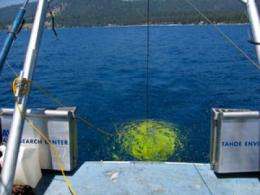
Scripps researchers deploy a CHIRP instrument to survey the faults below Lake Tahoe. Credit: Scripps Institution of Oceanography, UC San Diego

For more than a decade, scientists at Scripps Institution of Oceanography at UC San Diego have been unraveling the history of fault ruptures below the cobalt blue waters of Lake Tahoe one earthquake at a time. Two new studies by the Scripps research team offer a more comprehensive analysis of earthquake activity in the Lake Tahoe region, which suggest a magnitude-7 earthquake occurs every 2,000 to 3,000 years in the basin, and that the largest fault in the basin, West Tahoe, appears to have last ruptured between 4,100 and 4,500 years ago.

These studies, led by a team of Scripps researchers including Graham Kent, Neal Driscoll, Jeff Babcock and Alistair Harding, collected new data on earthquake history along three active faults in the region. These new data suggest that the most recent ruptures along the West Tahoe and Incline Village faults each produced nearly 4-meter-high offsets. The most recent event along the Incline Village Fault occurred about 575 years ago.

"These studies taken together show that the West Tahoe Fault is capable of a magnitude-7 earthquake - similar to large earthquakes that have occurred on the nearby Genoa Fault - but with the added danger of nearly 500 m of overlying water, which is capable of spawning a large tsunami wave," said Kent, a research geophysicist at Scripps.
Scripps studies offer new picture of Lake Tahoe's earthquake potential
Enlarge

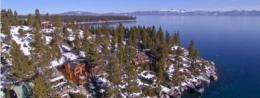
Snow scenics in Sierra Nevada near Donner Lake and Lake Tahoe. Credit: California Department of Water Resources

Jeff Dingler, lead author on a paper in the April online issue of Geological Society of America Bulletin (GSA Bulletin) and former Scripps Oceanography graduate student, used a high-resolution seismic imaging technique, known as CHIRP, to supply a comprehensive view of faulting beneath the lake. Scripps' Neal Driscoll developed the new digital CHIRP profiler for this study, which provided an unprecedented picture of deformation within the sedimentary layers that blanket the floor of Lake Tahoe, laying the groundwork for more detailed fault studies that continue today.

In a complementary paper, published in the April issue of the Bulletin of the Seismological Society of America (BSSA), Scripps graduate student Danny Brothers investigated the rupture history of the West Tahoe Fault in greater detail. Using comprehensive CHIRP and coring surveys of Fallen Leaf Lake, where the West Tahoe Fault crosses the southern end of the lake, the study confirmed the suspected fault length of over 50 km (31 miles). When combined with the rupture offset size observed across the fault from CHIRP imagery, the analysis suggests an upper limit of a magnitude-7.3 earthquake for the basin's most dangerous fault.

This new analysis, coupled with a slip-rate approaching 0.8 mm/year and the rupture timeline taking place between 4,100 and 4,500 years ago, places the West Tahoe Fault near the end of its characteristic earthquake cycle. Researchers caution that some degree of variability is to be expected. Such an earthquake could produce tsunami waves some three to 10 meters (10 to 33 feet) high, colleagues at the University of Nevada, Reno, have shown.

Lake Tahoe, which straddles the California and Nevada border in the Sierra Nevada region, is one of the world's deepest freshwater lakes. At more than 501 meters (1,645 feet) deep, the lake covers 191 square miles in a basin prone to earthquakes and catastrophic landslides. The West Tahoe Fault runs along the west shore of the lake and comes onshore at Baldwin Beach, then passes through the southern third of Fallen Leaf Lake, where it descends into Christmas Valley near Echo Summit.

Source: University of California - San Diego (news : web)


print this article email this article download pdf blog this article bookmark this article     Stumble it Digg this share on Facebook retweet share on Reddit add to delicious
Rate this story - 5 /5 (2 votes)


April 29, 2009 all stories

Comments: 0

5 /5 (2 votes)
  • Stumble this up

  • Digg this

  • share this

  • hide
  • Related Stories

  • Why do earthquakes stop?
    created Feb 06, 2008 | popularity not rated yet | comments 0
  • New Measurements of Toxics and Organics in Tahoe Smoke
    created Jul 10, 2008 | popularity not rated yet | comments 0
  • Early warning systems underestimate magnitude of large earthquakes
    created Jan 28, 2009 | popularity not rated yet | comments 0
  • Loma Prieta fault not so weak?
    created Dec 19, 2007 | popularity not rated yet | comments 0
  • Biggest recorded earthquake was brewing for four centuries
    created Oct 07, 2005 | popularity not rated yet | comments 0


  • hide
  • Relevant PhysicsForums posts

  • The IPCC and the term "most"
    created Nov 23, 2009
  • Is global warming a fact?
    created Nov 23, 2009
  • Random variability of wind patterns
    created Nov 23, 2009
  • Record precipitation in the UK
    created Nov 22, 2009
  • How to move cloud from one time to another..
    created Nov 22, 2009
  • Which countries around the world cause the most destruction to the rain forest
    created Nov 21, 2009
  • More from Physics Forums - Earth

Other News

Cosmic 'dig' reveals vestiges of the Milky Way's building blocks

Cosmic 'Dig' Reveals Vestiges of the Milky Way's Building Blocks

Space & Earth / Astronomy

created 41 minutes ago | popularity 5 / 5 (1) | comments 0

(PhysOrg.com) -- Peering through the thick dust clouds of our galaxy's "bulge" (the myriads of stars surrounding its center), a team of astronomers has unveiled an unusual mix of stars in the stellar grouping ...


Cutting greenhouse pollutants could directly save millions of lives worldwide

Space & Earth / Environment

created 2 hours ago | popularity 1 / 5 (2) | comments 1

Tackling climate change by reducing carbon dioxide and other greenhouse emissions will have major direct health benefits in addition to reducing the risk of climate change, especially in low-income countries, according to ...


Small faults in Southeast Spain reduce earthquake risk of larger ones

Small faults in Southeast Spain reduce earthquake risk of larger ones

Space & Earth / Earth Sciences

created 3 hours ago | popularity not rated yet | comments 0

A team of Spanish scientists, studying recent, active deformations in the Baetic mountain range, have shown that the activity of smaller tectonic structures close to larger faults in the south east of the ...


Mars Reconnaissance Orbite

Mars Reconnaissance Orbite Team Plans Uplink of Protective Files

Space & Earth / Space Exploration

created 5 hours ago | popularity 5 / 5 (1) | comments 0

(PhysOrg.com) -- The team operating NASA's Mars Reconnaissance Orbiter plans to uplink protective files to the spacecraft next week as one step toward resuming the orbiter's research and relay activities.


It's not just dirt!

Space & Earth / Environment

created 2 hours ago | popularity 5 / 5 (1) | comments 0

Soil is the linchpin of the environment, where atmosphere, biosphere, and hydrosphere meet. Despite that, many students see soil as "just dirt" - a place to grow plants, but nothing more. Soil science educators are challenged ...