Star Trek-like technology offers noninvasive monitor for patients and athletes
How long will it take to develop Star Trek-like medical technologies? The gap between science fiction and reality is closing faster than many people may think.
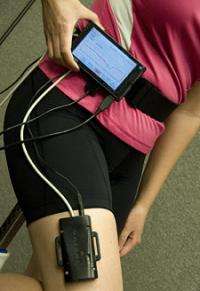
A noninvasive, needle-free system that uses light to measure tissue oxygen and pH will soon be an alternative to the painful use of needles to draw blood and cumbersome equipment to determine metabolic rate. The futuristic system, dubbed the Venus prototype, is being developed by Dr. Babs Soller and her colleagues. It has the capability to measure blood and tissue chemistry, metabolic rate (oxygen consumption) and other parameters.
The sensor and portable monitor are funded by the National Space Biomedical Research Institute (NSBRI) for use in space. Soller said the technology's multiple, real-time applications will be beneficial to astronauts in their day-to-day activities and to critically ill patients on Earth.
"Tissue and blood chemistry measurements can be used in medical care to assess patients with traumatic injuries and those at risk for cardiovascular collapse," said Soller, who leads NSBRI's Smart Medical Systems and Technology team. "The measurement of metabolic rate will let astronauts know how quickly they are using up the oxygen in their life-support backpacks. If spacewalking astronauts run low on oxygen, the situation can become fatal."
Placed directly on the skin, the four-inch by two-inch sensor uses near infrared light (that is just beyond the visible spectrum) to take the measurements. Blood in tiny blood vessels absorbs some of the light, but the rest is reflected back to the sensor. The monitor analyzes the reflected light to determine metabolic rate, along with tissue oxygen and pH. One unique advantage of Dr. Soller's near infrared device is that its measurements are not impacted by skin color or body fat.
A noninvasive system also means a reduced risk of infection due to the lack of needle pricks. Most of the system's development has occurred at the University of Massachusetts Medical School, where Soller is a professor of anesthesiology. She has worked closely with researchers at NASA Johnson Space Center in Houston to develop applications of the Venus system for space.
Former NASA astronaut and NSBRI User Panel Chairman Dr. Leroy Chiao said Soller's sensor system and other technologies being developed for spaceflight are a wise investment.
"The neat thing about the work being done is that it is a two-for-one deal," Chiao said. "Not only is this research going to help future astronaut crews and operations, it has very real benefits to people on the ground, especially to people in more rural areas."
On Earth, there are several areas of health care that could benefit from Venus. However, it is patients treated by emergency personnel on ambulances and on the battlefield that could benefit the most from the technology.
"Eventually, we expect first-responders would have these devices, which would provide feedback on the severity of a person's injury," Soller said. "Data can be communicated directly to the hospital. Early access to this type of information may increase a victim's chances of survival."
The system's Earth applications are not limited to urgent care. It will allow doctors to more efficiently monitor pediatric and intensive care patients. Athletes and physical therapy patients also stand to gain from the technology's ability to measure metabolic rate and to assist in determining the level of activity or exercise that is most beneficial to the individual.
"Athletes would benefit from using these parameters in developing training programs that will help them improve their endurance and performance," she said. "And we suspect the same thing will be true for patients in physical rehabilitation."
Currently, Soller and her collaborators are working on several aspects to prepare the sensor for integration into spacesuits by reducing its size, increasing its accuracy in measuring metabolic rate, and developing the capability to run on batteries. These activities will also speed its application in helping to care for patients on Earth.
Soller's technology is one of a group of innovative medical systems being developed by NSBRI to provide health care to NASA astronauts in space and to improve health care on Earth.
Source: National Space Biomedical Research Institute


