New clinical study probes how light fights psoriasis
April 29, 2009
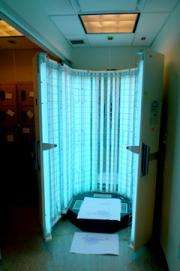
Bright lights. By studying psoriasis patients treated with narrowband ultraviolet light in a light box (above), researchers hope to learn how phototherapy fights the skin disease at the molecular level.
Ultraviolet light is a proven treatment for psoriasis, one of humanity’s oldest known diseases. Sunshine can also beat back the chronic autoimmune disorder of the skin. But explaining light’s therapeutic effects has been difficult. “We know it works, but we want to know how,” says Michelle Lowes, an assistant professor of clinical investigation in the Laboratory for Investigative Dermatology at Rockefeller University. “Does it target the pathways that we think are important in the disease?”
A new clinical trial under way at the Center for Clinical and Translational Science in The Rockefeller University Hospital will literally shine light on the disease in hopes of finding out. Researchers, including Lowes and Clinical Research Nurse Practitioner Patricia Gilleaudeau, have recruited the first of what will be 20 patients who will visit the hospital three times a week for up to four months to receive narrowband ultraviolet light B (UVB) treatment. Patients will give skin and blood samples as the treatment takes its course, giving the scientists the possibility to study what is happening at the molecular level as the skin gets better.
UVB therapy is known to kill off T cells, which are partly to blame for the inflammation caused by the disease. For years, Lowes has been systematically accounting for the cell types and proteins involved in the disease. She is specifically interested in whether UVB targets a pathway involving two immune system proteins called cytokines, which she believes may disrupt certain types of T cells and another specialized group of immune-directing dendritic cells. “If we can define the mechanism of action we may potentially have new therapeutic targets for psoriasis and other diseases,” says Lowes, the recipient of a 2008 Doris Duke Charitable Foundation Clinical Scientist Development Award, which is supporting the study.
Doctors often recommend UVB therapy if standard ointment treatments fail and if patients would rather avoid a systemic immunosuppressive drug regimen that has been developed more recently. Patients receive the treatment, brief blasts of UVB, standing inside an upright cabinet whose inside is lined with fluorescent tube lights. The duration of the light exposure increases over the course of the treatment.
In addition to providing free treatment to the study participants, Gilleaudeau consults with the patients and their families and directs them to resources for getting the equipment they need to administer the treatment at home. “We try to help them continue with treatment after they leave whenever we can,” says Gilleaudeau, who will staff a table for The Rockefeller University Hospital May 3 at the National Psoriasis Walk for Awareness in the New York Botanical Garden. “We want to help.”
Lowes hopes to have some preliminary results in about a year. “We are excited about studying this commonly used therapy for psoriasis with modern methods, and hope that this will lead to a better understanding of this complicated and common skin disease,” she says.
More information: Clinical study: Narrowband UVB Phototherapy in the Treatment of Psoriasis Vulgaris
-
Psoriasis lesions loaded with newly discovered immune cell
Feb 22, 2008 |
not rated yet |
0
-
Recently discovered cell is unexpected player in psoriasis
Nov 29, 2007 |
not rated yet |
0
-
New research reveals ultraviolet light therapy is as beneficial for darker skin as lighter skin
Jul 08, 2008 |
not rated yet |
0
-
Patients with severe psoriasis need evaluation of heart disease risk
Dec 18, 2008 |
not rated yet |
0
-
Sunburn alert: UVB does more damage to DNA than UVA
Jul 01, 2008 |
not rated yet |
0
-
Engineers build first sub-10-nm carbon nanotube transistor
Feb 01, 2012 |
4.9 / 5 (31) |
30
-
Something old, something new: Evolution and the structural divergence of duplicate genes
Jan 31, 2012 |
4.6 / 5 (7) |
1
-
The hidden nanoworld of ice crystals: Revealing the dynamic behavior of quasi-liquid layers
Jan 30, 2012 |
5 / 5 (3) |
1
-
Stock market network reveals investor clustering
Jan 27, 2012 |
3.9 / 5 (23) |
8
-
Of microchemistry and molecules: Electronic microfluidic device synthesizes biocompatible probes
Jan 26, 2012 |
5 / 5 (1) |
0
-
Classical and Quantum Mechanics via Lie algebras
Apr 15, 2011
- More from Physics Forums - Independent Research
More news stories
Study finds that anti-diabetic medication can prevent the long-term effects of maternal obesity
In a study to be presented today at the Society for Maternal-Fetal Medicine's annual meeting, The Pregnancy Meeting, in Dallas, Texas, researchers will report findings that show that short therapy with the anti-diabetic medication ...
20 hours ago |
5 / 5 (1) |
1
FDA-approved drug rapidly clears amyloid from the brain, reverses Alzheimer's symptoms in mice
Neuroscientists at Case Western Reserve University School of Medicine have made a dramatic breakthrough in their efforts to find a cure for Alzheimer's disease. The researchers' findings, published in the journal Science, show t ...
Medicine & Health / Neuroscience
Feb 09, 2012 |
4.9 / 5 (52) |
20
|
Steroid injections prove effective in treatment of lumbar disc herniations
The use of epidural steroid injections may be a more efficient treatment option for lumbar disc herniations, according to research presented today at the American Orthopaedic Society for Sports Medicine's Specialty Day in ...
20 hours ago |
5 / 5 (1) |
0
Teen school drop-outs three times as likely to be on benefits in later life
Teen school drop-outs are almost three times as likely to be on benefits in later life as their peers who complete their schooling, indicates research published online in the Journal of Epidemiology and Community Health.
Feb 06, 2012 |
not rated yet |
11
Amateur football players not always keen on returning to play after ACL injuries
Despite the known success rates of reconstructive Anterior Cruciate Ligament (ACL) surgery, the number of high school and collegiate football players returning to play may not be as high as anticipated, say researchers presenting ...
20 hours ago |
not rated yet |
0
Google might launch Drive for cloud storage soon
(PhysOrg.com) -- Google's next big move, according to the Wall Street Journal, is a cloud storage service called Drive. Hardly first to the plate, Google is simply catching up to introducing its cloud reposi ...
Latin America mining boom clashes with conservation
Latin America is experiencing a mining boom as prices rise fuelled by a hike in global demand, but the region is also being hit by a wave of violent protests, strikes and rallies by environmentalists.
Love a click away in Indonesia's Twitter Republic
He was a geeky kid from Yogyakarta, she a glamorous city girl in Jakarta. In a country with one of the world's most vibrant social networking scenes they fell in love on Twitter.
Walney offshore wind farm is world's biggest (for now)
(PhysOrg.com) -- The Walney wind farm on the Irish Sea--characterized by high tides, waves and windy weather--officially opened this week. The farm is treated in the press as a very big deal as the Walney ...
GPS court ruling leaves US phone tracking unclear
A US Supreme Court decision requiring a warrant to place a GPS device on the car of a criminal suspect leaves unresolved the bigger issue of police tracking using mobile phones, legal experts say.
Europeans protest controversial Internet pact
Tens of thousands of people marched in protests in more than a dozen European cities Saturday against a controversial anti-online piracy pact that critics say could curtail Internet freedom.
Apr 29, 2009
Rank: not rated yet
The immune suppressors increase cancer and infections.
Have there been any studies on this?
May 01, 2009
Rank: not rated yet
Jun 05, 2009
Rank: not rated yet
Creams containing vitamin D analogs or variants such as calcitriol (1,25 hydroxyvitamin D) are used with very good effect in psoriasis. Dr. Michael Holick of Boston University, a world renown vitamin D researcher, first posited that it would be helpful and ran trials of it as described in this slide deck on slide 43: http://www.grassr...0208.pdf
There is also a YouTube video of Dr. Holick doing his famous presentation. The section touching on vitamin D and skin starts at time point 41:50. http://www.youtub...t9WqOD-0