Ka-Boom! The sequel
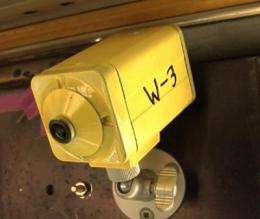
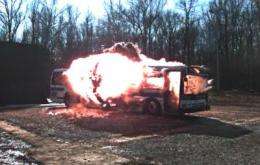
When two camera prototypes were tested in a bombing last month aboard a mass transit bus, not only was the Transportation Security Administration interested, so were the cities of New York, Washington, Chicago, and Seattle. Would these cameras show they were sturdy enough to withstand bombing attacks, fires, and floods, but inexpensive enough to use in places where a complete surveillance system is not workable - like mass transit venues?
Last month we reported the cameras did indeed survive. "Amid the wreckage, clean-up crews found the cameras," said Stephen Dennis, Homeland Security Science and Technology Directorate (S&T) program manager for the test. The question was, had their memory chips survived? The prototype chips had been preloaded with video so that engineers could cleanly compare the content and quality of images both before and after the blast.
"Today we can report that 14 of 16 chips did survive," continued Dennis. "Of the 14 cameras recovered, every video minute on there was without degradation."
DHS is developing plans to work with a pilot group of U.S. cities to test the reliability, performance, and maintenance requirements of cameras operating on regular bus routes and trains. Two companies - Videology, Inc. of Greenville, R.I. and Visual Defence-USA, Inc. of Alexandria, Va. - are working to deliver this technology to the commercial marketplace within months.
Development of the forensic cameras is occurring through a public-private partnership known as SECURE - one in which the private sector uses its own money and expertise to develop products and services. "The only taxpayer money used with these forensic cameras was in the testing," says Tom Cellucci, Department of Homeland Security chief commercialization officer. "In most SECURE projects, no taxpayer money is used at any stage. The SECURE program helps bypass what typically is an arduous technology development process within government."
"Prevention of suicide bombings and crimes is the primary concern," Dennis explains, "The collection of forensic data from tragic events like bombings helps us develop strategies to prevent the crime in the first place." While so-called "rugged" memory chips currently on the market can survive heavy vibrations in industrial applications like lumber and drilling, these prototype chips are a "step beyond," said Dennis.
Images recovered from working cameras would be used by law enforcement only forensically after an incident, rather than transmitting video to a third party. At $150-$200 each, outfitting a bus with cameras is a bargain compared to a surveillance system likely to cost more than $6,000.
The bus blast test is just one of three phases of testing. In January, prior to attempting the transit bus bombing test, engineers put 36 cameras through more controlled testing to measure the survival rate. All of them survived that first test also.
The final phase of testing will investigate how well the systems survive the kind of heat likely to be found in a burning vehicle. Engineers will bake the camera-and-chip units inside an oven at high temperatures to see if they turn to crisp.
Source: US Department of Homeland Security (news : web)


