Michigan Astronomer to Search in Space for Precursors of Life
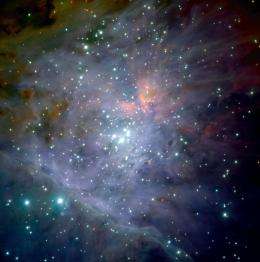
April 30, 2009 The Orion Nebula

Enlarge

The Orion Nebula is one of the places where astronomer Ted Bergin will search for organic molecules using the Herschel Space Observatory.

Many of the organic molecules that make up life on Earth have also been found in space. A University of Michigan astronomer will use the Herschel Space Observatory to study these chemical compounds in new detail in the warm clouds of gas and dust around young stars.

They hope to gain insights into how organic molecules form in space, and possibly, how life formed on Earth.

"The chemistry of space makes molecules that are the precursors of life. It's possible that the Earth didn't have to make these things on its own, but that they were provided from space," said Ted Bergin, an associate professor in the Department of Astronomy.

Bergin is a co-investigator on the Heterodyne Instrument for the Infrared aboard Herschel and a principal investigator on one of its key observing programs. Herschel, a mission with NASA participation, is scheduled to launch May 6. An orbiting telescope that will unlock new wavelengths on the , it will allow astronomers to observe at the far-infrared wavelengths where organic molecules and water emit their chemical signatures.

"We'll be studying the full extent of chemistry in space and we hope to learn what types of organics are out there as a function of their distance from a star," Bergin said. "And we want to understand the chemical machinery that led to the formation of these organics."

Meteorites flecked with amino acids, which make proteins, have fallen to Earth from space. In faraway galaxies and stellar nurseries, astronomers have detected complex organic sugar and hydrocarbon molecules that are key components in chlorophyll in plants and RNA. Bergin expects to detect tens if not hundreds of these kinds of compounds---some of which have never been found before outside the Earth.

He is also involved in a Herschel project to look for water molecules in space. Traces of water in warm clouds of gas and dust around young stars could hold clues to how water forms and behaves in space, and how this elixir of life came to be so abundant on Earth. Scientists believe water got to Earth in a similar way as .

"Most of the water in the solar system is not where we are, but further out in the solar system," Bergin said. "Most theories suggest that the Earth formed dry and impacts from asteroids or other objects provided the water here."

Provided by Herschel Observatory


print this article email this article download pdf blog this article bookmark this article     Stumble it Digg this share on Facebook retweet share on Reddit add to delicious
Rate this story - 4.6 /5 (5 votes)


April 30, 2009 all stories

Comments: 0

4.6 /5 (5 votes)
  • Stumble this up

  • Digg this

  • share this

  • hide
  • Related Stories

  • Pre-life molecules present in comets
    created Jul 26, 2006 | popularity not rated yet | comments 0
  • Life's Building Blocks Are Common In Space
    created Oct 11, 2005 | popularity not rated yet | comments 0
  • Clues to our birth may be written in space
    created Jan 22, 2005 | popularity not rated yet | comments 0
  • Ingredients for DNA and Protein Found Around Star
    created Dec 21, 2005 | popularity not rated yet | comments 0
  • Researcher presents origin-of-life theory for young Earth, supports life on other planets
    created Oct 02, 2007 | popularity not rated yet | comments 0


  • hide
  • Relevant PhysicsForums posts

  • Question about 2-body gravity
    created Nov 24, 2009
  • life on Mars
    created Nov 24, 2009
  • Semi-major axis from cartesian co-ordinates
    created Nov 23, 2009
  • Primary Mirror grinding
    created Nov 23, 2009
  • More from Physics Forums - General Astronomy

Other News

Monster Waves on the Sun are Real

Monster Waves on the Sun are Real (w/ Video)

Space & Earth / Astronomy

created 9 hours ago | popularity 4.8 / 5 (11) | comments 1

Sometimes you really can believe your eyes. That's what NASA's STEREO (Solar Terrestrial Relations Observatory) spacecraft are telling researchers about a controversial phenomenon on the sun known as the "solar ...


Cosmic 'dig' reveals vestiges of the Milky Way's building blocks

Cosmic 'Dig' Reveals Vestiges of the Milky Way's Building Blocks

Space & Earth / Astronomy

created 14 hours ago | popularity 4.9 / 5 (14) | comments 1

(PhysOrg.com) -- Peering through the thick dust clouds of our galaxy's "bulge" (the myriads of stars surrounding its center), a team of astronomers has unveiled an unusual mix of stars in the stellar grouping ...


No Wheel Stall in Diagnostic Drive

Spirit Mars Rover: No Wheel Stall in Diagnostic Drive

Space & Earth / Space Exploration

created 10 hours ago | popularity 4.5 / 5 (2) | comments 0

(PhysOrg.com) -- On Sol 2095 (Tuesday, Nov. 24), Spirit performed a set of diagnostic actions related to a stall of the right-rear wheel on the previous drive, three days earlier.


Climate experts debate strategies for reducing atmospheric carbon and future warming

Climate experts debate strategies for reducing atmospheric carbon and future warming

Space & Earth / Environment

created 10 hours ago | popularity 2.6 / 5 (7) | comments 9

(PhysOrg.com) -- Reducing carbon dioxide to safe levels may require extracting carbon from the air, says Cornell climate researcher.


Cutting greenhouse pollutants could directly save millions of lives worldwide

Space & Earth / Environment

created 16 hours ago | popularity 2.2 / 5 (10) | comments 6

Tackling climate change by reducing carbon dioxide and other greenhouse emissions will have major direct health benefits in addition to reducing the risk of climate change, especially in low-income countries, according to ...