IMEC reports method to integrate plasmonic technology with state-of-the-art ICs
April 30, 2009 IMEC reports method to integrate plasmonic technology with state-of-the-art ICs

Enlarge

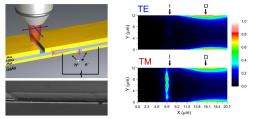
Top left: schematic overview of the device, showing focused illumination of a slit in the waveguide using polarized light. This results in plasmon excitation of the waveguide for the red polarization and the generation of electron/hole pairs in the semiconductor. Bottom left: SEM picture of a typical device. Top/bottom right: Photocurrent scans for the “red” (bottom) and “blue” (top) polarization indicate a strong polarization dependence of the photoresponse

IMEC reports a method to integrate high-speed CMOS electronics and nanophotonic circuitry based on plasmonic effects. Metal-based nanophotonics (plasmonics) can squeeze light into nanoscale structures that are much smaller than conventional optic components. Plasmonic technology, today still in an experimental stage, has the potential to be used in future applications such as nanoscale optical interconnects for high performance computer chips, extremely sensitive (bio)molecular sensors, and highly efficient thin-film solar cells. IMEC’s results are published in the May issue of Nature Photonics.

The properties of nanostructured (noble) metals show great promise for use in nanophotonic applications. When such nanostructures are illuminated with visible to near-infrared light, the excitation of collective oscillations of conduction electrons - called surface plasmons - generates strong optical resonances. Moreover, surface plasmons are capable of capturing, guiding, and focusing electromagnetic energy in deep-subwavelength length-scales, i.e. smaller than the diffraction limit of the light. This is unlike conventional dielectric optical waveguides, which are limited by the wavelength of the light, and which therefore cannot be scaled down to tens of nanometers, which is the dimension of the components on today’s nanoelectronic ICs.

Nanoscale plasmonic circuits would allow massive parallel routing of optical information on ICs. But eventually that high-bandwidth optical information has to be converted to electrical signals. To make such ICs that combine high-speed CMOS electronics and plasmonic circuitry, efficient and fast interfacing components are needed that couple the signals from plasmon waveguides to electrical devices.

As an important stepping stone to such components, IMEC has now demonstrated integrated electrical detection of highly confined short-wavelength surface plasmon polaritons in metal-dielectric-metal plasmon waveguides. The detection was done by embedding a photodetector in a metal plasmon waveguide. Because the waveguide and the photodetector have the same nanoscale dimensions, there is an efficient coupling of the surface plasmons into the photodetector and an ultrafast response. IMEC has set up a number of experiments that unambiguously demonstrate this electrical detection. The strong measured polarization dependence, the experimentally obtained influence of the waveguide length and the measured spectral response are all in line with theoretical expectations, obtained from finite element and finite-difference-time-domain calculations. These results pave the way for the integration of nanoscale plasmonic circuitry and high-speed electronics.

Source: IMEC


print this article email this article download pdf blog this article bookmark this article     Stumble it Digg this share on Facebook retweet share on Reddit add to delicious
Rate this story - 4.3 /5 (8 votes)

Rank Filter

Move the slider to adjust rank threshold, so that you can hide some of the comments.


Display comments: newest first

  • plasma_guy - Apr 30, 2009
    • Rank: not rated yet
    The plasmonic cannot both travel very far AND be confined to small enough scales. That is their nature. Needless to say surface contamination can kill them as well.

April 30, 2009 all stories

Comments: 1

4.3 /5 (8 votes)
  • Stumble this up

  • Digg this

  • share this

  • hide
  • Related Stories

  • Understanding light at the nanoscale: a nano-sized double-slit experiment
    created Jul 17, 2007 | popularity not rated yet | comments 0
  • Engineers study whether 'light on a wire' is wave of future for circuitry
    created Mar 16, 2005 | popularity not rated yet | comments 0
  • Tiny holes offer surprising insights
    created Mar 04, 2005 | popularity not rated yet | comments 0
  • On a wire or in a fiber, a wave is a wave
    created Jul 13, 2007 | popularity not rated yet | comments 0
  • Surface plasmons enhance nanostructure possibilities
    created Sep 18, 2007 | popularity not rated yet | comments 0


  • hide
  • Relevant PhysicsForums posts

  • tonometer experiment
    created 3 hours ago
  • Radiation heat transfer between air or wall
    created 3 hours ago
  • Hi ,new here and have a question! :)
    created 4 hours ago
  • Hydrostatic pressure in a submerged pipe
    created 6 hours ago
  • More from Physics Forums - General Physics

Other News

First Neutrino Events Observed at T2K Near Detector

First Neutrino Events Observed at T2K Near Detector

Physics / General Physics

created 16 hours ago | popularity 4.8 / 5 (17) | comments 0

(PhysOrg.com) -- Physicists from the Japanese-led multi-national T2K neutrino collaboration announced today that over the weekend they detected the first events generated by their newly built neutrino beam ...


Researchers develop virtual streams to help restore real ones

Physics / General Physics

created 12 hours ago | popularity not rated yet | comments 0

Researchers at the University of Minnesota have developed a unique new computer model called the Virtual StreamLab, designed to help restore real streams to a healthier state. The Virtual StreamLab, which demonstrates the ...


Scientists react as they stand in front of a screen at CERN

First atoms reported smashed in Large Hadron Collider (Update)

Physics / General Physics

created Nov 23, 2009 | popularity 4.7 / 5 (27) | comments 21

Two circulating beams on Monday produced the first particle collisions in the world's biggest atom smasher, the Large Hadron Collider (LHC), three days after its restart, scientists announced.


In the Brain, Seven Is A Magic Number

In the Brain, Seven Is A Magic Number

Physics / General Physics

created Nov 23, 2009 | popularity 4.4 / 5 (30) | comments 8

Having a tough time recalling a phone number someone spoke a few minutes ago or forgetting items from a mental grocery list is not a sign of mental decline; in fact, it's natural.


Restored machine to explore mysteries of Big Bang (AP)

Restored machine to explore mysteries of Big Bang

Physics / General Physics

created Nov 21, 2009 | popularity 4.6 / 5 (18) | comments 26

(AP) -- Scientists are preparing the world's largest atom smasher to explore the depths of matter after successfully restarting the $10 billion machine following more than a year of repairs.