Playing Dead Increases Survival Rate at the Expense of Active Neighbors
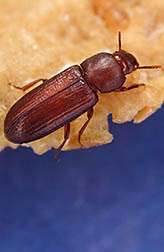
April 30, 2009 by Mary Anne Simpson Red Flour Beetle

Red Flour Beetle. Credit USDA

A study published in the Proceeding of The Royal Society B entitled "Tonically Immobilized Selfish Prey Can Survive By Sacrificing Other", authored by researchers at Okayama University in Japan point out death feigning has broad application among animal species.

The study involved the red flour beetle an its predator the jumping spider. The idea of playing dead to avoid confrontation with a powerful combatant has been observed in vertebrate and invertebrate . The technical term to describe the behavior is tonic immobility or death-feigning. The Okayama University team comprised of environmental scientist, agricultural scientists and natural scientists, headed by Takahisa Miyatake et.al examined the following five hypotheses in the study:

Death feigning is effective for because, i) avoiding dead prey is safer for ; ii) immobility plays a role in self defense; iii) immobility plays a role in concealment and/or background matching; iv) predators lose interest in non-moving prey; v) the characteristic immobilization posture signals a bad taste to predators.

For the purposes of the study at hand, researchers eliminated the "bad taste to " fifth hypothesis by introducing a chemical analysis of the secretions of the red flour beetle while under attack by the jumping spider. Particular attention was paid to the concept of "selfish-prey" which is the idea of feigning death or blending into the environment that acts to turn the predator's attention to moving prey. As an anti-predator strategy, death feigning or tonic immobility is very effective, but costly to more active neighbors.

The Okayama University team concluded that the death feigner's' survival rate increases in the presence of active prey or prey of a different species when compared to the sole feigner. Thus, the "selfish-prey" theory explains why immobility following an initial attack by the jumping spider increased the red flour beetles survival rate when active prey is present to engage the interest of the predator.

Sources:

Proceedings of the Royal Society B, Tonically immobilized selfish can survive by sacrificing others, Takahisa Miyataka, Satoshi Nakayama, Yusuke Nishi, and Shuhei Nakajima, published, April 29, 2009.

• Is Death Feigning Adaptive? Heritable variation in fitness differences of death-feigning behaviour, Miyatake et.al, 2004, http://www.pubmedcentral.nih.gov/picrender.fcgi?artid=1691851&blobtype=pdf

© 2009 PhysOrg.com


print this article email this article download pdf blog this article bookmark this article     Stumble it Digg this share on Facebook retweet share on Reddit add to delicious
Rate this story - 4 /5 (1 vote)


April 30, 2009 all stories

Comments: 0

4 /5 (1 vote)
  • Stumble this up

  • Digg this

  • share this

  • hide
  • Related Stories

  • Mosquitoes supply spider with blood
    created Oct 11, 2005 | popularity not rated yet | comments 0
  • Predators prefer to hunt small-brained prey
    created Aug 02, 2006 | popularity not rated yet | comments 0
  • Fear of predators may be a bigger killer than the predators themselves
    created Aug 19, 2008 | popularity not rated yet | comments 0
  • Playing dead is no game for ant survival
    created Apr 08, 2008 | popularity not rated yet | comments 0
  • Siberian jays can communicate about behavior of birds of prey
    created Jan 09, 2008 | popularity not rated yet | comments 0


  • hide
  • Relevant PhysicsForums posts

  • Super quick question about Starling forces?
    created 6 hours ago
  • Questions about diffusion
    created 12 hours ago
  • Human Leukocyte Antigen (HLA) typing
    created 19 hours ago
  • Breeding program
    created Nov 20, 2009
  • More from Physics Forums - Biology

Other News

Beyond sunlight: Explorers census 17,650 ocean species between edge of darkness and black abyss

Beyond sunlight: Explorers census 17,650 ocean species between edge of darkness and black abyss (w/ Video)

Biology / Plants & Animals

created 12 minutes ago | popularity not rated yet | comments 0

Census of Marine Life scientists have inventoried an astonishing abundance, diversity and distribution of deep sea species that have never known sunlight - creatures that somehow manage a living in a frigid ...


The Monarchs' annual migration ritual has yet to be scientifically explained

Tree-eating bugs threaten Monarch butterfly in Mexico

Biology / Ecology

created 20 hours ago | popularity 4 / 5 (1) | comments 0

The mysterious Monarch butterfly, which migrates en masse annually between Canada and Mexico, is now facing a new peril: another insect thriving in Western Mexican forests.


Bigger not necessarily better, when it comes to brains

Bigger not necessarily better, when it comes to brains

Biology / Plants & Animals

created Nov 17, 2009 | popularity 4.5 / 5 (18) | comments 11

(PhysOrg.com) -- Tiny insects could be as intelligent as much bigger animals, despite only having a brain the size of a pinhead, say scientists at Queen Mary, University of London.


Extinct goat Myotragus balearicus

Extinct goat was cold-blooded

Biology / Plants & Animals

created Nov 18, 2009 | popularity 4.9 / 5 (33) | comments 10

(PhysOrg.com) -- An extinct goat that lived on a barren Mediterranean island survived for millions of years by reducing in size and by becoming cold-blooded, which has never before been discovered in mammals.


Right-handed chimpanzees provide clues to the origin of human language

Biology / Plants & Animals

created Nov 16, 2009 | popularity 3 / 5 (1) | comments 7

Most of the linguistic functions in humans are controlled by the left cerebral hemisphere. A study of captive chimpanzees at the Yerkes National Primate Research Center (Atlanta, Georgia), reported in the January 2010 issue ...