Birds can dance, really
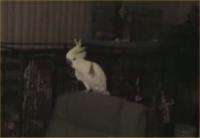
Researchers at Harvard University have found that humans aren't the only ones who can groove to a beat -- some other species can dance, too. This capability was previously believed to be specific to humans. The research team found that only species that can mimic sound seem to be able to keep a beat, implying an evolutionary link between the two capacities.
The study was led by Adena Schachner, a doctoral candidate in psychology at Harvard, and is published in the current issue of Current Biology. Schachner's co-authors are Marc Hauser, professor of psychology at Harvard, Irene Pepperberg, lecturer at Harvard and adjunct associate professor of psychology at Brandeis University, and Timothy Brady, a doctoral candidate at the Massachusetts Institute of Technology.
Schachner and her colleagues closely studied Alex, a well-known African grey parrot who passed away shortly after the study, and Snowball, a sulphur-crested cockatoo whose humanlike dancing behavior had led to online fame.
"Our analyses showed that these birds' movements were more lined up with the musical beat than we'd expect by chance," says Schachner. "We found strong evidence that they were synchronizing with the beat, something that has not been seen before in other species."
The researchers noted that these two birds had something in common: an excellent ability to mimic sound.
"It had recently been theorized that vocal mimicry might be related to the ability to move to a beat," says Schachner. "The particular theory was that natural selection for vocal mimicry resulted in a brain mechanism that was also needed for moving to a beat. This theory made a really specific prediction: Only animals that can mimic sound should be able to keep a beat."
To test this prediction, Schachner needed data from a large variety of animals—so she turned to a novel source of data, the YouTube video database. Schachner systematically searched the database for videos of animals moving with the beat of the music, including vocal mimics such as parrots and vocal non-mimics such as dogs and cats.
Schachner analyzed the videos frame-by-frame, using the same analyses applied to the case-study birds. Criteria included the animal's speed compared to the speed of the music and alignment with individual beats. Potentially "fake" videos were omitted, where music was added to the video after the fact, or the animal was following visual movement.
"The really important point is that many animals showed really strong evidence of synchronizing with the music, but they were all vocal mimics," says Schachner. "Most of them were parrots -- we found 14 different species of parrot on YouTube that showed convincing evidence that they could keep a beat."
Because only animals capable of vocal mimicry - such as parrots - appear to be able to keep a beat, the study implies an evolutionary link between vocal mimicry and this crucial part of dance.
"Our data suggests that some of the brain mechanisms needed for human dance originally evolved to allow us to imitate sound," says Schachner.
It is important to note that vocal mimicry alone is not enough for a bird to keep a beat, although the researchers aren't yet certain why some parrots can dance and not others. It may be that all parrots have a latent capacity, but need certain experiences or social motivation, according to Schachner.
Schachner says that these birds do not seem to move in synchrony with sounds in the wild, and so the behavior could not have evolved as a result of direct natural selection. For this reason, in bird species this capacity must be an evolutionary byproduct of something else, says Schachner, seemingly vocal mimicry.
It may be, says Schachner, that the human ability to keep time with music has also evolved as a byproduct of vocal mimicry. She points out that the cognitive processes needed for both actions are related.
"In both vocal mimicry and entrainment," says Schachner, "you're taking in auditory input, and constantly monitoring not only your output but also the sound input. This allows you to fix your output in real time, to better resemble or line up with what you hear. For example, if you are tapping to a beat, you constantly monitor the sound and your taps, so that if you become misaligned with the beat, you immediately change your timing. If you are imitating a sound, you constantly monitor your memory of the sound you are trying to imitate, as well as the sound you are producing, so if you notice a difference, you can change your vocalization. So it seems plausible that vocal mimicry and keeping a beat might rely on some of the same mechanisms."
Source: Harvard University (news : web)


