The story of ancient Persia gets digitized
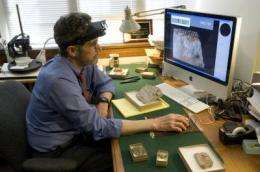
The Oriental Institute at the University of Chicago is using modern technology to digitally record thousands of tablets that, as they are being pieced together, tell an unusually detailed story of the Persian Empire.
These ancient tablets from the palaces of Persepolis include pieces of language and art from the center of the Persian Empire, all made when it extended from India and Central Asia to Egypt and the Mediterranean.
Most have texts in impressed cuneiform characters, many them have inked texts in Aramaic writing and almost all of the tablets have seal impressions. They are now being recorded and distributed with digital processes that will allow scholars and viewers across the world to examine them as if they had picked them up and rotated under a light.
With a substantial grant from the Andrew W. Mellon Foundation, a team of researchers began work in 2007. Now, with a second Mellon grant, the team will continue this work through 2010. By that time researchers hope to have about 10,000 tablets and fragments recorded.
Gil Stein, Director of the Oriental Institute, where the tablets are kept, is principal investigator along with Matthew Stolper, John A. Wilson Professor in the Oriental Institute. Other team members and co-principal investigators are Annalisa Azzoni at Vanderbilt University, Elpeth Dusinberre at the University of Colorado, Mark Garrison at Trinity University, Wouter Henkelman at the Free University of Amsterdam, and Bruce Zuckerman and members of the West Semitic Research Project at the University of Southern California. The team collaborates in person, but also electronically.
The tablets being digitized come from the Persepolis Fortification Archive, some 30,000 administrative tablets and fragments that Oriental Institute archaeologists recovered in 1933 at Persepolis, the ruined palaces where the kings of the ancient Persian Empire held court. Since 1936 they have been on loan from Iran to the Oriental Institute for analysis and recording.
"They were written, sealed and filed in a short span of time, between 509 and 493 B.C., in the middle of the reign of the Achaemenid Persian king Darius I," Stein said. "The oldest Greek tragedy of Aeschylus, and the first Greek history of Herodotus tell us about the reign of Darius, but they don't tell us anything like this. The administration that these documents record touched every level of society, from lowly workers through bureaucrats and governors to the royal family itself," he said.
Part of the collection has been recorded, and many of the tablets have been returned to Iran, but the tablets have challenged scholars since their discovery. Only one other document of its kind had been found before the discovery of the archive, making the comparison, reading and understanding of the archive's tens of thousands of pieces difficult.
Oriental Institute professor Richard Hallock devoted his career to the tablets. His work, culminating in the groundbreaking publication of 2,087 texts in 1969, fundamentally changed how scholars look at the Persian Empire.
"It is no exaggeration to say that this knowledge has transformed every aspect of modern study of the languages, history and society, institutions and art of the Achaemenid Persian Empire," Stolper said. "No serious treatment of the Achaemenid Empire can any longer omit the perspectives provided by the Fortification Archive."
As the project continues, scholars will be able to better analyze the information available in the archive. Online presentation of images of the tablets, images of the seal impressions and editions of the texts will allow researchers to be able to look at each piece, compare and connect it with other pieces, and to assemble and work with the archive as a whole system.
How the recording works
The phase of the project supported by the Mellon grants is a close collaboration between the Oriental Institute at the University of Chicago and the West Semitic Research Project at the University of Southern California. This phase captures and distributes two kinds of high-quality images of Persepolis Fortification tablets.
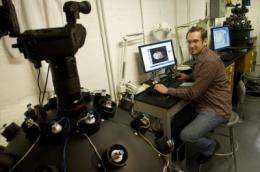
One set of images is made with a high-resolution, large-format scanning camera with polarized and filtered lighting. The lighting compensates for some of the staining, glare and fading that problematic in seeing inked texts.
The second set of images is captured with Polynomial Texture Mapping (PTM) apparatuses, using a technology developed by Hewlett Packard Labs and Cultural Heritage Imaging. Only a dozen or so of these apparatuses exist, and two of them are recording Persepolis tablets in the basement of the Oriental Institute. A computer controls the camera in each device, making a set of 32 distinctly lighted views of each document. Each image set is combined by a software application in such a way that viewers can control the apparent direction, angle and intensity of the light falling on the object, using a computer mouse just as if they were handling the original object under a desk lamp.
Source: University of Chicago


