Mysterious 1934 Disappearance of Explorer Everett Ruess in Utah Solved
The mysterious disappearance of Everett Ruess, a 20-year-old artist, writer and footloose explorer who wandered the Southwest in the early 1930s on a burro and who has become a folk hero to many, has been solved with the help of University of Colorado at Boulder researchers and the National Geographic Society.
The short, compelling life of Ruess, who went missing in 1934 after leaving the town of Escalante, Utah, has been the subject of much speculation. His story has spawned two documentary films, as well as plays, books, magazine and newspaper articles and a T-shirt line, and his name now graces an annual art festival in Escalante.
Ruess is well known for his artwork -- including watercolors and woodcuts of Southwest landscapes -- as well as extensive, romantic journaling of his travels. He was photographed by famous American documentary photojournalist Dorothea Lange, exchanged photos with Ansel Adams, and even merited a chapter in John Krakauer's book "Into the Wild," about another young wanderer, Chris McCandless.
An investigative article in the April/May issue of National Geographic Adventure by David Roberts, who had been probing the Ruess disappearance for years, indicates a Navajo man, Aneth Nez, told his granddaughter, Daisy Johnson, in 1971 that he witnessed the murder of a young white man near Bluff, Utah, in the 1930s by Ute Indians. Nez told her he buried the body in a crevasse on nearby Comb Ridge.
Roberts reported that in May 2008, Denny Belson, grandson of Nez and sister of Johnson, located the burial site and contacted the FBI in Monticello, Utah. FBI investigators then visited the site and took photographs. The enterprising Belson used a Google search using the keywords "missing persons," "1930s," and "Arizona/Utah," and came across stories about the disappearance and speculation about Ruess, said Roberts.
Roberts contacted Ron Maldano, the supervisory archaeologist at the Cultural Resource Compliance Section of the Navajo Nation based in Chimney Rock, Ariz. Maldano conducted a detailed examination of the burial site and determined the remains were likely Caucasian. Roberts put him in touch with two nieces and two nephews of Ruess for mitochondrial DNA samples, which proved inconclusive.
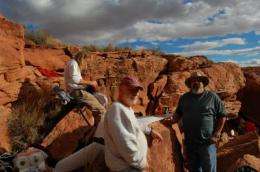
Roberts then contacted CU-Boulder anthropology Professor Dennis Van Gerven, who traveled to the site with doctoral student Paul Sandberg with the support of the National Geographic Society, excavated the remains, and returned with them to CU-Boulder with the permission of the Ruess family.
An analysis of teeth and bones by Van Gerven and Sandberg were used to determine the sex, age and stature of the person. Wisdom tooth eruption, pelvic structure, bone growth markers and femur length indicated it was a male roughly 20 years old and about 5 feet 8 inches tall -- a virtual match for Ruess, said Van Gerven.
The CU-Boulder researchers began a painstaking reconstruction of the fragile facial bones, stabilizing them on a ball of clay. Sandberg used Adobe Photoshop to superimpose photos he took of the remade face onto a frontal portrait of a smiling Ruess and a profile portrait of him, both taken in the 1930s by Lange.
"The next step was to match two points on the photos of the bones to their respective positions on the portraits," Sandberg said. "If the other anatomical points did not match, we could exclude Ruess. But all the points fell into place. The jaw fit, the curve of the nasal bones fit, the rim of the eye orbit fit and the bridge of the nose fit."
The most compelling piece of evidence was the teeth, he said. "Once a single tooth was scaled into position, the size and shape of the other teeth, as well as the morphology of the face above the teeth, matched the portrait. The correspondence was striking," Sandberg said.
"We spent a lot of time making certain that the skeletal images superimposed on the Lange photos remained anatomically exact and were in no way altered by the technique," said Van Gerven.
"But we wound up with a constellation of evidence that was a remarkable match to Ruess," he said. "We had a male about 20 years old, 5 feet 8 inches tall with facial bones that precisely matched the photographs. We concluded it was very, very unlikely that this was not Everett Ruess. But we also knew the final arbiter in this case would be genetic testing."
Van Gerven contacted CU-Boulder molecular, cellular and developmental biology Professor Kenneth Krauter, an expert in DNA analysis. Krauter brought in CU-Boulder research assistant Helen Marshall, who had extensive experience working with DNA. Marshall took two small femur fragments and prepared them by grinding and liquefying them, subsequently extracting, purifying and amplifying DNA samples.
The team members used techniques developed as a byproduct of the Human Genome Project that permitted them to assess the passing of DNA markers from one generation to the next. "We used the most stringent protocols and standards available," said Marshall. "The results were totally blind in the sense that the computer doesn't have an opinion in terms of the DNA marker matches."
High-tech "gene chips," or microarrays, made by Affymetrix Corp., a global company headquartered in Santa Clara, Calif., provided Krauter and Marshall with 600,000 separate DNA markers from the femur DNA. These were compared with roughly the same number of DNA markers extracted from saliva samples taken from the two nieces and two nephews of Ruess. As an added precaution, the team also compared the markers with the DNA of 50 people around the world.
CU-Boulder Assistant Professor Matthew McQueen of CU-Boulder's Institute for Behavioral Genetics, consulting with experts at Oxford University in England, statistically analyzed the data. The results showed the nieces and nephews of Ruess -- all siblings -- shared about 50 percent of the genetic markers with each other, and all four shared about 25 percent of the DNA markers from the femur bone samples. The results from the DNA comparisons from the 50 random people from around the world showed a less than 1 percent match, said Krauter.
"It was almost exactly what geneticists would expect when comparing DNA between nieces and nephews and an uncle or an aunt," said Krauter. "This is entirely consistent with the hypothesis that the bones are those of Everett Ruess, and make it virtually impossible that the bones are from an unrelated individual.
"The combination of the forensic analysis and the genetic analysis makes it an open and shut case," Krauter said. "I believe it would hold up in any court in the country."
The wandering spirit of Ruess, whom author Wallace Stegner once compared to a young John Muir, appears to have finally come to rest. The family of Ruess plans to have the remains cremated and scattered over the Pacific Ocean. Case closed.
Source: University of Colorado at Boulder (news : web)


