Researchers pinpoint the mechanisms of self-control in the brain
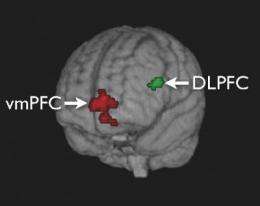
When you're on a diet, deciding to skip your favorite calorie-laden foods and eat something healthier takes a whole lot of self-control--an ability that seems to come easier to some of us than others. Now, scientists from the California Institute of Technology have uncovered differences in the brains of people who are able to exercise self-control versus those who find it almost impossible.
The key? While everyone uses the same single area of the brain to make these sorts of value-laden decisions, a second brain region modulates the activity of the first region in people with good self-control, allowing them to weigh more abstract factors--healthiness, for example--in addition to basic desires such as taste to make a better overall choice.
These findings, which are being published in the May 1 issue of the journal Science, not only provide insight into the interplay between self-control and decisionmaking in dieters, but may explain how we make any number of decisions that require some degree of willpower.
"A very basic question in economics, psychology, and even religion, is why some people can exercise self-control but others cannot," notes Antonio Rangel, a Caltech associate professor of economics and the paper's principal investigator. "From the perspective of modern neuroscience, the question becomes, 'What is special about the circuitry of brains that can exercise good behavioral self-control?' This paper studies this question in the context of dieting decisions and provides an important insight."
That insight was the result of an innovative experiment: A group of volunteers--all self-reported dieters--were shown photos of 50 foods, including everything from Snickers bars to Jello to cauliflower. The participants were asked to rate each of the foods based on how good they thought that food would taste. Afterwards, they were shown the same slides again and asked to rate each of the foods based on its supposed health benefits.
From those ratings, the researchers selected an "index food" for each volunteer--a food that fell about in the middle of the pack in terms of tastiness and supposed health benefits.
The participant was then shown the 50 items one final time and was asked to choose between it and the index item. (To keep the choosers "honest" without forcing them to eat 50 different foods in one sitting, the researchers would randomly select a number corresponding to one of the slides, and the participant would have to eat whichever food had been chosen at that point.)
All three viewings of the slides were done with the participant inside an MRI scanner, so that the blood-oxygen level dependent signal (a proxy for neuronal activity) in specific areas of the brain could be measured.
After all the choices had been made, the researchers were able to pick out 19 volunteers who showed a significant amount of dietary self-control in their choices, picking mostly healthy foods, regardless of taste. They were also able to identify 18 additional volunteers who showed very little self-control, picking what they believed to be the tastier food most of the time, regardless of its nutritional value.
When they looked at the brain scans of the participants, they found significant differences in the brain activity of the self-control group as compared to the non-self-controllers.
Previous studies have shown that value-based decisions--like what kind of food to eat--are reflected in the activity of a region in the brain called the ventromedial prefrontal cortex, or vmPFC. If activity in the vmPFC goes down, explains Todd Hare, a postdoctoral scholar in neuroeconomics and the first author on the Science paper, "it means the person is probably going to say no to that item; if it goes up, they're likely to choose that item."
In the non-self-controllers, Rangel notes, the vmPFC seemed to only take the taste of the food into consideration in making a decision. "In the case of good self-controllers, however, another area of the brain--called the dorsolateral prefrontal cortex [DLPFC]--becomes active, and modulates the basic value signals so that the self-controllers can also incorporate health considerations into their decisions," he explains. In other words, the DLPFC allows the vmPFC to weigh both taste and health benefits at the same time.
"The vmPFC works during every decision," says Hare. "The DLPFC, on the other hand, is more active when you're employing self-control."
"This, ultimately, is one reason why self-controllers can make better choices," Rangel adds.
Still, the DLPFC can only do so much. For instance, it can't override a truly negative reaction to a food, notes Hare. "We rarely got people to say they'd eat cauliflower if they didn't like cauliflower," he says. "But they would choose not to eat ice cream or candy bars, knowing they could eat the healthier index food instead."
"After centuries of debate in social sciences we are finally making big strides in understanding self-control from watching the brain resist temptation directly," says Colin Camerer, the Robert Kirby Professor of Behavioral Economics in Caltech's Division of Humanities and Social Sciences and another of the paper's coauthors. "This study, and many more to come, will eventually lead to much better theories about how self-control develops and how it works for different kinds of temptations."
The next step, the researchers say, is to come up with ways to engage the DLPFC in the decisions made by people with poor self-control under normal conditions. For instance, Hare says, it might be possible to kick the DLPFC into gear by making the health qualities of foods more salient for people, rather than asking them to make the effort to judge a food's health benefits on their own. "If we highlight the fact that ice cream is unhealthy just before we offer it," he notes, "maybe we can reduce its value in advance, give the person a head start to making a better decision."
Whether this is indeed feasible remains to be tested. But clearly, the possibilities are tantalizing, since these same sorts of value-based choices are at the root of everything from addictions like smoking to risky financial decisions.
"Imagine how much better life could be if we knew how to flex the willpower muscles in the brain and strengthen them with exercises," says Camerer.
Source: California Institute of Technology (news : web)


