Proteins, Soft Tissue from 80 Million-Year-Old Hadrosaur Add Weight to Theory that Molecules Preserve Over Time
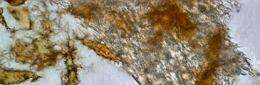
(PhysOrg.com) -- A North Carolina State University paleontologist has more evidence that soft tissues and original proteins can be preserved over time - even in fossilized remains - in the form of new protein sequence data from an 80 million-year-old hadrosaur, or duck-billed dinosaur.
Dr. Mary Schweitzer, associate professor of marine, earth and atmospheric sciences at NC State with a joint appointment at the N.C. Museum of Natural History, along with colleague Dr. John Asara from the Beth Israel Deaconess Medical Center (BIDMC) and Harvard Medical School, Dr. Chris Organ from Harvard University, and a team of researchers from Montana State University, the Dana Farber Cancer Institute, and Matrix Science Ltd. analyzed the hadrosaur samples.
The researchers' findings appear in the May 1 edition of Science.
Schweitzer and Asara had previously used multiple methods to analyze soft tissue recovered from a 68 million-year-old Tyrannosaurus Rex. Mass spectrometry conducted on extracts of T. rex bone supported their theory that the materials were original proteins from the dinosaur.
These papers were controversial, and the team wanted to demonstrate that molecular preservation of this sort in dinosaurs was not an isolated event. Based upon other studies, they made predictions of the type of environment most likely to favor this preservation, so Schweitzer and students, working with Jack Horner's Museum of the Rockies field crews, went looking for a dinosaur preserved under a lot of sandstone. Using specially designed field methodology, with the aim of avoiding environmental exposure until the fossil was inside the lab, they set aside the femur from a Brachylophosaurus canadensis - a hadrosaurid dinosaur-buried deeply in sandstone in the Judith River formation.
"This particular sample was chosen for study because it met our criteria for burial conditions of rapid burial in deep sandstones," Schweitzer says. "We know the moment the fossil is removed from chemical equilibrium, any organic remains immediately become susceptible to degradation. The more quickly we can get it from the ground to a test tube, the better chance we have of recovering original tissues and molecules."
Preliminary results seemed to confirm their methodology, as Schweitzer found evidence of the same fibrous matrix, transparent, flexible vessels and preserved microstructures she had seen in the T. rex sample in the much older hadrosaur bone. Because of the rapidity of analyses after the bones were removed, the preservation of these dinosaurian components was even better. The samples were examined microscopically via both transmitted light and electron microscopes to confirm that they were consistent in appearance with collagen. They were also tested against antibodies that are known to react with collagen and other proteins.
Next, Schweitzer sent the samples to Asara's lab to be analyzed by a new mass spectrometer, capable of producing sequences with much greater resolution than the one used previously. Mass spectrometry identifies molecules by measuring the mass of the protein fragments, or peptides, that result from breaking apart molecules with specific enzymes. The masses are measured with very high mass accuracy, and then compared with existing databases of proteins to achieve a best fit. In this way, Asara was able to identify eight collagen peptides from the hadrosaur, then confirm the identity of the sequences by comparing them both to synthesized fragments and to modern proteins analyzed under the same conditions. Once sequence data were validated, they were evaluated by Organ who determined that, like T.rex, this dinosaur's protein family tree is closer to that of modern birds than that of alligators.
All results were independently verified by researchers at BIDMC, Montana State University, Harvard University, the Dana Farber Cancer Institute, and Matrix Science of London.
The data were consistent with that of the earlier T. rex analysis, confirming that molecular preservation in fossilized remains is not an isolated event. "We used improved methodology with better instrumentation, did more experiments and had the results verified by other independent labs," Schweitzer says. "These data not only build upon what we got from the T. rex, they take the research even further."
Schweitzer hopes that this finding will lead to more work by other scientists on these ancient molecules.
"I'm hoping in the future we can use this work as a jumping off point to look for other proteins that are more species-specific than collagen. It will give us much clearer insight into all sorts of evolutionary questions."
More info: "Biomolecular Characterization and Protein Sequences of the Campanian Hadrosaur Brachylophosaurus canadensis" Authors: Mary H. Schweitzer, North Carolina State University and the N.C. Museum of Natural Sciences; John M. Asara, Beth Israel Deaconess Medical Center and Harvard Medical School, et al. Published: May 1, 2009 in Science
Source: North Carolina State University (news : web)


