Magnesium detected in MESSENGER flyby of Mercury (w/Video)
April 30, 2009
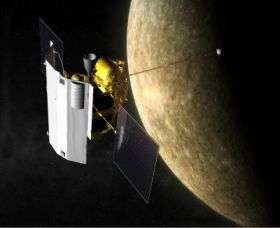
Artist's concept of the NASA's MESSENGER spaceraft at Mercury. Credit: NASA
NASA's MESSENGER spacecraft served up another curveball to a University of Colorado at Boulder team after a second flyby of the hot inner planet Oct. 6 detected magnesium -- an element created inside exploding stars and which is found in many medicine cabinets on Earth -- clumped in the tenuous atmosphere of the planet.
Scientists had suspected magnesium would be present, but were surprised at its distribution and abundance, said Senior Research Associate William McClintock of CU-Boulder's Laboratory for Atmospheric and Space Physics. The discovery in the planet's wispy atmosphere, known as its exosphere, is one more clue to the mystery of the creation of the rocky, bizarre planet that resides closest to the sun.
"Detecting magnesium was not too surprising, but seeing it in the amounts and distribution we recorded was unexpected," said McClintock, a MESSENGER co- investigator who led the development of CU-Boulder's Mercury Atmospheric and Surface Composition Spectrometer, or MASCS. "This is an example of the kind of individual discoveries that the MESSENGER team will piece together to give us a new picture of how the planet formed and evolved."
This video is not supported by your browser at this time.
An animation of the MESSENGER spacecraft's journey to Mercury.
A paper on the subject by McClintock is being published in the May 1 issue of Science. Co-authors on the paper are Ronald Vervack and Noam Izenberg of Johns Hopkins University, E. Todd Bradley of the University of Central Florida, Rosemary Killen, Nelly Mouand and Mathew Burger of the University of Maryland, Ann Sprague of the University of Arizona and Sean Solomon of the Carnegie Institution of Washington, D.C. Solomon is the MESSENGER principal investigator.The CU-Boulder instrument also measured other elements in the exosphere during the Oct. 6 flyby, including calcium and sodium. "Since calcium and magnesium are chemically similar, we might expect them to have a similar distribution in Mercury's exosphere," McClintock said. "But they don't, and we don't yet understand why."
McClintock said materials escaping from Mercury's surface are accelerated by solar radiation pressure to form a gigantic tail of atoms flowing away from the sun. Their abundances change, however, depending on the season as well as changes in magnetic field orientation and solar wind intensity.
The LASP team suspects that other metallic elements from the surface -- including aluminum, iron and silicon -- also are present in the exosphere. The metals permeated the solar nebula when it was coalescing some 4.5 billion years ago, shaping the planets, said McClintock.
Traveling at 4.2 miles per second, the spacecraft dipped within 124 miles of Mercury Oct. 6 and imaged about 30 percent of the surface never before seen by spacecraft. Launched in August 2004, MESSENGER will make the last of three Mercury passes in September 2009 before finally settling into orbit in 2011. The circuitous, 4.9 billion-mile-journey to Mercury requires more than six years and 15 loops around the sun to guide it closer to Mercury's orbit.
The desk-sized MESSENGER spacecraft is carrying seven instruments -- a camera, a magnetometer, an altimeter and four spectrometers. McClintock led the development of MASCS, which was miniaturized to weigh less than seven pounds for the arduous journey. Data from MASCS obtained during the first flyby in January 2008 provided LASP researchers with evidence that about 10 percent of the sodium atoms ejected from Mercury's hot surface during the daytime were accelerated into a 25,000-mile-long sodium tail trailing the planet, according to McClintock.
MESSENGER took data and images from Mercury for about 90 minutes on Oct. 6, when LASP turned on a detector in MASCS for its first look at Mercury's surface in the far ultraviolet portion of the light spectrum, said McClintock.
LASP Director Daniel Baker, also a co-investigator on the MESSENGER mission, is using data from the mission to study Mercury's magnetic field and its interaction with the solar wind. Mark Lankton is the LASP program manager for the MASCS instrument. Dozens of undergraduates and graduate students will be involved in analyzing data over the next several years as information and images pour back to Earth from MESSENGER.
-
Space scientists set for second spacecraft flyby of Mercury
Sep 30, 2008 |
not rated yet |
0
-
CU-Boulder scientists ready for MESSENGER Mission flyby of Mercury
Jan 10, 2008 |
not rated yet |
0
-
MESSENGER Spacecraft Reveals More Hidden Territory on Mercury
Oct 29, 2008 |
not rated yet |
0
-
NASA's Messenger Spacecraft Returns To Mercury
Oct 01, 2008 |
not rated yet |
0
-
Mercury's magnetosphere fends off the solar wind
Jan 30, 2008 |
not rated yet |
0
-
Engineers build first sub-10-nm carbon nanotube transistor
Feb 01, 2012 |
4.9 / 5 (33) |
30
-
Something old, something new: Evolution and the structural divergence of duplicate genes
Jan 31, 2012 |
4.6 / 5 (7) |
1
-
The hidden nanoworld of ice crystals: Revealing the dynamic behavior of quasi-liquid layers
Jan 30, 2012 |
5 / 5 (4) |
1
-
Stock market network reveals investor clustering
Jan 27, 2012 |
3.9 / 5 (23) |
8
-
Of microchemistry and molecules: Electronic microfluidic device synthesizes biocompatible probes
Jan 26, 2012 |
5 / 5 (2) |
0
-
Never ending outer space.....
18 hours ago
-
Neutron Star fragments?
20 hours ago
-
stationary or not?
Feb 11, 2012
-
Scale of the Universe
Feb 10, 2012
-
Titan's lack of impact craters
Feb 09, 2012
-
Real pictures of black hole eating a star?
Feb 08, 2012
- More from Physics Forums - General Astronomy
More news stories
Latin America mining boom clashes with conservation
Latin America is experiencing a mining boom as prices rise fuelled by a hike in global demand, but the region is also being hit by a wave of violent protests, strikes and rallies by environmentalists.
12 hours ago |
5 / 5 (1) |
1
Salvage workers begin pumping fuel from Italian shipwreck
Salvage workers Sunday began pumping fuel from the shipwrecked Italian cruise liner Costa Concordia, a day ahead of schedule, officials said.
4 hours ago |
not rated yet |
0
Political leaders play key role in how worried Americans are by climate change: study
More than extreme weather events and the work of scientists, it is national political leaders who influence how much Americans worry about the threat of climate change, new research finds.
Feb 06, 2012 |
5 / 5 (6) |
73
NASA budget will axe Mars deal with Europe: scientists
US President Barack Obama's budget proposal to be submitted next week for 2013 will cut NASA's budget by 20 percent and eliminate a major partnership with Europe on Mars exploration, scientists said Thursday.
Space & Earth / Space Exploration
Feb 10, 2012 |
5 / 5 (3) |
58
Humans may have helped the decline of African rainforests 3000 years ago
(PhysOrg.com) -- Large areas of rainforests in Central Africa mysteriously disappeared over three thousand years ago, to be replaced by savannas. The prevailing theory has been that the cause was a change ...
Overeating may double risk of memory loss
New research suggests that consuming between 2,100 and 6,000 calories per day may double the risk of memory loss, or mild cognitive impairment (MCI), among people age 70 and older. The study was released today and will be ...
Google might launch Drive for cloud storage soon
(PhysOrg.com) -- Google's next big move, according to the Wall Street Journal, is a cloud storage service called Drive. Hardly first to the plate, Google is simply catching up to introducing its cloud reposi ...
Scientists discover molecular secrets of 2,000-year-old Chinese herbal remedy
For roughly two thousand years, Chinese herbalists have treated Malaria using a root extract, commonly known as Chang Shan, from a type of hydrangea that grows in Tibet and Nepal. More recent studies suggest that halofuginone, ...
New method to examine batteries -- MRI from the inside
There is an ever-increasing need for advanced batteries for portable electronics, such as phones, cameras, and music players, but also to power electric vehicles and to facilitate the distribution and storage of energy derived ...
Lab study raises questions over nano-particle impact
Tests involving chickens have raised questions about the impact on health from engineered nano-particles, the ultra-fine grains commonly used in drugs and processed foods, scientists said on Sunday.
Injured boomers beware: Know when to see doctor
(AP) -- It happened to nurse Jane Byron years after an in-line skating fall, business owner Haralee Weintraub while doing "men's" push-ups, and avid cyclist Gene Wilberg while lifting a heavy box.
May 01, 2009
Rank: not rated yet