Dinosaurs declined before mass extinction
April 30, 2009 Dinosaurs declined before mass extinction

Enlarge

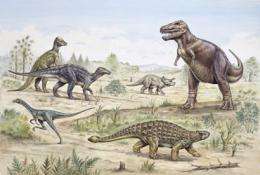
A dinosaur scene from the Cretaceous. Museum scientists reveal that dinosaur diversity was decreasing millions of years before the mass extinction 65 million years ago. Image: Natural History Museum

Dinosaurs were dying out much earlier than the mass extinction event 65 million years ago, Natural History Museum scientists report in the Proceedings of the Royal Society journal today.

The diversity of dinosaur species was already on the decline millions of years before this event. This changes the current theory about how and when became extinct.

'It appears that dinosaurs were declining well before the famous meteor impact,' says Paul Barrett, part of the research team and dinosaur expert at the Natural History Museum.

'The impact may have been the coup de grace that helped to finish off a group that was already in trouble for another reason.'

Common mass extinction theory

Until now, the common theory was that all dinosaurs, except the ancestors of birds, were wiped out at one time, perhaps by a huge , at the end of the Cretaceous period. Many dinosaur species such as Triceratops were wiped out abruptly around this time. However, this does not tell the full story.

Barrett and his team found that most species, such as those in the theropod group, like Baryonyx and T.rex, had already declined millions of years earlier.

This discovery was made while Barrett and his colleagues were studying how shows itself in the fossil record.

By studying species preserved as fossils in rocks, palaeontologists (fossil experts) can reveal what creatures lived in the past and major events that may have happened, such as mass extinctions.

However, the fossil record is not perfect. There are gaps and fossils can also be altered by geological processes. Erosion, burial and subduction (when plates slide under other plates) all help to destroy the fossil record.

Rock and diversity relationship

Barrett and his team's results uncovered a relationship between the amount of fossil-containing rock available and the pattern of species diversity. In general, the more rock available, the higher the diversity uncovered.

The diversity decline at the end of the Cretaceous was at a time in Earth's history when plenty of rock and fossils were preserved. So the high amount of available rock from this time should have shown a high diversity of dinosaurs if there was one. But it didn't.

'Our work shows for the first time that the number of different types of dinosaur was declining well before their final extinction, in spite of the fact the amount of rock available for preserving dinosaurs was at its peak.'

Barrett concludes, ‘The of dinosaurs continues to give us new surprises, even after 150 years of concentrated study’.

More information: Proceedings of the Royal Society, Biological Sciences

Provided by American Museum of Natural History (news : web)


print this article email this article download pdf blog this article bookmark this article     Stumble it Digg this share on Facebook retweet share on Reddit add to delicious
Rate this story - 4.1 /5 (14 votes)

Rank Filter

Move the slider to adjust rank threshold, so that you can hide some of the comments.


Display comments: newest first

  • mysticshakra - Apr 30, 2009
    • Rank: 1 / 5 (5)
    Dinosaurs could not have lived under our current gravity. The gravity in the past was much less. As the gravity increased they would obviously have declined.
  • DonR - Apr 30, 2009
    • Rank: 3 / 5 (3)
    My troll sense is tingling.

    (You'll notice, mysticshakra, that I gave you the benefit of the doubt against plain old idiocy)
  • Szkeptik - May 01, 2009
    • Rank: not rated yet
    Of course we all know that the gravity of an object changes over time. :)
  • mysticshakra - May 01, 2009
    • Rank: 1 / 5 (1)
    Rethink your dogma guys, the issue has not been given much common sense. Too much is assumed.
  • Megapixel - May 02, 2009
    • Rank: 1 / 5 (1)
    mysticshakra,
    You are correct, gravity was lower during the Age of the Dinosaurs. Recent science headlines such as "Dinosaurs kept their heads down in a bid to stay alive..." , Pterosaurs could'nt fly, "Giant prehistoric geese the size of small planes" are but a few of the bits of circumstantial evidence that support this.

April 30, 2009 all stories

Comments: 5

4.1 /5 (14 votes)
  • Stumble this up

  • Digg this

  • share this

  • hide
  • Related Stories

  • Dinosaur fossils fit perfectly into the evolutionary tree of life
    created Jan 26, 2009 | popularity not rated yet | comments 0
  • Fossil record supports evidence of impending mass extinction
    created Oct 24, 2007 | popularity not rated yet | comments 0
  • Luck gave dinosaurs their edge
    created Sep 11, 2008 | popularity not rated yet | comments 0
  • New dinosaur species found in Montana
    created Sep 24, 2007 | popularity not rated yet | comments 0
  • UCSB researcher leads worldwide study on marine fossil diversity
    created Jul 11, 2008 | popularity not rated yet | comments 0


  • hide
  • Relevant PhysicsForums posts

  • Super quick question about Starling forces?
    created 17 hours ago
  • Questions about diffusion
    created 23 hours ago
  • Human Leukocyte Antigen (HLA) typing
    created Nov 21, 2009
  • Breeding program
    created Nov 20, 2009
  • More from Physics Forums - Biology

Other News

Researcher: Faint writing seen on Shroud of Turin (AP)

Researcher: Faint writing seen on Shroud of Turin (Update)

Other Sciences / Archaeology & Fossils

created Nov 20, 2009 | popularity 2.3 / 5 (27) | comments 30

(AP) -- A Vatican researcher has rekindled the age-old debate over the Shroud of Turin, saying that faint writing on the linen proves it was the burial cloth of Jesus. Experts say the historian may be reading ...


Museum: Galileo's fingers, tooth are found (AP)

Museum: Galileo's fingers, tooth are found

Other Sciences / Archaeology & Fossils

created Nov 21, 2009 | popularity 4.3 / 5 (3) | comments 7

(AP) -- Two fingers and a tooth removed from Galileo Galilei's corpse in a Florentine basilica in the 18th century and given up for lost have been found again and will soon be put on display, an Italian museum ...


Maya

New insights into the life of the Maya

Other Sciences / Archaeology & Fossils

created Nov 16, 2009 | popularity 4.6 / 5 (15) | comments 7

(PhysOrg.com) -- Ancient artifacts are almost always concerned with rich and powerful religious and political leaders, but new excavations of an ancient Maya site have unearthed a pyramid decorated with murals ...


Three of a kind

Three of a kind: Revealing language’s universal essence

Other Sciences / Social Sciences

created Nov 20, 2009 | popularity 4.1 / 5 (13) | comments 6

(PhysOrg.com) -- On the surface, English, Japanese, and Kinande, a member of the Bantu family of languages spoken in the Democratic Republic of Congo, have little in common. It is not just that the vocabularies ...


Only tax increase can cure Illinois budget woes, study says

Other Sciences / Economics

created Nov 18, 2009 | popularity 1 / 5 (2) | comments 3

Tax increases are the only solution to a widening budget crisis that a new study says has landed Illinois among the nation's most financially troubled states, a soon-to-be-released report by a team of University of Illinois ...