Swine Flu Worst Case Scenario: Computer Simulations (w/Video, Podcast)
April 30, 2009 Swine Flu Scenarios: Computer Simulations

Enlarge

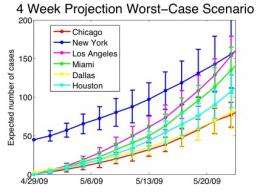
The figure indicates the time course of the number of infected individuals as a function of time in the next four weeks. The bars indicate the degree of uncertainty. This is again the projection of a worst-case scenario that does not take into account containment efforts.

(PhysOrg.com) -- Large-scale computer simulations run by Northwestern University researchers show worst-case scenario projections of approximately 1,700 cases of swine flu for the entire United States four weeks from now.

Associate Professor Dirk Brockmann and his research group have found that the major areas projected to have incidents in the worst-case scenario include California, Texas and Florida. Worst-case scenario means that no measures have been taken to combat the spread of disease. These numbers would, of course, be lessened by preventive measures already under way.


Under the worst-case scenario, more than 100 cases are projected for the Chicago area. The affected locations largely correspond to major transportation hubs in the country. The researchers also will be running simulations on the possible time course of the spread of swine flu in Europe.

FLV player

The video depicts a four week projection of the time course of a simulated swine flu epidemic.

Brockmann says their results are in excellent agreement to those of a research group at Indiana University led by Alex Vespignani that is using a different method.

“The Indiana group uses a different computational approach, and the agreement of our results is promising and an indicator of reliability in both methods,” says Brockmann, associate professor of engineering sciences and applied mathematics at the McCormick School of Engineering and Applied Science.


Brockmann and his doctoral students Christian Thiemann, Rafael Brune and Alejandro Morales-Gallardo are constantly updating the simulation, taking into account new information on confirmed cases and more precise information on transmissibility and disease-specific parameters.

Brockmann has extensive experience modeling the spread of disease. His high-performance computer clusters can be used to simulate an infectious disease that spreads among 300 million people. 


“We can, on a very realistic scale, try to model an epidemic that has the same size as a real epidemic,” he says. In order to understand how disease travels, Brockmann also must understand human transportation networks.

“These networks play an important role in the spread of infectious disease,” he says. “So we’re looking at how people travel in the and Europe and trying to find a theory behind human traffic. Then we can unravel the structures within these networks and explain them.”


FLV player

Health officials around the world continue to search for the origins of a recent outbreak of swine flu that appears to be centered in Mexico. Robert Lamb, professor of molecular and cell biology at Northwestern University, is an internationally recognized authority on the influenza virus and discusses the current outbreak.


One way to track how people travel is to monitor how money travels. In a 2006 study, Brockmann used data from WheresGeorge.com -- a site where users enter the serial numbers from their dollar bills in order to track their travels -- to create a model to predict the probability of a bill staying within a 10-kilometer radius over time. From that information, Brockmann found a key factor in his disease-spread modeling approach: very accurate datasets on human mobility. This multi-scale human mobility network included small-scale daily commuting traffic, intermediate traffic and long-distance air travel, which helps determine how a disease could potentially spread.


Brockmann and his research group also have created a map of community boundaries in the United States based on human mobility, rather than the usual state-line boundaries of rivers, mountain ranges or administrative lines. The map shows that some states, like Missouri, are essentially cut in half -- likely due to two large cities that lie on either side of the state. Other boundaries are islands in the middle of states, as is the case with Santa Fe, New Mexico. 


“These boundaries might be better suited for developing mitigation strategies against epidemics,” Brockmann says. “We’re working on creating a similar map for Europe.”


For his work, Brockmann collaborates with linguists, epidemiologists, ecologists and other scientists from around the world. He is motivated by results that could potentially be useful for humanity.

“I want to do work that is important, that involves pressing matters,” he says. “It motivates me to do research on complex systems that will eventually improve life.”


Provided by Northwestern University (news : web)


print this article email this article download pdf blog this article bookmark this article     Stumble it Digg this share on Facebook retweet share on Reddit add to delicious
Rate this story - 2.6 /5 (19 votes)

Rank Filter

Move the slider to adjust rank threshold, so that you can hide some of the comments.


Display comments: newest first

  • freethinking - Apr 30, 2009
    • Rank: 5 / 5 (1)
    Ok, I looked at the simulation for the Mexican flu and compared it to where we are today, and either I'm reading this wrong or the simulation for worst case is already way off on the low end
  • x646d63 - Apr 30, 2009
    • Rank: 3.4 / 5 (5)
    Would be nice if media stopped calling it "swine flu." It's not, it's Influenza A subtype H1N1.
  • JLMEALER - Apr 30, 2009
    • Rank: 2.1 / 5 (7)
    Both swine and Mexicans are given and or take large doses of anti-biotics for the most inane sickeness or infection. The disease from Mexico and from swines are related as they are seriously mutated.

    I am not associating Mexicans and swines by anything but the misuse of anti biotics. People coming out of Mexico have the worst types of sicknesses because of this fact. People who are not Mexicans that have been abusing anti biotics are very succeptable to these bad diseases....

    Simply call the Border Patrol and ask an agent who patrols the field and finds these mexicans with their faces falling off from these same diseases that are on the way to the USA!
  • dirk_bruere - Apr 30, 2009
    • Rank: 3 / 5 (4)
    Here's a bit of perspective: normal flu kills tens of thousands in the USA every year.
  • NeilFarbstein - Apr 30, 2009
    • Rank: 1 / 5 (2)
    If people from Mexico city travel to remote areas of Mexican and latin america it may be impossible top treat all the cases or even a majority since most of the medicine to treat them is in Mexico city.
  • Ricochet - Apr 30, 2009
    • Rank: 4 / 5 (2)
    It could be that the "swine flu" just isn't quite as bad as people fear. That one boy in Texas who died might have had some mitigating circumstances that provided him with a severly compromised immune system, whether it be personal or environmental. Also, the simulation would not be able to predict migration due to winds, water circulation, etc.
  • Soylent - Apr 30, 2009
    • Rank: 4 / 5 (5)
    Both swine and Mexicans are given and or take large doses of anti-biotics for the most inane sickeness or infection.

    [...]

    I am not associating Mexicans and swines by anything but the misuse of anti biotics.


    Flu is a virus you dolt.

  • Ricochet - Apr 30, 2009
    • Rank: 2.5 / 5 (6)
    The point is that too many antibiotics compromise your immune system, whether it be from virus or bacteria, it doesn't matter. It lowers your ability to fight any kind of infection.
  • Velanarris - Apr 30, 2009
    • Rank: 4 / 5 (6)
    This is just another thing to scare people with. Next it'll be the taliban in pakistan and nuclear terrorism. Just give it a month or two.
  • Dismay - Apr 30, 2009
    • Rank: 5 / 5 (4)
    The real question is the mortality rate versus a normal flu, and the age/health of the people that die. If tens of thousands of people die a year from a normal flu with millions infected, it's a low percentage, what if the H1N1 has 10 to 20 times that mortality rate, and infects the same millions? Also it was reported that it doesn't kill mostly the elderly/young/with poor healt, it is killing healthy 24-40 year olds.
  • Woobie - Apr 30, 2009
    • Rank: not rated yet
    No, this is not a particularly dangerous flu, yet, but it is still a rapidly spreading epidemic and bears watching. If it continues in this trend, it will mean hundreds or thousands of deaths that would not have occurred otherwise, and it could mutate into a more virulent form. The only thing dysfunctional thus far is the response of the American Panic Media, by which I mean most every television news source. At least this will be a thorough run through for worldwide disease control agencies.
  • Soylent - May 01, 2009
    • Rank: 4.2 / 5 (5)
    The point is that too many antibiotics compromise your immune system, whether it be from virus or bacteria, it doesn't matter. It lowers your ability to fight any kind of infection.


    1) No.

    2) Cytokine storm only kills people with strong immune systems, all those who died of suspected swine flu in mexico have been between 25 and 50.
  • Egnite - May 01, 2009
    • Rank: 5 / 5 (2)
    Are any of you guys old enough to remember the last "outbreak" of swine flu in the US? Think it was the early '70s but I'm not sure as I read a report about it quite a while ago.

    If my memory serves me right, the report said that some pharm corp gave the impression that a soldier had "swine flu" (was actually legionaires disease) and scared the US people into recievening onnoculations (actually they were forced by the government I think). This generated over $100million for the corp but leaded in law suits for millions coz of side effects from the vaccine (palalysis) that effected thousands.

    Anyone know anything about this who could possibly confirm this actually happened?

  • Velanarris - May 01, 2009
    • Rank: 5 / 5 (3)
    Are any of you guys old enough to remember the last "outbreak" of swine flu in the US? Think it was the early '70s but I'm not sure as I read a report about it quite a while ago.


    If my memory serves me right, the report said that some pharm corp gave the impression that a soldier had "swine flu" (was actually legionaires disease) and scared the US people into recievening onnoculations (actually they were forced by the government I think). This generated over $100million for the corp but leaded in law suits for millions coz of side effects from the vaccine (palalysis) that effected thousands.


    Anyone know anything about this who could possibly confirm this actually happened?


    I can confirm it happened. Unsurprisingly it was shortly after Vietnam and the Oil Crisis.

    Hmm....

    A war and oil crisis followed by a reported disease outbreak to scare the people....
  • Egnite - May 01, 2009
    • Rank: 5 / 5 (2)
    Lol, sounds like many americans could be suffering from dejavu...
  • mysticfree - May 01, 2009
    • Rank: not rated yet
    if you hog medicine for the swine flu, are you incurable or redundant?
  • QubitTamer - May 01, 2009
    • Rank: 2.3 / 5 (3)
    I don't see what all the panic is about... President Obama will save us. Have faith. Don't doubt... Don't QUESTION.

    OBEY!
  • freethinking - May 01, 2009
    • Rank: 2 / 5 (5)
    But Obama vice presidend says PANIC! But wait he is about as smart as a typical liberal ;)

    Seriously the Mexican flu is growing faster than the projections show. But Im still trying to figure out if this is overblown or underblown, the government and the medical community look like they are saying one thing, but doing another
  • Trippy - May 02, 2009
    • Rank: 5 / 5 (1)
    This variant of H1N1 is (as near as I can tell) being called swine flue because it is a combination of 4 different strains, but is predominantly swine in origin, and the important defining genes are swine in origin.

    2 Parts Pig Flu

    1 Part Avian Flu

    1 Part Human Flu


    The HA and NA Genes are both swine in origin, (North American and European).


    WHO pandemic level 5 is defined as being "Deaths in at least two countries in the same WHO region". The death of the five year old in Texas was a mexican child that was already sick when he came across the border. To my knowledge, there have been no deaths outside of mexico of people who have contracted the disease from other people out side of Mexico. So far, all of the deaths have been mexicans that have contracted the flu in Mexico.
  • Modernmystic - May 03, 2009
    • Rank: 1.8 / 5 (4)
    Here's a bit of perspective: normal flu kills tens of thousands in the USA every year.


    Ever hear of a little thing called mortality rate. Figure it for this strain in mexico and that will give you your perspective back....
  • Velanarris - May 04, 2009
    • Rank: 5 / 5 (1)
    This variant of H1N1 is (as near as I can tell) being called swine flue because it is a combination of 4 different strains, but is predominantly swine in origin, and the important defining genes are swine in origin.
    2 Parts Pig Flu
    1 Part Avian Flu
    1 Part Human Flu

    Almost all influenza virii come from birds through swine and into humans. In rare cases it make a jump from birds directly to humans.

    The influenza path is known to be Fowl to Swine to Humans. This is why most influenzas originate in Central America and Southeast Asia, where fowl and swine are raised in volume in close proximity.
  • Ricochet - May 14, 2009
    • Rank: 5 / 5 (1)
    Let's see... 4298 cases in 47 states and 3 deaths, 2 in Texas, 1 in Washington.
    Overall, not bad for a flu outbreak we weren't prepared for...
  • thales - May 15, 2009
    • Rank: not rated yet
    I can confirm it happened. Unsurprisingly it was shortly after Vietnam and the Oil Crisis.

    Hmm....

    A war and oil crisis followed by a reported disease outbreak to scare the people....


    Yeah, similar to how the 1918 flu scare began at the end of WWI. Maybe there's an actual cause-effect relationship.

April 30, 2009 all stories

Comments: 23

2.6 /5 (19 votes)
  • Stumble this up

  • Digg this

  • share this

  • hide
  • Related Stories

  • SARS: a model disease
    created Nov 21, 2007 | popularity not rated yet | comments 0
  • Scientists assess risk of potential flu pandemic spread via global airlines
    created Jan 23, 2007 | popularity not rated yet | comments 0
  • Internet 'flooded with swine virus spam emails'
    created Apr 30, 2009 | popularity not rated yet | comments 0
  • CDC, states: US swine flu cases jump to 68
    created Apr 28, 2009 | popularity not rated yet | comments 0
  • Good hygiene might prevent bird flu spread
    created Oct 19, 2005 | popularity not rated yet | comments 0


  • hide
  • Relevant PhysicsForums posts

  • Has the H1N1 vaccine been scientifically proven to work?
    created 11 hours ago
  • nesfatin
    created Nov 22, 2009
  • Obsessive Compulsive Disorder
    created Nov 20, 2009
  • West's zone 2 starling resistor respiratory physiology
    created Nov 18, 2009
  • 50-0-50 rule
    created Nov 18, 2009
  • What is the evidence in support of the anti-vaccine movement?
    created Nov 17, 2009
  • More from Physics Forums - Medical Sciences

Other News

Early protein processes crucial to formation and layering of myelin membrane

Medicine & Health / Research

created 1hour ago | popularity not rated yet | comments 0

New findings from an international team of researchers probing the nerve-insulating myelin sheath were bolstered by the work of Boston College biologists, who used x-rays to uncover how mutations affect the structure of myelin, ...


Belgian man: end of coma misdiagnosis like rebirth (AP)

Belgian man: end of coma misdiagnosis like rebirth

Medicine & Health / Other

created 1hour ago | popularity not rated yet | comments 2

(AP) -- With a caretaker holding his hand, a Belgian man who was diagnosed as comatose for 23 years typed out a message Tuesday that he felt reborn after decades of loneliness and frustration.


Bottling up work woes increases heart risk: study

Medicine & Health / Health

created 1hour ago | popularity not rated yet | comments 0

Men who bottle up frustrations about unfair treatment at work are twice as likely to have a heart attack, a study published in Britain on Tuesday suggests.


'Too fat to be a princess?' Study shows young girls worry about body image

Medicine & Health / Psychology & Psychiatry

created 6 hours ago | popularity 4 / 5 (2) | comments 2

Even before they start school, many young girls worry that they are fat. But a new study suggests watching a movie starring a stereotypically thin and beautiful princess may not increase children's anxieties.


Clinical trials of spray-on skin to start in US

Medicine & Health / Research

created 6 hours ago | popularity 5 / 5 (1) | comments 1

(PhysOrg.com) -- Clinical trials comparing a spray-on skin product with skin grafts will start in the US in December. The trials, which are partly funded by a US army grant of $1.4 million, will last about a year and will ...