Swine flu name change? Flu genes spell pig
May 1, 2009 By SETH BORENSTEIN , AP Science Writer
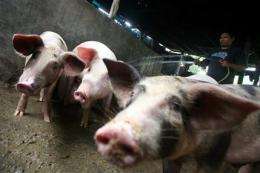
A farmer wash pigs at a pig farm in Medan, North Sumatra, Indonesia, Thursday, April 30, 2009. Indonesia, which was hit hardest by bird flu, said it was banning all pork imports to prevent swine fever infections. (AP Photo/Binsar Bakkara)
(AP) -- No matter what you call it, leading experts say the virus that is scaring the world is pretty much all pig. So while the U.S. government and now the World Health Organization are taking the swine out of "swine flu," the experts who track the genetic heritage of the virus say this: If it is genetically mostly porcine and its parents are pig viruses, it smells like swine flu to them.
Six of the eight genetic segments of this virus strain are purely swine flu and the other two segments are bird and human, but have lived in swine for the past decade, says Dr. Raul Rabadan, a professor of computational biology at Columbia University.
A preliminary analysis shows that the closest genetic parents are swine flu strains from North America and Eurasia, Rabadan wrote in a scientific posting in a European surveillance network.
• Join PhysOrg.com on Facebook!
• Follow PhysOrg.com on Twitter!
"Scientifically this is a swine virus," said top virologist Dr. Richard Webby, a researcher at St. Jude Children's Research Hospital in Memphis. Webby is director of the WHO Collaborating Center for Studies on the Ecology of Influenza Viruses in Lower Animals and Birds. He documented the spread a decade ago of one of the parent viruses of this strain in scientific papers.
"It's clearly swine," said Henry Niman, president of Recombinomics, a Pittsburgh company that tracks how viruses evolve. "It's a flu virus from a swine, there's no other name to call it."
Dr. Edwin D. Kilbourne, the father of the 1976 swine flu vaccine and a retired professor at New York Medical College in Valhalla, called the idea of changing the name an "absurd position."
The name swine flu has specific meaning when it comes to stimulating antibodies in the body and shouldn't be tinkered with, said Kilbourne, 88.
That's not what government health officials say.
"We have no idea where it came from," said Michael Shaw, associate director for laboratory science for the Centers for Disease Control and Prevention. "Everybody's calling it swine flu, but the better term is 'swine-like.' It's like viruses we have seen in pigs, it's not something we know was in pigs."
On Wednesday, U.S. officials not only started calling the virus 2009 H1N1 after two of its genetic markers, but Dr. Anthony Fauci the National Institutes of Health corrected reporters for calling it swine flu. Then on Thursday, the WHO said it would stop using the name swine flu because it was misleading and triggering the slaughter of pigs in some countries.
Another reason the U.S. government wants to ditch the swine label is that many people are afraid to eat pork, hurting the $97 billion U.S. pork industry. Even the experts who point to the swine genetic origins of the virus agree that people can't get the disease from food or handling pork, even raw.
"Calling this swine flu, when to date there has been no connection between animals and humans, has the potential to cause confusion," Chris Novak, chief executive officer of the National Pork Board, said in a news release.
One top flu expert, doesn't like the swine flu name either, but for a different reason. Traditional swine flu doesn't spread easily among people, although this one does now, said Dr. Paul Glezen, a flu epidemiologist at Baylor University.
Columbia's Rabadan said sometimes when he talks to other scientists, he uses the name "swine" or the name "Mexican flu." And that name only adds another case of political incorrectness.
Mexico Health Secretary Jose Angel Cordova said it's wrong to call it "North American flu" and flatly rejects the idea of calling it "Mexican flu." He pointed to WHO information that the swine genes in the virus are from Europe and Asia. Rabadan and others say four of the six pure swine genetic markers are North American.
"I don't think it's fair for someone to blame Mexico for this. You can't blame any country; you can't blame a person or an institution. The recombination of genes in the virus is something that happens naturally," Mexico's chief epidemiologist, Miguel Angel Lezana said Wednesday.
And while the U.S. government and WHO are dropping "swine flu" as the name, someone hasn't told their Webmasters.
On Thursday afternoon, the phrase "swine flu" was still in the Internet addresses for the WHO, Homeland Security and CDC pages on the disease and the question-and-answer page on the U.S. government's pandemic flu Web site.
---
On the Net:
Rabadan paper on the virus' origins: http://www.eurosurveillance.org/ViewArticle.aspx?ArticleId19193
The CDC on this flu: http://www.cdc.gov/swineflu/
The World Health Organization on this outbreak: http://www.who.int/csr/disease/swineflu/en/index.html
Medical Writers Lauran Neergaard in Washington and Mike Stobbe in Atlanta and reporters Rita Beamish in San Mateo, Calif., and E. Eduardo Castillo in Mexico City contributed to this report.
©2009 The Associated Press. All rights reserved. This material may not be published, broadcast, rewritten or redistributed.
-
Mexico City closes museums to stop flu outbreak
Apr 24, 2009 |
not rated yet |
0
-
Questions and answers on swine flu
Apr 29, 2009 |
not rated yet |
0
-
CDC, states: US swine flu cases jump to 68
Apr 28, 2009 |
not rated yet |
0
-
Internet 'flooded with swine virus spam emails'
Apr 30, 2009 |
not rated yet |
0
-
Swine flu cases up to 7, probe expanding
Apr 23, 2009 |
not rated yet |
0
-
Engineers build first sub-10-nm carbon nanotube transistor
Feb 01, 2012 |
4.9 / 5 (28) |
26
-
Something old, something new: Evolution and the structural divergence of duplicate genes
Jan 31, 2012 |
4.6 / 5 (7) |
1
-
The hidden nanoworld of ice crystals: Revealing the dynamic behavior of quasi-liquid layers
Jan 30, 2012 |
5 / 5 (3) |
1
-
Stock market network reveals investor clustering
Jan 27, 2012 |
4 / 5 (22) |
8
-
Of microchemistry and molecules: Electronic microfluidic device synthesizes biocompatible probes
Jan 26, 2012 |
5 / 5 (1) |
0
-
Classical and Quantum Mechanics via Lie algebras
Apr 15, 2011
- More from Physics Forums - Independent Research
More news stories
Discovery predicts patient sensitivity to important drug target in deadly brain cancer
A recent discovery by Van Andel Research Institute (VARI) scientists enables the prediction of patient sensitivity to proposed drug therapies for glioblastoma the most common and most aggressive malignant brain tumor ...
11 hours ago |
5 / 5 (1) |
0
|
New study finds individual differences in anthrax susceptibility
Susceptibility to anthrax toxin is a heritable genetic trait that may vary tremendously among individuals, according to a new study by researchers at the Stanford University School of Medicine.
12 hours ago |
5 / 5 (1) |
0
|
Study identifies new prostate cancer drug target
Research led by Wanguo Liu, PhD, Associate Professor of Genetics at LSU Health Sciences Center New Orleans, has identified a new protein critical to the development and growth of prostate cancer. The findings are published ...
12 hours ago |
5 / 5 (1) |
0
|
Tasting fructose with the pancreas
Taste receptors on the tongue help us distinguish between safe food and food that's spoiled or toxic. But taste receptors are now being found in other organs, too. In a study published online the week of February ...
12 hours ago |
4.5 / 5 (6) |
0
|
Exercise triggers stem cells in muscle
University of Illinois researchers determined that an adult stem cell present in muscle is responsive to exercise, a discovery that may provide a link between exercise and muscle health. The findings could lead to new therapeutic ...
14 hours ago |
4.7 / 5 (6) |
0
|
Nicira promises virtual networks will transform networking
(PhysOrg.com) -- For the past four years, founders of the start-up company Nicira have been developing cutting-edge software that they predict will transform the networking technology underlying the Internet. ...
Navy to begin tests on electromagnetic railgun prototype launcher
The Office of Naval Research (ONR)'s Electromagnetic (EM) Railgun program will take an important step forward in the coming weeks when the first industry railgun prototype launcher is tested at a facility ...
Study of diving beetles suggest sperm evolution may be driven by changes in female reproductive organs
Studying female reproductive tracts and sperm in diving beetles (Dytiscidae), researchers from the University of Arizona and Syracuse University have obtained a glimpse into a bizarre and amazing world of spe ...
Fossil cricket: Jurassic love song reconstructed
Some 165 million years ago, the world was host to a diversity of sounds. Primitive bushcrickets and croaking amphibians were among the first animals to produce loud sounds by stridulation (rubbing certain body parts together). ...
New insight from whole-genome sequencing of Europe's 2011 E. coli outbreaks
Using whole-genome sequencing, a team led by researchers from Harvard School of Public Health (HSPH) and the Broad Institute has traced the path of the E. coli outbreak that sickened thousands and killed over 50 people in Ger ...
Redder ladybirds more deadly, say scientists
A ladybird's colour indicates how well-fed and how toxic it is, according to an international team of scientists. Research led by the Universities of Exeter and Liverpool directly shows that differences between ...
May 01, 2009
Rank: not rated yet
But!!!!! In the US, you cant say anything that even apprears to be negative about Mexico.
May 05, 2009
Rank: not rated yet
What led to the slaughter of pigs is not the name of the flu, but an appalling ignorance of the means of virus transmission.
And calling it "H1N1" doesn't remove any confusion - it creates more. Influenza A (H1N1) is actually the broad designation for a wide range of flu strains having common genetic characteristics, including about half of all cases of common seasonal flu.
So calling it H1N1 is pretty much like calling it "the flu." The name doesn't distinguish this swine-origin flu from other common influenza strains. Besides, from an SEO perspective, who's going to type "Influenza A/H1N1" into a Google search box? Calling it H1N1 makes vital information about the swine flu more difficult to find.
My question is, why didn't the CDC or WHO change the name of bird flu to avoid offending the chicken industry? The whole thing's ridiculous. I hope everyone calling it "H1N1" grows a snout and a tail.