Mosquito parasite may help fight dengue fever
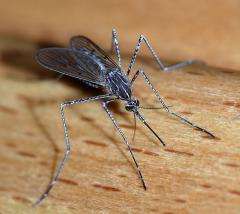
Dengue fever is a terrible viral disease blighting many of the world's tropical regions. Carried by mosquitoes, such as Aedes aegypti, 40% of the world's population is believed to be at risk from the infection. What is more, previous exposure to other strains of the fever does not confer protection. In fact, subsequent infections are significantly worse, and can result in fatal dengue haemorrhagic fever.
The lack of a functioning vaccine forced Scott O'Neill and Elizabeth McGraw to look for a more creative form of defence. Knowing that a parasite, Wolbachia pipientis, shortens the lifespan of host insects and could restrict dengue fever transmission by killing the insects before they can pass the infection on, O'Neill and his team successfully infected Ae. aegypti with a strain of the Wolbachia bacterium and shortened the mosquitoes' lifespan.
But before insects carrying the bacterium can be released into the environment, the O'Neill and McGraw teams have to convince international governments that mosquitoes carrying the Wolbachia parasite could successfully limit transmission of the virus. McGraw and O'Neill had to find out how the bacterium affects the mosquito's physiology and behaviour and publish their results in the Journal of Experimental Biology on May 1 2009.
Knowing that Wolbachia slows down some insects' activity and speeds up others, the team decided to test how the parasite affects Ae. aegypti as they age and the infection takes hold. Working with uninfected and infected mosquitoes produced by Conor McMeniman, Oliver Evans and Eric Caragata used a system designed by Craig Williams to film the activities of male and female mosquitoes as they aged to find how the bacteria affected the insects' activity levels. According to McGraw, the experiments generated a huge amount of video data, so Evans teamed up with Megan Woolfit and David Green to pipe the data to a cluster of workstations to track the insects' movements and analyse their activity levels.
After a year of experimental design, data collection and analysis, it was clear that the infected mosquitoes were more active than the uninfected insects. Most surprisingly, as the mosquitoes aged and the infection took hold, it did not increase their activity levels further.
Having found that the insects became more active in response to their bacterial lodgers, Craig Franklin joined the team to help measure the insects' CO2 production to find how their metabolic rates respond to the parasite. Again, the insects' metabolic rates were higher than those of the uninfected mosquitoes.
So why are the infected insects more active than the uninfected insects? McGraw says there are three possible explanations; the insects are living fast and dying young; the insects are hungrier and consume more energy in their constant search for food; or the bacteria somehow affect the insects' tissues to change their behaviour and increase their metabolic rate. McGraw suspects that the last explanation is the most likely.
Having shown that the activity levels of Wolbachia infected mosquitoes respond to the bacterium, McGraw and O'Neill are continuing to test how the infection affects the insects' biting behaviour and whether a Wolbachia infection can become established in Ae. aegypti populations to limit their lifespans. Ultimately, McGraw and O'Neill hope to release infected mosquitoes into afflicted regions of the world to limit dengue fever transmission, but only once they are sure that the insects will do no harm to the environment.
More information: Evans, O., Caragata, E. P., McMeniman, C. J., Woolfit, M., Green, D. C., Williams, C. R., Franklin, C. E., O'Neill, S. L. and McGraw, E. A. (2009). Increased locomotor activity and metabolism of Aedes aegypti infected with a life-shortening strain of Wolbachia pipientis J. Exp. Biol. 212, 1436-1441. jeb.biologists.org
Source: The Company of Biologists (news : web)


