Dolphins maintain round-the-clock visual vigilance
May 1, 2009 Dolphin

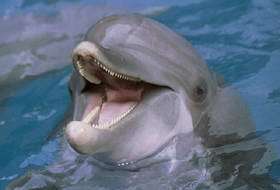
Dolphins have a clever trick for overcoming sleep deprivation. Sam Ridgway from the US Navy Marine Mammal Program explains that they are able to send half of their brains to sleep while the other half remains conscious. What is more, the mammals seem to be able to remain continually vigilant for sounds for days on end.

All of this made Ridgway and his colleagues from San Diego and Tel Aviv wonder whether the dolphins' unrelenting auditory vigilance tired them and took a toll on the animals' other senses? Ridgway and his team set about testing two dolphins' acoustic and visual vigilance over a 5 day period to find out how well they functioned after days without a break. The team publish their results on May 1 2009 in the .

First Ridgway and his colleagues, Mandy Keogh, Mark Todd and Tricia Kamolnick, trained two dolphins to respond to a 1.5 s beep sounded randomly against a background of 0.5 s beeps every 30 s. Ridgway explains that the sounds were low enough for the dolphins to barely notice them as they swam through their enclosure, but the animals sprung into action every time they heard the 1.5 s tone, even after listening to the sounds for 5 days without a break. Their auditory vigilance remained as sharp as it had been 5 days earlier.

Next Allen Goldblatt and Don Carder designed a visual stimulus to test the dolphins' vigilance while they continued listening to the repetitive beeps. Knowing that the dolphins' binocular vision is limited because their eyes are situated on opposite sides of their heads, Kamolnick trained one of the dolphins, SAY, to recognise two shapes (either three horizontal red bars or one vertical green bar) with her right eye before training her to recognise the same shapes with the left eye, reasoning that if half of her brain was asleep during testing, the dolphin would only see the shapes through the eye connected to the conscious half of the brain. But the team were in for a surprise when they began training SAY's left eye. She already recognised the shapes, even though her left eye had not seen them previously. Ridgway explains that the information must be transferred between the two brain hemispheres and suspects that the dolphin's inter-hemispheric commissures, which connects the two halves, may transfer the visual information.

Having trained both dolphins to recognise the shapes, the hard part began: monitoring and rewarding the dolphins continually over a 5 day period while the team tested the animals' responses to both the sound and visual stimuli. Amazingly, even after 5 days of listening out for 1.5 s beeps amongst the 0.5 s beep background, the dolphins were still responding as accurately as they had done at the beginning of the experiment. The team also enticed the dolphins into a bay at night where they could be shown the horizontal and vertical bar shapes, and found that the dolphins were as sharp at the end of the 120 hour experiment as they had been at the beginning. And when the team checked the dolphins' blood for physical signs of , they couldn't find any. After 5 days of unbroken vigilance the dolphins were in much better shape than the scientists.

More information: Ridgway, S., Keogh, M., Carder, D., Finneran, J., Kamolnick, T., Todd, M. and Goldblatt, A. (2009). maintain cognitive performance during 72 to 120 hours of continuous auditory vigilance. J. Exp. Biol. 212, 1519-1527. http://jeb.biologists.org


Join PhysOrg.com on Facebook!
Follow PhysOrg.com on Twitter!

Source: The Company of Biologists (news : web)


print this article email this article download pdf blog this article bookmark this article     Stumble it Digg this share on Facebook retweet share on Reddit add to delicious
Rate this story - 4.6 /5 (8 votes)

Rank Filter

Move the slider to adjust rank threshold, so that you can hide some of the comments.


Display comments: newest first

  • A_Paradox - May 01, 2009
    • Rank: not rated yet
    This whole subject is very interesting but the article does not go very deeply into the assumptions that may have been made. They don't say what they did to ensure that they were "training one of the dolphins to recognise two shapes with one eye before training her to recognise the same two shapes with the other eye." They do not specify that when the training for one eye was happening, then the hemisphere associated with the opposite eye was definitely asleep. How could they be sure of this anyway, without using EEG monitors.

    As dolphins live in a more practically 3D world than land based animals, it figures that they would need to detect and monitor signals reliably for 24 - 7. My understanding is that the need for sleep is directly related to the extent that memory is important for the creature in question. This is because remembering is a creative process that takes energy and produces random inappropriate connections amongst all the useful linkages which embody the memories. Sleep - disconnection of the brain/hemisphere from sensory inputs and from effective muscular movement - allows the swamping and erasure of the dysfunctional connections while allowing enhancement through practice of the useful new networks. Just because land based "dumb animals" may tend to park their bodies and switch off both hemispheres over night or through daylight, does not mean that dolphins must also do this. Dolphins are always potentially prey to sharks and orca yet have survived for many score millions of years so clearly they have solved all the problems.
  • Mercury_01 - May 02, 2009
    • Rank: 1 / 5 (1)
    "First Ridgway and his colleagues, Mandy Keogh, Mark Todd and Tricia Kamolnick, trained two dolphins to respond to a 1.5 s beep sounded randomly against a background of 0.5 s beeps every 30 s. Ridgway explains that the sounds were low enough for the dolphins to barely notice them as they swam through their enclosure, but the animals sprung into action every time they heard the 1.5 s tone, even after listening to the sounds for 5 days without a break. Their auditory vigilance remained as sharp as it had been 5 days earlier."


    This is just cruel.


    "Next Allen Goldblatt and Don Carder designed a visual stimulus to test the dolphins' vigilance while they continued listening to the repetitive beeps. Knowing that the dolphins' binocular vision is limited because their eyes are situated on opposite sides of their heads, Kamolnick trained one of the dolphins, SAY, to recognise two shapes (either three horizontal red bars or one vertical green bar) with her right eye before training her to recognise the same shapes with the left eye, reasoning that if half of her brain was asleep during testing, the dolphin would only see the shapes through the eye connected to the conscious half of the brain. But the team were in for a surprise when they began training SAY's left eye. She already recognised the shapes, even though her left eye had not seen them previously. Ridgway explains that the information must be transferred between the two brain hemispheres and suspects that the dolphin's inter-hemispheric commissures, which connects the two halves, may transfer the visual information."


    you mean that the information passed between hemeshpheres through the neural pathway that connects the two hemespheres?!!!

    Wow, did you deduce that?


    Well, it looks like once again, dolphins are smarter than scientists.


May 1, 2009 all stories

Comments: 2

4.6 /5 (8 votes)
  • Stumble this up

  • Digg this

  • share this

  • hide
  • Related Stories

  • Another dolphin stranding off Cape Cod
    created Jan 29, 2006 | popularity not rated yet | comments 0
  • 'Flipper' trainer against dolphin tourism
    created Oct 28, 2005 | popularity not rated yet | comments 0
  • Group calls for ban on dolphin therapy
    created Oct 28, 2007 | popularity not rated yet | comments 0
  • Four dolphins found dead on Florida beach
    created Dec 14, 2007 | popularity not rated yet | comments 0
  • Environment shapes dolphin noises
    created Nov 19, 2007 | popularity not rated yet | comments 0


  • hide
  • Relevant PhysicsForums posts

  • What is transpulmonary pressure?
    created 21 hours ago
  • Is there a gay gene?
    created Nov 23, 2009
  • Super quick question about Starling forces?
    created Nov 22, 2009
  • Questions about diffusion
    created Nov 22, 2009
  • More from Physics Forums - Biology

Other News

Asian carp may have breached barrier protecting Lake Michigan

Biology / Ecology

created 7 hours ago | popularity 5 / 5 (3) | comments 0

Two feared species of Asian carp have zoomed beyond the $9 million electric barriers built to keep them out of Lake Michigan. Now, the only thing left between the carp and the Great Lakes is a lock and dam in southern Chicago.


Got a pain? -- Have a cup of Brazilian mint

Biology / Plants & Animals

created 9 hours ago | popularity 4.6 / 5 (7) | comments 0

For thousands of years it has been prescribed by traditional healers in Brazil to treat a range of ailments from headaches and stomach pain to fever and flu.


Opposites attract: Monkeys choose mating partners with different genes

Biology / Evolution

created 9 hours ago | popularity 5 / 5 (1) | comments 0

The world's largest species of monkey 'chooses' mates with genes that are different from their own to guarantee healthy and strong offspring, according to a new research study.


When is a stem cell really a stem cell?

When is a stem cell really a stem cell?

Biology / Biotechnology

created 10 hours ago | popularity 4.7 / 5 (3) | comments 0

(PhysOrg.com) -- Induced pluripotent stem (iPS) cells -- adult cells reprogrammed to look and function like versatile embryonic stem cells -- are of growing interest in medicine. They may provide a way to ...


Ice Cold: Cooler Than Being Cool

Ice Cold: Cooler Than Being Cool

Biology / Cell & Microbiology

created 11 hours ago | popularity 4.2 / 5 (9) | comments 0

(PhysOrg.com) -- Water expands when it freezes. Anyone who has ever left a can of soda or bottle of water in the freezer too long has witnessed this first hand. So how do plants and animals survive severe ...