Frozen helium-4 may be an unusual 'superglass'
May 1, 2009 By Bill Steele
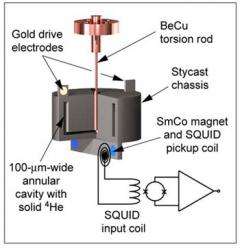
A torsion oscillator shakes a sample of frozen helium back and forth like a washing machine agitator, and gives experimenters information about the state of the matter inside. At temperatures near absolute zero some of the helium goes into a frictionless "supermatter" state and offers less resistance to being pushed back and forth. The entire apparatus is about the diameter of a quarter. Image: Davis Lab
(PhysOrg.com) -- When helium is cooled to around 4 degrees above absolute zero, it turns liquid. Make it a couple of degrees cooler, and it becomes a "superfluid" that flows without resistance from its container, just as electrons flow without resistance in a superconductor.
Now pressurize the helium to about 50 atmospheres until it solidifies, and then cool it a lot more to about two-tenths of a degree above absolute zero, and it becomes -- well, there's a lot of argument about what it is. Perhaps a supersolid, or a solid with some superfluid moving through it.
In fact, it may be a superglass, report J.C. Séamus Davis, the James Gilbert White Distinguished Professor in the Physical Sciences at Cornell and colleagues in the May 1 issue of the journal Science.
The researchers are cautious in their conclusions, not insisting that the material is a glass but presenting evidence to support that idea, which was proposed by theorists about two years ago.
(All this refers to helium-4, the common variety you see in balloons. Helium-3, an isotope with two protons and only one neutron in its nucleus, has parallel but different properties. Cornell researchers Robert Richardson, David Lee and Douglas Osheroff earned a Nobel Prize for discovering the superfluid state of helium-3.)
In a solid, as scientists define it, atoms bond to one another in an orderly crystal lattice. In a liquid, the atoms freely move around. A glass is really a liquid flowing so slowly that it appears to be solid. Look out your window for a few hundred years, and you might notice it starting to sag.
Although the theory that frozen helium might be a supersolid has been around for years, the first evidence that it was at least a super-something was provided in a 2004 experiment by Moses Chan at Penn State. Researchers there placed a tiny cylinder of frozen helium in a torsion oscillator, which rotates rapidly forward and back, like a washing machine agitator. The resonant frequency of the oscillator -- the one it naturally settles into -- depends on the mass it's trying to move around and back. The researchers found that below a critical temperature, some of the mass of the helium seemed to disappear.
Imagine holding an egg upright in your hand and twisting your wrist back and forth. There isn't much resistance because the inside is liquid and slides around. Hard-boil the egg and you feel all of its mass pushing back. Now suppose a hard-boiled egg decided not to push back: odd. That won't happen with eggs, but it does happen with solid helium near absolute zero.
One way to explain this is in terms of the famous Heisenberg uncertainty principle: We can't know both the position and velocity of a particle with great precision; the more we know about one, the less we know about the other. Near absolute zero atoms aren't moving very fast, so their position becomes very loose. The many atoms of helium overlap so much that they behave as a single atom -- a state of matter known as a Bose-Einstein condensate -- which is unaffected by anything around it and essentially frictionless.
Davis' group used an apparatus similar to Chan's, but "heated" the sample to a range of temperatures from near absolute zero up to about 300 milliKelvins (thousandths of a degree above absolute zero). After each heating they watched how the resonant frequency of the oscillator changed over a period of many hours, essentially measuring how long it took for the material to "refreeze." What they found was consistent with a material that becomes more and more glass-like as the temperature increases, rather than something that responds like a crystalline solid.
Davis likens the effect to a glass-blowing demonstration. At room temperature glass seems pretty solid. At around 1,500 degrees Celsius it begins to melt and flow at speeds visible to humans. As the temperature rises it flows more freely. The dependence of these ultraslow flow properties on temperature can be used to distinguish a glass from a crystal, Davis explained. He compares heating glass to heating a diamond, which remains an ordered crystal no matter how hot it gets, until it reaches its melting point (3550 degrees Celsius). Below the melting point no slow changes would be seen over time after heating.
The second surprise was that only when the glasslike properties freeze out does the frictionless superflow signal discovered by Chan appear. "This is interesting not just because it appears glass-like and not just because it shows the Chan signal but because it shows a relationship between the two," Davis said. "We think that when this glass freezes, the superfluid begins to move, and such a state could be called a superglass."
-
High-quality helium crystals show supersolid behavior
Feb 18, 2007 |
not rated yet |
0
-
Probable observation of a supersolid helium phase
Apr 21, 2004 |
not rated yet |
0
-
Probing Question: What is a supersolid?
May 13, 2005 |
not rated yet |
0
-
When is a supersolid not quite so super?
Oct 24, 2006 |
not rated yet |
0
-
Probing Question: Are there upper and lower limits to temperature?
Jun 07, 2007 |
not rated yet |
0
-
Engineers build first sub-10-nm carbon nanotube transistor
Feb 01, 2012 |
4.9 / 5 (33) |
30
-
Something old, something new: Evolution and the structural divergence of duplicate genes
Jan 31, 2012 |
4.6 / 5 (7) |
1
-
The hidden nanoworld of ice crystals: Revealing the dynamic behavior of quasi-liquid layers
Jan 30, 2012 |
5 / 5 (4) |
1
-
Stock market network reveals investor clustering
Jan 27, 2012 |
3.9 / 5 (23) |
8
-
Of microchemistry and molecules: Electronic microfluidic device synthesizes biocompatible probes
Jan 26, 2012 |
5 / 5 (2) |
0
-
what is electricity???
4 hours ago
-
Can Plasma Be Solid
5 hours ago
-
What is delta Δ ?
5 hours ago
-
Need some help understanding HertzĀKnudsen formula
6 hours ago
-
Anatomy of Fat man: implosion-critical bomb
8 hours ago
-
what makes two sounds similar???
8 hours ago
- More from Physics Forums - General Physics
More news stories
Explained: Sigma
It's a question that arises with virtually every major new finding in science or medicine: What makes a result reliable enough to be taken seriously? The answer has to do with statistical significance -- but ...
Feb 09, 2012 |
5 / 5 (20) |
76
Quantum physicist explains $100K offer for proof scaled-up quantum computing is impossible
(PhysOrg.com) -- MIT researcher Scott Aaronson has certainly riled the physics community with his offer this past Friday, of $100,000 to anyone who can prove that scaled-up quantum computing is impossible. ...
Diamond light, brighter than the sun
Its the size of five football pitches and generates light 10 billion times brighter than the sun. As the Diamond Light Source celebrates its tenth anniversary this year, Penny Bailey visits one of the ...
Feb 07, 2012 |
4.1 / 5 (10) |
18
|
Physicists 'record' magnetic breakthrough
An international team of scientists has demonstrated a revolutionary new way of magnetic recording which will allow information to be processed hundreds of times faster than by current hard drive technology.
Feb 07, 2012 |
4.6 / 5 (43) |
15
|
Hints of the Higgs - papers are submitted
Back in December 2011, the ATLAS and CMS experiments at CERN presented some exciting results that provided tantalising hints of the Higgs boson.
Feb 08, 2012 |
4.3 / 5 (8) |
10
Scientists discover molecular secrets of 2,000-year-old Chinese herbal remedy
For roughly two thousand years, Chinese herbalists have treated Malaria using a root extract, commonly known as Chang Shan, from a type of hydrangea that grows in Tibet and Nepal. More recent studies suggest that halofuginone, ...
New method to examine batteries -- MRI from the inside
There is an ever-increasing need for advanced batteries for portable electronics, such as phones, cameras, and music players, but also to power electric vehicles and to facilitate the distribution and storage of energy derived ...
Google might launch Drive for cloud storage soon
(PhysOrg.com) -- Google's next big move, according to the Wall Street Journal, is a cloud storage service called Drive. Hardly first to the plate, Google is simply catching up to introducing its cloud reposi ...
A mitosis mystery solved: How chromosomes align perfectly in a dividing cell
Although the process of mitotic cell division has been studied intensely for more than 50 years, Whitehead Institute researchers have only now solved the mystery of how cells correctly align their chromosomes during symmetric ...
Lab study raises questions over nano-particle impact
Tests involving chickens have raised questions about the impact on health from engineered nano-particles, the ultra-fine grains commonly used in drugs and processed foods, scientists said on Sunday.
Starve a virus, feed a cure? Findings show how some cells protect themselves against HIV
A protein that protects some of our immune cells from the most common and virulent form of HIV works by starving the virus of the molecular building blocks that it needs to replicate, according to research published online ...
May 01, 2009
Rank: 1 / 5 (1)
May 01, 2009
Rank: 3 / 5 (4)
No you wouldn't - glass is an amorphous solid, it does not flow on a macroscopic scale. Very old glass panes tend to be a little distorted and thicker on the bottom because of method of manufacture and the reason that they are mostly found thicker at the bottom is that it just makes sense when putting the window together to put the heavier side down. You will find some old panes where the glass is thicker at the top.
If glass flows, you should see some small effect after 30 years, right? Look out of the glass in a building from the 70's and note if there is any distortion in the glass.
May 01, 2009
Rank: 1 / 5 (1)
Thats completely subjective. You're suggesting a visible change after 30 years when it seems at least a century is required for any real visible difference. Glass is a very slow liquid, in fact all solids are liquids in some way - just think of any solid and give it say a million years, there will be no doubt migration of atoms to the bottom.
May 02, 2009
Rank: 5 / 5 (1)
May 02, 2009
Rank: 5 / 5 (2)
First is a very nice link concerning glass flow from UC Riverside:
http://math.ucr.e...ass.html
Nice short and sweet explanation from "infoplease.com" web site:
http://www.infopl...ows.html
and for goodness sakes, even Corning Museum of Glass calls it a myth
http://www.cmog.o...x?id=294
May 02, 2009
Rank: 5 / 5 (1)
May 03, 2009
Rank: 1 / 5 (1)
http://blog.scien...ur-feet/
The trick is, the surface of helium-4 crystals isn't dry in certain range of low temperatures, as it's being covered by thin layer of molten superfluid helium, which lubricates them by the same way, like surface of snowflakes.
May 03, 2009
Rank: 1 / 5 (1)
But I don't think, such mechanism is responsible for regelation of helium-3 crystals, because it doesn't explain, why the supersolidity phenomena is so sensitive to:
1) range of temperatures (too low temperatures are killing the effect)
2) anealing of helium-3 crystals (prolonged standing at 2K kills the effect)
3) impurities (tiny addition of helium-4 kills the effect)
May 04, 2009
Rank: not rated yet
And what mechanism produces the creaking sound in the absence of friction?
May 04, 2009
Rank: 1 / 5 (1)
The same mechanism occurs in thin surface layers of snow or ice, where it is magnified by large number of crystalline particles involved. The fluid moves in thin quantum vortices along surface of crystals, simmilar to domino effect. And of course, it occurs in solid hellium, too - just in much more pronounced way. It means, the fluid / solid mixture of crystals is not completelly superfluous, but it responds to small deformations freely. We can observe it even in another systems, for example the crying tin is the effect of the same cathegory.
http://en.wikiped.../Tin_cry
These subtle quantum mechanic phenomena can become quite significant even at large scales, as they can promote for example the formation of avalanches in mountain areas. It means, a subtle quantum surface effect, which applies to nanometer distances only can kill people here due its cummulative effect and large number of particles involved....
May 04, 2009
Rank: 1 / 5 (1)
The supersolidity of hellium-4 is much more subtle phenomena, which occurs at lowest temperatures only, because of high degree of symmetry of atom nuclei. It manifests only at the moment, when number of crystalline domains becomes very high - it means inside of glass phase of hellium, prepared by fast cooling. Such glass can be considered as amorphous phase with large amount of tiny dislocations, where the surface quantum phenomena become more pronounced due the large number of surfaces involved. Because dislocations inside of glass phase are very small in size, the scope of ballistic transport is quite limited here, which results into "quantum jelly" behavior, rather then "quantum crunching".