'Smart turbine blades' to improve wind power
May 1, 2009 'Smart turbine blades' to improve wind power

Enlarge

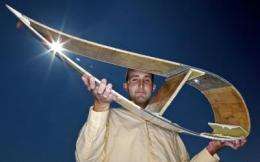
Purdue doctoral student Jonathan White holds a cross section of a wind turbine blade like the one used in research to improve the efficiency of turbines and prevent damage to blades from high winds. The researchers, from Purdue and Sandia National Laboratories, have developed a technique that uses sensors and computational software to constantly monitor forces exerted on wind turbine blades. Such sensors could be instrumental in future turbine blades that have control surfaces and flaps like those on an airplane's wings to change the aerodynamic characteristics of the blades for better control. Credit: Purdue University photo/Andrew Hancock

Researchers have developed a technique that uses sensors and computational software to constantly monitor forces exerted on wind turbine blades, a step toward improving efficiency by adjusting for rapidly changing wind conditions.

The research by engineers at Purdue University and Sandia National Laboratories is part of an effort to develop a smarter wind turbine structure

"The ultimate goal is to feed information from sensors into an active control system that precisely adjusts components to optimize efficiency," said Purdue doctoral student Jonathan White, who is leading the research with Douglas Adams, a professor of mechanical engineering and director of Purdue's Center for Systems Integrity.

The system also could help improve wind turbine reliability by providing critical real-time information to the control system to prevent catastrophic wind turbine damage from high winds.

"Wind energy is playing an increasing role in providing electrical power," Adams said. "The United States is now the largest harvester of wind energy in the world. The question is, what can be done to to make them more efficient, more cost effective and more reliable?"

The engineers embedded sensors called uniaxial and triaxial accelerometers inside a wind turbine blade as the blade was being built. The blade is now being tested on a research wind turbine at the U.S. Department of Agriculture's Agriculture Research Service laboratory in Bushland, Texas. Personnel from Sandia and the USDA operate the research wind turbines at the Texas site.

Such sensors could be instrumental in future turbine blades that have "control surfaces" and simple flaps like those on an airplane's wings to change the aerodynamic characteristics of the blades for better control. Because these flaps would be changed in real time to respond to changing winds, constant would be critical.

"This is a perfect example of a partnership between a national lab and an academic institution to develop innovations by leveraging the expertise of both," said Jose R. Zayas, manager of Sandia's Wind Energy Technology Department.

Research findings show that using a trio of sensors and "estimator model" software developed by White accurately reveals how much force is being exerted on the blades. Purdue and Sandia have applied for a provisional patent on the technique.

Findings are detailed in a paper being presented Monday (May 4) during the Windpower 2009 Conference & Exhibition in Chicago. The paper was written by White, Adams and Sandia engineer Mark A. Rumsey and Zayas. The four-day conference, organized by the American Association, attracts thousands of attendees and is geared toward industry.

"Industry is most interested in identifying loads, or forces, exerted on turbine blades and predicting fatigue, and this work is a step toward accomplishing that," White said.

A wind turbine's major components include rotor blades, a gearbox and generator. The wind turbine blades are made primarily of fiberglass and balsa wood and occasionally are strengthened with carbon fiber.

"The aim is to operate the generator and the turbine in the most efficient way, but this is difficult because wind speeds fluctuate," Adams said. "You want to be able to control the generator or the pitch of the blades to optimize energy capture by reducing forces on the components in the wind turbine during excessively high winds and increase the loads during low winds. In addition to improving efficiency, this should help improve reliability. The wind turbine towers can be 200 feet tall or more, so it is very expensive to service and repair damaged components."

Sensor data in a smart system might be used to better control the turbine speed by automatically adjusting the blade pitch while also commanding the generator to take corrective steps.

"We envision smart systems being a potentially huge step forward for turbines," said Sandia's Rumsey. "There is still a lot of work to be done, but we believe the payoff will be great. Our goal is to provide the electric utility industry with a reliable and efficient product. We are laying the groundwork for the wind turbine of the future."

Sensor data also will be used to design more resilient blades.

The sensors are capable of measuring acceleration occurring in various directions, which is necessary to accurately characterize the blade's bending and twisting and small vibrations near the tip that eventually cause fatigue and possible failure.

The sensors also measure two types of acceleration. One type, the dynamic acceleration, results from gusting winds, while the other, called static acceleration, results from gravity and the steady background winds. It is essential to accurately measure both forms of acceleration to estimate forces exerted on the blades. The sensor data reveal precisely how much a blade bends and twists from winds.

The research is ongoing, and the engineers are now pursuing the application of their system to advanced, next-generation turbine blades that are more curved than conventional blades. This more complex shape makes it more challenging to apply the technique.

In 2008 the United States added 8,358 megawatts of new wind-power capacity, which equates to thousands of new turbines since the average wind turbine generates 1.5 megawatts. The new capacity increased the total U.S. installed wind power to 25,170 megawatts, surpassing Germany's capacity as the world's largest harvester of wind power.

"Our aim is to do two things - improve reliability and prevent failure - and the most direct way to enable those two capabilities is by monitoring forces exerted on the blades by winds," Adams said.

Source: Purdue University (news : web)


print this article email this article download pdf blog this article bookmark this article     Stumble it Digg this share on Facebook retweet share on Reddit add to delicious
Rate this story - 3.9 /5 (12 votes)

Rank Filter

Move the slider to adjust rank threshold, so that you can hide some of the comments.


Display comments: newest first

  • tpb - May 01, 2009
    • Rank: not rated yet
    Does anyone know what the actual total generated power from these windmills is, say over a six month or one year period of time.

    Please include any windmills that are not running, for whatever reason.

    It would be enlightening to compare this to the rated power as quoted in the article.

    Quote,
    The new capacity increased the total U.S. installed wind power to 25,170 megawatts.
  • sender - May 01, 2009
    • Rank: not rated yet
    Variable pitch and forward swept wing concepts for defense contracts via the use of polymorphic electrostatic plastics should move this tech forward.
  • Soylent - May 02, 2009
    • Rank: 1 / 5 (1)
    Does anyone know what the actual total generated power from these windmills is, say over a six month or one year period of time.


    The capacity factor is typically 15-40%. The variability is monstrous because power output is to a first approximation proportional to the cube of wind speed.

    There's an efficiency curve that's generally optimized for generating government subsidies(as many kWh as possible, not as little variability as possible).

    Siting is likewise geared towards goverment subsidies. Windmills are not sited where seasonal variability tends to match up with patterns of demand, they're sited where as many kWh as possible can be generated with no regard for whether the power output is wasted or not.

    When you count all the power lost in keeping fossil fuel plants on stand by in spinning reserve and all the gas burnt in inefficient single cycle gas turbines to be able to integrate wind into the grid it's arguable whether wind provides any CO2 savings at all.

    Realistic studies on wind and actual data is hard to come by, and that's just the way wind advocates want it.
  • arcticireland - May 02, 2009
    • Rank: not rated yet
    Official figures from the UK show that during a long cold spell early 2008 wind was only producing a measly 1% of the installed capacity.
    "Similarly, one would not expect a man whose institute is claimed to be "a world-leader in low carbon technologies" to claim, as he does in his book, that by next year wind energy "is set to account for 8 per cent of electricity generation in the UK", when the current figure is scarcely 1 per cent; or that "wind accounted for 35 per cent of total installed power capacity in the US in 2007", when two minutes on the internet could have shown him that wind power that year generated less electricity in the US than a single large coal-fired power station." Christopher Booker [Daily Telegraph ]observing on the latest nonsense from Lord Stern.
  • Thadieus - May 03, 2009
    • Rank: not rated yet
    another interesting design, I believe this design is approaching 50% efficiency http://www.windta...ndex.asp
  • arcticireland - May 03, 2009
    • Rank: 2 / 5 (1)
    another interesting design, I believe this design is approaching 50% efficiency http://www.windta...ndex.asp


    Perhaps we will soon see a turbine with 100% efficiency? Always assuming that wind will oblige by blowing 24/7 and not leave us frequently in the dark, especially while perched on the potty or in some other potentially embarrassing situation :)
  • Soylent - May 04, 2009
    • Rank: 5 / 5 (1)
    Perhaps we will soon see a turbine with 100% efficiency?


    Thermodynamically impossible, see betz' law. Wind turbines are about as efficient as they can be.
  • Lord_jag - May 04, 2009
    • Rank: 5 / 5 (1)
    If the power is coming to you freely (after the inital investment) who cares if it is wasted?

    If you use 100 GW and you have a network that can make 150 to 3000 GW, then does it really matter if the wind slows?

    When there is surplus power, let the consumers know and we'll all find ways to use it whether it be fast-charging our car or suplementing the heat/AC to our house.

    We can live energy effincent for the most part, but not one of us will have troubles finding a way to burn excess electricity! We're good at consuming - its what we do!
  • arcticireland - May 04, 2009
    • Rank: not rated yet
    If the power is coming to you freely (after the inital investment) who cares if it is wasted?

    "If " being the operative word here.

    "If you use 100 GW and you have a network that can make 150 to 3000 GW, then does it really matter if the wind slows?"
    I may be having senior moment but perhaps you could clarify this comment please?
  • arcticireland - May 06, 2009
    • Rank: not rated yet
    Perhaps we will soon see a turbine with 100% efficiency?


    Thermodynamically impossible, see betz' law. Wind turbines are about as efficient as they can be.


    I was being sarcastic :)

May 1, 2009 all stories

Comments: 10

3.9 /5 (12 votes)
  • Stumble this up

  • Digg this

  • share this

  • hide
  • Related Stories

  • Quiet wind turbine could provide up to 30% of a home's power
    created Oct 31, 2008 | popularity not rated yet | comments 0
  • Device determines how well wind turbines operate
    created Jul 26, 2006 | popularity not rated yet | comments 0
  • 'Anti-noise' silences wind turbines
    created Aug 11, 2008 | popularity not rated yet | comments 0
  • Scalable wind turbine might fit on your roof
    created May 26, 2008 | popularity not rated yet | comments 0
  • Why wind turbines can mean death for bats
    created Aug 25, 2008 | popularity not rated yet | comments 0


  • hide
  • Relevant PhysicsForums posts

Other News

A system of space solar power system (SSPS)

Japan eyes solar station in space as new energy source

Technology / Energy

created 22 hours ago | popularity 4.7 / 5 (13) | comments 20

It may sound like a sci-fi vision, but Japan's space agency is dead serious: by 2030 it wants to collect solar power in space and zap it down to Earth, using laser beams or microwaves.


Framed for child porn -- by a PC virus

Framed for child porn -- by a PC virus

Technology / Internet

created 14 hours ago | popularity 5 / 5 (5) | comments 2

(AP) -- Of all the sinister things that Internet viruses do, this might be the worst: They can make you an unsuspecting collector of child pornography.


Software cos. eye key patent case in Supreme Court (AP)

Software cos. eye key patent case in Supreme Court

Technology / Business

created 23 hours ago | popularity 5 / 5 (4) | comments 2

(AP) -- With the technology industry looking on, the Supreme Court on Monday will explore what types of inventions should be eligible for a patent in a pivotal case that could undermine such legal protections ...


Campaigners are stepping up efforts to curb online tracking

Advertisers face resistance to on-line tracking

Technology / Internet

created 22 hours ago | popularity 5 / 5 (4) | comments 0

Campaigners are stepping up efforts to curb online tracking of Internet use by firms that deliver adverts tailored to the specific interests of consumers, as polls reveal widespread unease with the practice.


Sony offers 'Cloudy' early to people with its TVs

Technology / Business

created 15 hours ago | popularity not rated yet | comments 0

(AP) -- In a bid to sell living room electronics and spur buzz for "Cloudy with A Chance of Meatballs," Sony Corp. is offering the movie for free to U.S. buyers of its Internet-connected TVs and Blu-ray players starting ...