Invisibility Cloak Blurs Line Between Magic and Science (w/Video)
May 1, 2009
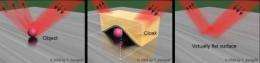
These three images depict how light striking an object covered with the carpet cloak acts as if there were no object being concealed on the flat surface. In essence, the object has become invisible. Credit: Image by Thomas Zentgraf
(PhysOrg.com) -- The great science fiction writer Arthur C. Clarke famously noted the similarities between advanced technology and magic. This summer on the big screen, the young wizard Harry Potter will once again don his magic invisibility cloak and disappear. Meanwhile, researchers with Berkeley Lab and the University of California Berkeley will be studying an invisibility cloak of their own that also hides objects from view.
A team led by Xiang Zhang, a principal investigator with Berkeley Lab's Materials Sciences Division and director of UC Berkeley's Nano-scale Science and Engineering Center, has created a "carpet cloak" from nanostructured silicon that conceals the presence of objects placed under it from optical detection. While the carpet itself can still be seen, the bulge of the object underneath it disappears from view. Shining a beam of light on the bulge shows a reflection identical to that of a beam reflected from a flat surface, meaning the object itself has essentially been rendered invisible.
"We have come up with a new solution to the problem of invisibility based on the use of dielectric (nonconducting) materials," says Zhang. "Our optical cloak not only suggests that true invisibility materials are within reach, it also represents a major step towards transformation optics, opening the door to manipulating light at will for the creation of powerful new microscopes and faster computers."
FLV player
This video shows how a beam of light is obstructed by an object in a flat surface and casts a shadow until the object is cloaked, at which point the light is reflected as if the surface were still perfectly flat. Credit: Video by Jensen Li
Zhang and his team have published a paper on this research in the journal Nature Materials entitled: An Optical Cloak Made of Dielectrics. Co-authoring the paper with Zhang were Jason Valentine, Jensen Li, Thomas Zentgraf and Guy Bartal, all members of Zhang's research group.Previous work by Zhang and his group with invisibility devices involved complex metamaterials - composites of metals and dielectrics whose extraordinary optical properties arise from their unique structure rather than their composition. They constructed one material out of an elaborate fishnet of alternating layers of silver and magnesium fluoride, and another out of silver nanowires grown inside porous aluminum oxide. With these metallic metamaterials, Zhang and his group demonstrated that light can be bent backwards, a property unprecedented in nature.
While metallic metamaterials have been successfully used to achieve invisibility cloaking at microwave frequencies, until now cloaking at optical frequencies, a key step towards achieving actual invisibility, has not been successful because the metal elements absorb too much light.
Says Zhang, "Even with the advances that have been made in optical metamaterials, scaling sub-wavelength metallic elements and placing them in an arbitrarily designed spatial manner remains a challenge at optical frequencies."
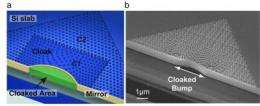
Image (a) is a schematic diagram showing the cloaked region (marked with green) which resides below the reflecting bump (carpet) and can conceal any arbitrary object by transforming the shape of the bump back into a virtually flat object. Image (b) was taken with a scanning electron microscope image of the carpet coated bump. Credit: Image by Thomas Zentgraf
The new cloak created by Zhang and his team is made exclusively from dielectric materials, which are often transparent at optical frequencies. The cloak was demonstrated in a rectangular slab of silicon (250 nanometers thick) that serves as an optical waveguide in which light is confined in the vertical dimension but free to propagate in the other two dimensions. A carefully designed pattern of holes - each 110 nanometers in diameter - perforates the silicon, transforming the slab into a metamaterial that forces light to bend like water flowing around a rock. In the experiments reported in Nature Materials, the cloak was used to cover an area that measured about 3.8 microns by 400 nanometers. It demonstrated invisibility at variable angles of light incident.Right now the cloak operates for light between 1,400 and 1,800 nanometers in wavelength, which is the near-infrared portion of the electromagnetic spectrum, just slightly longer than light that can be seen with the human eye. However, because of its all dielectric composition and design, Zhang says the cloak is relatively easy to fabricate and should be upwardly scalable. He is also optimistic that with more precise fabrication this all dielectric approach to cloaking should yield a material that operates for visible light - in other words, true invisibility to the naked eye.
"In this experiment, we have demonstrated a proof of concept for optical cloaking that works well in two dimensions" says Zhang. "Our next goal is to realize a cloak for all three dimensions, extending the transformation optics into potential applications."
More information: A copy of the Nature Materials paper “An Optical Cloak Made of Dielectrics” by Zhang, et al., can be read here: http://www.nature.com/nmat/journal/vaop/ncurrent/full/nmat2461.html
Source: Lawrence Berkeley National Laboratory (news : web)


"While the carpet itself can still be seen, the bulge of the object underneath it disappears from view"
Well son of a bitch, I'm just gonna cover myself with a blanket in my living room and call myself "cloaked". LMAO!!!
Oh and then I'll put a piece of drywall on top of me so I look like I'm reflecting light from a flat surface....again LMAO
Seriously though, I only bothered to read about half of this article. The fact is, if you can see the "carpet" over the object with your bare eyes, sorry guys, you have failed to make a cloak.
The freakin copper coils that can actually disappear in certain spectrums is MUCH more impressive then this junk....
All the enemy is going to do is switch from other detection methods to simply having people on the ground...sure, they may not be able to target you with a laser for blowing you out of existence, but they sure as shit can carpet bomb your carpet without much of a problem now cant they...
When the enemy commanders instruct their soldiers to target any big carpet-looking blobs, they won't know WHICH big carpet-looking blob is the one hiding our secret weapon.
So, even if they get bored of shooting at ALL of the big carpet blobs, and they decide to shine a light beam of very specific frequencies through the blobs, hoping to catch us in the act, they will fail, because our secret weapong will be cloaked! Huaw Haw Haw HAW!!!!
Seriously though, they have shown that this can be done with different materials than had been looked at before, AND they created a physical working model (I think the only other real world model was designed to work with microwaves.) So I am impressed, despite their funny 'carpet cloak' description.
Spoken by an infantry soldier here who was stuck wearing the damned sniper target american flag on his arm.
I agree that these things are not representative of the classic fantasy of a cloaking device, but here is a repost of a comment I made a while back when someone said that cloaks would only be used for sinister purposes:
Not only it is a bit too early for such headlines, but it also attracts a lot of douchebags that read this, who then get disappointed that their weapon of choice has not yet been fully implemented which ultimately leads to douchebag comments such as most of the above.
First and foremost, the guys at UCB do not owe you guys anything, zip zero nada.
Second, yes this is a good article, and a step closer not only for invisibility shields but for overall understanding of light manipulation. You know, 'understanding' is alone worth researching for. The applications will come later, and baby-boomers will eventually buy the gadgets they have always been craving, use it for all the wrong reasons, and manage to make humanity suck just a little more.
I think our attempts at humor here are exactly because of the rash of articles on cloaking. We are interested in the subject, but there just isn't much to say that we haven't already said as comments on other articles.
Since this seems to be your first comment on Physorg, maybe you have something more to add on this subject.
You say that baby-boomers will buy the gadgets and use them for all of the wrong reasons. What, in your opinion, would be the right reasons? What would be the best use of this technology?
http://newsimg.bb...r466.jpg
But the fact remains that this study got closer to a cloaking device in the visible spectrum whereas all the previous cloaking attempts were in the microwave regime.
Not to be confused with negative index materials (NIM), as these have already been implemented in the visible regime as 3D metamaterials. Cloaking is without a doubt the hardest of the metamaterial applications (antennas, sub-wavelength imaging..) and surely is not going to lead to an invisible dynamic relatively-big object/vehicle/dude in less than a decade. Whereas cloaking on a smaller scale and non-dynamic medium could have closer applications.
The other problem remains with the title of this article. Such inaccurate headlines account for most of the rumors, paranoia, unnecessary anticipation and disappointment around this subject ! Get a grip on it, physorg.
I do not have any college degrees, but I have an interest in science and technology. For me, this website provides a snapshot of current research, and gives me a chance to exchange ideas with other like-minded people, even if my own ideas are sometimes a bit lame or misinformed.
You sound like you have given this some thought. What types of small scale applications do you see coming out of this type of research?
The oversimplified explanations of concepts is not wrong in my opinion, as long as it does not jump to conclusions beyond what is found in the literature. Which might lead to over-hearing people who are already paranoid about invisible dudes and all kind of wacky nano-conspiracy theories (true story).
cheers.
Sub-wavelength, you say? I don't see how that is possible...I better do some reading.
SPOILARS!!!11
C'mon...we're all thinking it...
BURN THE WITCH! BURN THE WITCH! BURRRRNNNN......
Plus that SKoda that was mentioned by Slotin is partially hidden because our brains are wired to willfully ignore that which we find ugly or unimportant, not from any technical coolness acting upon it.
PLUS,Plus it was a really neat art project by the gal in the picture. Gives me an idea on how to hide my crappy LeBaron so the neighbors quit griping.