How thermal-imaging cameras can spot flu fevers
May 1, 2009 By BARBARA ORTUTAY , AP Technology Writer How thermal-imaging cameras can spot flu fevers (AP)

Enlarge

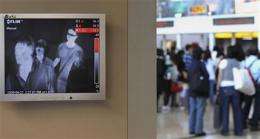
FILE - In this April 27, 2009 file photo, in hopes of spotting feverish travelers, thermal images are seen on a monitor showing recent arrivals to the Taoyuan International Airport, in Taoyuan, Taiwan. Because of swine flu fears, airports around the world are installing thermal imaging cameras to take travelers' temperatures without having to stick thermometers in their mouths. (AP Photo, File)

(AP) -- To screen passengers for swine flu and other contagious diseases, some airports use thermal imaging cameras to see whether travelers have fevers, without having to stick thermometers in their mouths. So how do the cameras work?

The devices are just like regular cameras, except that instead of recording light that objects reflect, these cameras are sensitive to heat. They can even work in the dark.

Recordings from these cameras show up on video screens with hotter objects looking brighter. The systems are very sensitive, measuring temperatures down to a fraction of a degree Fahrenheit, said Andrew Sarangan, an associate professor in the University of Dayton's electro-optics program.

Thermal cameras were rolled out during the SARS outbreak in 2002 and 2003, and airports in Singapore and China have been using them continuously since, said Alan Thomson, regional sales director at U.K.-based Irisys, a maker of thermal imaging devices.

Now manufacturers say they've noticed an uptick in orders in recent days. "The phone hasn't stopped ringing," Thomson said.

In Mexico, which already has 10 such cameras, the transportation secretary, Juan Molinar, said Thursday that 40 more were being bought for the country's eight largest airports.

Of course, while the cameras can detect higher temperatures, they can't screen for swine flu itself. Someone running to catch a flight can have a higher body temperature, as can someone who's just had a drink. A fever also does not necessarily mean someone is sick with , so airports need to do further screening once they spot passengers with high temperatures.

Irisys' cameras, which cost about $3,000, merge visual and thermal images to create a "heat picture" of a person. This image shows up on a screen on the back of the , much like the displays on consumer cameras. A pointer automatically shows the hottest area in the picture, which is usually a person's face, mainly because it's not covered in clothes.

Tony Trunzo, senior vice president at Wilsonville, Ore.-based Flir Systems Inc., said his company has seen orders pick up not only from airports, but factory operators as well.

Flir's cameras have improved significantly since the SARS outbreak, Trunzo said. The cameras have a higher resolution, for example. They've gotten cheaper, too, though the company's cameras still range between $10,000 and $15,000.

Flir also has determined that it's best to screen one person at a time, instead of scanning a large crowd.

---

Associated Press Writer Morgan Lee in Mexico City contributed to this report.
©2009 The Associated Press. All rights reserved. This material may not be published, broadcast, rewritten or redistributed.


print this article email this article download pdf blog this article bookmark this article     Stumble it Digg this share on Facebook retweet share on Reddit add to delicious
Rate this story - 3 /5 (2 votes)

Rank Filter

Move the slider to adjust rank threshold, so that you can hide some of the comments.


Display comments: newest first

  • ArtyNouveau - May 01, 2009
    • Rank: not rated yet
    This will measure will not identify the recently infected, but still asymptomatic traveler. Still, better than nothing.
  • Fazer - May 01, 2009
    • Rank: not rated yet
    Wow, they just used an IR imager on the sci-fi show Fringe this week to find an infected person in a crowd who had some rediculously high body temperature.

    So they just grab anyone with an apparent temperature? Sounds like an impossible task.
  • Bob_Kob - May 01, 2009
    • Rank: not rated yet
    What if you were just jogging around for 10 minutes and were wearing a jumper?
  • E_L_Earnhardt - May 03, 2009
    • Rank: not rated yet
    An insys' camera could spot and track a tumor without the x-ray radiation that further activates cancer! Do physicians care more about patient health or expediancy and income? It's the HEAT that accelerates mitosis! (electron speed & spin)

May 1, 2009 all stories

Comments: 4

3 /5 (2 votes)
  • Stumble this up

  • Digg this

  • share this

  • hide
  • Related Stories

  • Survey: cell cameras boost digital photos
    created Aug 30, 2005 | popularity not rated yet | comments 0
  • New light source may up inspection quality
    created Mar 19, 2007 | popularity not rated yet | comments 0
  • Asia on alert after flu threat spreads
    created Apr 26, 2009 | popularity not rated yet | comments 0
  • Sony Cameras Wait for Baby to Smile
    created Jan 25, 2008 | popularity not rated yet | comments 0
  • Mexico City closes museums to stop flu outbreak
    created Apr 24, 2009 | popularity not rated yet | comments 0


  • hide
  • Relevant PhysicsForums posts

  • Nonlinear State-Space
    created 16 hours ago
  • Ultrasound heating of metals
    created 21 hours ago
  • Friction coefficient
    created 23 hours ago
  • Laser plasma emission
    created Nov 26, 2009
  • More from Physics Forums - General Engineering

Other News

For stars, high-tech gaffes hard to hide (AP)

For stars, high-tech gaffes hard to hide

Technology / Internet

created 16 hours ago | popularity not rated yet | comments 0

(AP) -- So, you fail to take a deep breath and to count to 10 - and you post something you probably shouldn't on Twitter or Facebook, or somewhere else online.


Text-a-Tip programs allow tipsters to help police (AP)

Text-a-Tip programs allow tipsters to help police

Technology / Other

created 17 hours ago | popularity 1 / 5 (1) | comments 0

(AP) -- A mother in Boston tells police her 8-year-old boy was shot to death in their apartment by gunmen in hooded sweat shirts during a home invasion.


Intel logo A

Intel wants a chip implant in your brain

Technology / Hi Tech

created Nov 23, 2009 | popularity 4.4 / 5 (30) | comments 45

(PhysOrg.com) -- Computer chip maker Intel wants to implant a brain-sensing chip directly into the brains of its customers to allow them to operate computers and other devices without moving a muscle.


Should I buy a PC or Mac?

Technology / Software

created Nov 25, 2009 | popularity 2.9 / 5 (15) | comments 23

Q. Our 6-year-old PC computer is dying a slow death and we are considering moving to a new iMac but have a few concerns. First, of all, we have several Word documents on our disk drive now that we want to keep and add to ...


Taking the drudgery out of software development

Taking the drudgery out of software development

Technology / Software

created Nov 24, 2009 | popularity 3.7 / 5 (15) | comments 15

(PhysOrg.com) -- Software developers will no longer have to reinvent the wheel when writing new programs and applications thanks to a clever new set of tools and a central repository of 'building blocks'.