Super-Sensors to Measure 'Signature' of Inflationary Universe (w/Video)
May 3, 2009 Super-Sensors to Measure 'Signature' of Inflationary Universe

Enlarge

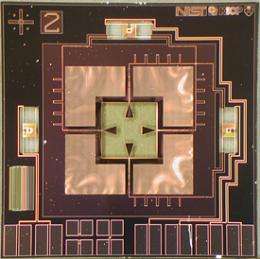
Micrograph of a prototype NIST detector that will be used to seek B-mode polarization, the signature of the rapid inflation of the universe after the Big Bang. Cosmic radiation will be received by the arrow-shaped antennas in the middle of the detector. The antennas separate the radiation into two different polarization directions at a frequency of 145 gigahertz. (All light has two polarization directions.) Finally, the radiation for each polarization will be converted to heat by transition-edge sensors (top and right sides of the image), which precisely measure the energy using a superconducting metal that changes resistance in response to heat. The resulting data will be mapped to identify the polarization patterns. Credit: NIST

What happened in the first trillionth of a trillionth of a trillionth of a second after the Big Bang? Super-sensitive microwave detectors, built at the National Institute of Standards and Technology, may soon help scientists find out.

The new sensors, described today at the American Physical Society (APS) meeting in Denver*, were made for a potentially ground-breaking experiment by a collaboration involving NIST, Princeton University, the University of Colorado at Boulder, and the University of Chicago.

FLV player

What happened in the first trillionth of a trillionth of a trillionth of a second after the Big Bang? Super-sensitive microwave detectors may soon help scientists find out.

Although NIST is best known for earthbound measurements, a long-standing project at NIST's Boulder campus plays a critical role in the study of the cosmic microwave background (CMB)--the faint afterglow of the that still fills the universe. This project previously built superconducting amplifiers and cameras for CMB experiments at the , in balloon-borne observatories, and on the Atacama Plateau in Chile.

The new experiment will begin approximately a year from now on the Chilean desert and will consist of placing a large array of powerful NIST sensors on a telescope mounted in a converted shipping container.

The detectors will look for subtle fingerprints in the CMB from primordial gravitational waves—ripples in the fabric of space-time from the violent birth of the universe more than 13 billion years ago. Such waves are believed to have left a faint but unique imprint on the direction of the CMB's electric field, called the "B-mode polarization." These waves—never before confirmed through measurements—are potentially detectable today, if sensitive enough equipment is used.

"This is one of the great measurement challenges facing the scientific community over the next 20 years, and one of the most exciting ones as well," said Kent Irwin, the NIST physicist leading the project.

If found, these waves would be the clearest evidence yet in support of the "inflation theory," which suggests that all of the currently observable universe expanded rapidly from a subatomic volume, leaving in its wake the telltale cosmic background of gravitational waves.

"The B-mode polarization is the most significant piece of evidence related to inflation that has yet to be observed," said Ki Won Yoon, a NIST postdoctoral scholar who will describe the project at the APS meeting. "A detection of primordial gravitational waves through CMB polarization would go a long way toward putting the inflation theory on firm ground."

The data also could provide scientists with insights into different string theory models of the universe and other "unified" theories of physics.

These types of experiments can only be done by studying the universe as a whole, because the particles and electromagnetic fields at the beginning of the inflationary epoch were roughly 10 billion times hotter than the energies attainable by the most powerful particle colliders on Earth today. At this energy scale, fundamental forces now identified as separate are predicted to merge.

"The universe is a physics lab," Irwin said. "If you look far away, you are actually looking back in time, potentially observing interactions that occurred at energy levels forever out of reach of terrestrial experiments."

Recent studies of the CMB have focused on measuring slight spatial variations in temperature or power that existed about 380,000 years after the Big Bang. These patterns of radiation allow scientists to characterize the early distributions of matter and energy that evolved into the stars and galaxies of today.

By comparing the measurements to predictions made by various theories, scientists have added to the authoritative history of the universe, narrowing down, for instance, its age (13.7 billion years).

By contrast, the new NIST detectors are designed to measure not only temperature but also the polarization. The B-mode polarization signals may be more than a million times fainter than the temperature signals.

To detect such subtle patterns, the NIST detectors will collect significant amounts of radiation efficiently, and will be free of moving parts and traditional sources of systematic error, such as vibration and magnetic interference, Irwin said. In addition, advanced signal processing and error control will be needed.

The new sensors are prototypes for NIST polarimeter arrays that will greatly increase the sensitivity of future experiments by building thousands of detectors into monolithic units that can be deployed in cryogenic telescope cameras. The new NIST detectors may also have applications closer to home, such as in reducing glare in advanced terahertz imaging systems for detecting weapons and contraband.

*Atacama B-mode Search (ABS): Scientific Motivations and Design Overview, Sheraton Denver Hotel, Plaza Court 2, Saturday, May 2, 2009, 1:30 - 1:42 p.m.

Source: National Institute of Standards and Technology (news : web)


print this article email this article download pdf blog this article bookmark this article     Stumble it Digg this share on Facebook retweet share on Reddit add to delicious
Rate this story - 4.6 /5 (26 votes)

Rank Filter

Move the slider to adjust rank threshold, so that you can hide some of the comments.


Display comments: newest first

  • deatopmg - May 03, 2009
    • Rank: not rated yet
    and if the polarization is not detected, what then?
  • frajo - May 03, 2009
    • Rank: 1 / 5 (1)
    and if the polarization is not detected, what then?

    B-mode polarization is predicted by the inflationary model but not by the (string theory based) cyclic model (aka ekpyrotic model) of the universe. If it turns out that there's no B-mode but only E-mode polarization in the CMB then "it would push inflationary proponents into a corner where they would have to introduce further special fine-tunings".
    Upto now the WMAP analysis results show that the gravitational wave contribution to hot and cold spots of the CMB is less than 28%.
  • frajo - May 03, 2009
    • Rank: 1 / 5 (1)
    I'm fascinated - what's the intellectual constitution of that guy who rated this article about the most fascinating question of contemporary physics with one point only?
  • dogma - May 03, 2009
    • Rank: not rated yet
    His intellectual constitution is equal to his rating, squared.
  • rwinners - May 04, 2009
    • Rank: not rated yet
    Come on! Talk about speculative. We really don't know if there was a beginning or not, nor whether the 'beginning' we postulate was just an event in a never ending universe.
    In short, who cares?
  • deatopmg - May 04, 2009
    • Rank: not rated yet
    Come on! Talk about speculative. We really don't know if there was a beginning or not, nor whether the 'beginning' we postulate was just an event in a never ending universe.

    In short, who cares?


    Mathematical physicists build their careers on speculation and ever more complicated models such as the big bang and the myriad of string/brane theories. K.I.S.S. Nature likes simplicity, i.e. a static universe.
  • frajo - May 04, 2009
    • Rank: 1 / 5 (1)
    K.I.S.S. Nature likes simplicity, i.e. a static universe.


    As simple as thunder and lightning, the powers of nature? As simple as life and the human brain?
  • Alizee - May 04, 2009
    • Rank: 1 / 5 (1)
    ..B-mode polarization is the most significant piece of evidence related to inflation that has yet to be observed..
    A 10E-7 signal? It's not too much after nearly thirty years of inflationary theory existence. Everybody of us has learned about inflation as about solid fact...

May 3, 2009 all stories

Comments: 8

4.6 /5 (26 votes)
  • Stumble this up

  • Digg this

  • share this

  • hide
  • Related Stories

  • New Satellite Data On Universe's First Trillionth Second
    created Mar 16, 2006 | popularity not rated yet | comments 0
  • Cosmologists aim to observe first moments of universe
    created Feb 16, 2009 | popularity not rated yet | comments 0
  • Researchers interpret asymmetry in early universe
    created Dec 16, 2008 | popularity not rated yet | comments 0
  • Penn astrophysicist outlines a multi-pronged approach in the hunt for dark energy
    created Feb 18, 2005 | popularity not rated yet | comments 0
  • ESA's Planck satellite builds on Nobel-prize-winning science
    created Oct 04, 2006 | popularity not rated yet | comments 0


  • hide
  • Relevant PhysicsForums posts

  • Some Explanation with Rigid Rotator
    created 1hour ago
  • How to Make a Ferrofluid?
    created 4 hours ago
  • avoidance of admitting that we dont know somethin
    created 10 hours ago
  • Speed of light : missing energy
    created 13 hours ago
  • Can light produce darkness and can noise procude quiteness 4
    created 16 hours ago
  • Magnetic Oscillation Equations
    created 22 hours ago
  • More from Physics Forums - General Physics

Other News

Restored machine to explore mysteries of Big Bang (AP)

Restored machine to explore mysteries of Big Bang

Physics / General Physics

created 14 hours ago | popularity 4.4 / 5 (12) | comments 9

(AP) -- Scientists are preparing the world's largest atom smasher to explore the depths of matter after successfully restarting the $10 billion machine following more than a year of repairs.


nuclear power plant

Doubts raised on nuclear industry viability

Physics / General Physics

created Nov 19, 2009 | popularity 3.1 / 5 (20) | comments 19

(PhysOrg.com) -- The investment in nuclear power has been growing around the world over the last few years, being viewed as a means for countries to control their energy security, avoid the price fluctuations ...


Researchers Find Innate Correlations Among Different Power Law Phenomena

Researchers Find Innate Correlations Among Different Power Law Phenomena

Physics / General Physics

created Nov 17, 2009 | popularity 4.3 / 5 (15) | comments 13

(PhysOrg.com) -- Studying the patterns that emerge in natural and social phenomena is a popular area of research, although usually individual phenomena are studied separately from each other. In a recent study, ...


Scientists demonstrate 'universal' programmable quantum processor

Scientists demonstrate 'universal' programmable quantum processor

Physics / Quantum Physics

created Nov 15, 2009 | popularity 4.6 / 5 (21) | comments 11

Physicists at the National Institute of Standards and Technology have demonstrated the first "universal" programmable quantum information processor able to run any program allowed by quantum mechanics -- th ...


Proton's party pals may alter its internal structure

Proton's party pals may alter its internal structure

Physics / General Physics

created Nov 18, 2009 | popularity 4.6 / 5 (20) | comments 9

A recent experiment at the DOE's Thomas Jefferson National Accelerator Facility has found that a proton's nearest neighbors in the nucleus of the atom may modify the proton's internal structure.