Nanotechnology holds promise for STD drug delivery
May 3, 2009 Nanotechnology holds promise for STD drug delivery

Enlarge

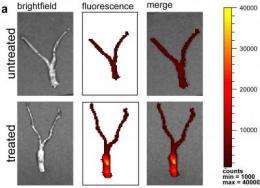
Distribution of nanoparticles seen by fluorescence throughout mouse reproductive tract. Credit: Woodrow/Yale

Yale researchers describe a breakthrough in safe and effective administration of potential antiviral drugs — small interfering RNA (siRNA) molecules that silence genes — the first step in development of a new kind of treatment for sexually transmitted diseases (STDs). The work is reported May 4 as an advance online publication of Nature Materials.

" is a promising approach for prevention and treatment of human disease," said lead author Kim Woodrow, Yale postdoctoral fellow in Yale's School of Engineering & Applied Science. "We wanted to develop a new strategy of delivering siRNAs with a FDA-approved material."

As their name suggests, siRNAs interfere and knock out the function of in higher organism as well as in microbes that may cause STDs. The researchers designed siRNAs to target a gene expressed widely in the lining of the female mouse reproductive tract, in this proof-of-principle work.

Using densely-loaded nanoparticles made of a biodegradable polymer known as PLGA, the researchers created a stable "time release" vehicle for delivery of siRNAs to sensitive mucosal tissue like that of the female reproductive system.

They found that the particles, loaded with the drug agent, moved effectively in two important ways, penetrating to reach cells below the surface of the mucosa and distributing throughout the vaginal, cervical, and uterine regions. Furthermore, the siRNAs stayed in the tissues for at least a week and knockdown of gene activity lasted up to 14 days.

While past work has focused on delivery of siRNAs with liposomes, bubble-like carriers made of phospholipids similar to those found in cell membranes, liposomes are potentially more toxic to the mucosal tissues and are unable to provide sustained release. In the current work, the researchers demonstrated that PLGA nanoparticles were safer than the best current lipid vehicles.

Gene interference therapy is moving rapidly from basic research to application. The PLGA packaging these researchers chose is already approved as safe and non-toxic by the FDA, speeding the path to clinical trials for infectious agents such as HPV and HIV.

"Before human clinical testing can begin, our next step in research will be to test this approach directly in disease models - for example in the HIV model mice that have an immune system genetically identical to humans," said senior author W. Mark Saltzman, the Goizueta Foundation Professor of Biomedical Engineering & Chemical Engineering.

This approach holds promise for global health and the ability of people to self-apply antimicrobial treatments. Woodrow said, "It is safe and effective and much easier than getting an injection of vaccine."

More information: , advance online publication May 4, 2009.

Source: Yale University (news : web)


print this article email this article download pdf blog this article bookmark this article     Stumble it Digg this share on Facebook retweet share on Reddit add to delicious
Rate this story - 5 /5 (1 vote)

Rank Filter

Move the slider to adjust rank threshold, so that you can hide some of the comments.


Display comments: newest first

  • stdsgirl - May 04, 2009
    • Rank: not rated yet
    April is STD awareness month, be careful. STD cases on the rise!
    A friend of mine who works for the largest STD dating == Positivefish. com == told me that the new subscribers have increased 30% over 2008. Rising STD rate sparks online dating sites.

May 3, 2009 all stories

Comments: 1

5 /5 (1 vote)
  • Stumble this up

  • Digg this

  • share this

  • hide
  • Related Stories

  • 'Silencing' HIV with small bits of RNA
    created Aug 07, 2008 | popularity not rated yet | comments 0
  • New treatments for viral and other diseases by blocking genes
    created May 27, 2008 | popularity not rated yet | comments 0
  • Targeted nanoparticles incorporating siRNA offer promise for cancer treatment
    created May 20, 2007 | popularity not rated yet | comments 0
  • Team develops safe, effective RNA interference technique
    created Apr 28, 2008 | popularity not rated yet | comments 0
  • Physician revolutionizes gene research
    created Mar 26, 2008 | popularity not rated yet | comments 0


  • hide
  • Relevant PhysicsForums posts

  • photoconductivity of polymers
    created 12 hours ago
  • Heat pipe for high temperature
    created Nov 24, 2009
  • Robot built out of acrylic
    created Nov 24, 2009
  • Thickness or Ga. of Stainless steel water tank?
    created Nov 24, 2009
  • More from Physics Forums - Materials & Chemical Engineering

Other News

Fast, easy, and highly sensitive arsenic detection with gold nanoparticles

Nanotechnology / Nanomaterials

created 19 hours ago | popularity 5 / 5 (1) | comments 0

(PhysOrg.com) -- Mention of arsenic poisoning usually brings to mind underhanded murder. However, the danger of arsenic poisoning from contaminated drinking water is far greater. Low concentrations of arsenic are found in ...


Water droplets direct self-assembly process in thin-film materials

Nanotechnology / Nanomaterials

created Nov 23, 2009 | popularity 5 / 5 (4) | comments 2

You can think of it as origami - very high-tech origami. Researchers at the University of Illinois have developed a technique for fabricating three-dimensional, single-crystalline silicon structures from thin films by coupling ...


Nanotube defects equal better energy and storage systems

Nanotube defects equal better energy and storage systems

Nanotechnology / Nanomaterials

created Nov 19, 2009 | popularity 4.4 / 5 (10) | comments 2

(PhysOrg.com) -- Most people would like to be able to charge their cell phones and other personal electronics quickly and not too often. A recent discovery made by UC San Diego engineers could lead to carbon ...


Nanotech in Space: Experiment To Weather the Trials of Orbit

Nanotech in Space: Experiment To Weather the Trials of Orbit

Nanotechnology / Nanomaterials

created Nov 24, 2009 | popularity 4 / 5 (2) | comments 0

Novel nanomaterials developed at Rensselaer were sent into orbit on Nov. 16 aboard Space Shuttle Atlantis.


Peptides control crystal growth with 'switches, throttles and brakes'

Peptides control crystal growth with 'switches, throttles and brakes'

Nanotechnology / Bio & Medicine

created Nov 23, 2009 | popularity 5 / 5 (3) | comments 0

(PhysOrg.com) -- By producing some of the highest resolution images of peptides attaching to mineral surfaces, scientists have a deeper understanding how biomolecules manipulate the growth crystals. This research ...