Austrian breakthrough in quantum cryptography: Record in the transmission of entangled photon pairs (Update)
May 3, 2009 Record in the transmission of entangled photon pairs

Enlarge

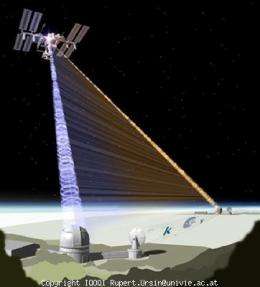
Distribution of Entanglement from the ISS. [Copyright ESA]

Austrian physicists say a breakthrough in next-generation quantum cryptography could allow encrypted messages to be bounced off satellites, the British journal Nature reported Sunday.

A team from Austria's Institute for Optics and Quantum Information (IQOQI) managed to send entangled 144 kilometres (90 miles) between the Spanish islands of Las Palmas and the Balearics.

Because of the success of the test, the IQOQI team said it was now feasible to send this kind of unbreakable encrypted communication through space using satellites.

Quantum cryptography works by sending streams of light particles, or photons, making it entirely secure, as any eavesdropping would leave traces and immediately be detected.

In quantum cryptography, photons are used as the key for the encrypted communication -- just as mathematical formula are used in conventional .

(c) 2009 AFP

Update: Please find IQOQI's press release below:

On 3 May 2009 an Austrian contribution will be published in the physical journal Nature Physics online edition, entitled "High-fidelity transmission of entanglement over a high-loss free-space channel", by Alessandro Fedrizzi, Rupert Ursin, Thomas Herbst, Matteo Nespoli, Robert Prevedel, Thomas Scheidl, Felix Tiefenbacher, Thomas Jennewein and Anton Zeilinger.

In a project funded by the European Space Agency ESA and the Austrian Space Agency FFG, Austrian physicists succeeded in transmitting a pair of entangled photons from La Palma over a distance of 144 km to Tenerife. This is an important milestone in the endeavour of ESA to distribute entangled photons from a satellite to ground stations.
Record in the transmission of entangled photon pairs
Enlarge

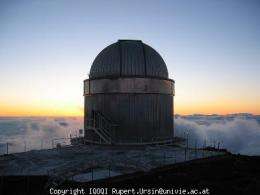
La Palma transmitter [Copyright IQOQI]

Based on the philosophical debate about entanglement in the 1930s, it took 40 years until the first experimental proof. Over the last decades the concepts of quantum mechanics have been developed to a point where entanglement as a practical technology can be deployed in quantum cryptography to ensure absolutely secure communications. Quantum mechanics originates from the 1930s to explain processes at the atomic level.

The application of entangled photons on satellites and their distribution will allow us to test quantum mechanics over a distance of many thousand of kilometres. Albert Einstein and his colleagues discovered the “spooky action at a distance,” whereas the term “entanglement” found its way into quantum language and quantum information through the Austrian scientist Erwin Schrödinger.

With the development of novel ideas which produce more then 2. Mio. pairs of entangled photons per second, it is now possible to think seriously about the use of satellites. In this experiment, created by a team around Anton Zeilinger and Rupert Ursin, both photons were sent on a 144 km long journey from La Palma to Tenerife, before being received by the ESA ground station. The photons were exposed to the conditions they would find on the way from the satellite to earth. With that the feasibility of transmission from satellite to an optical ground station has been proven.

Indeed quantum cryptography is possible over a modern glass fibre net, but because of the high rate of transmission loss, this is limited to around 100 km. To realise future quantum communication networks on a global scale, satellite based systems must be developed and photons transmitted over optical free space distant from the ground. Therefore we are working in parallel with partners in the industry on the development of this source until capability in space is realised. If these preparations work to the schedule planned by the ESA, we can reckon on a start in space in the next decade.

More information: http://www.nature.com/nphys/journal/vaop/ncurrent/abs/nphys1255.html

Provided by IQOQI


print this article email this article download pdf blog this article bookmark this article     Stumble it Digg this share on Facebook retweet share on Reddit add to delicious
Rate this story - 3.7 /5 (11 votes)

Rank Filter

Move the slider to adjust rank threshold, so that you can hide some of the comments.


Display comments: newest first

  • Fazer - May 03, 2009
    • Rank: not rated yet
    So much for the NSA.

    Now they will have to prove that there are hidden variables, if they can, and exploit them.

    Maybe Obama will move all of the national physics labs out of the DOE and into the DOD.
  • Ralph - May 04, 2009
    • Rank: not rated yet
    Fazer says NSA has to find and exploit hidden variables... very witty. Finally a real-world challenge. Earn power and money by making a stunning and historical breakthrough in physics. Join NSA now and enter an exciting secret life of... well, we can't tell you. And of course if your work is successful it will never be published.
  • sex_doctor - May 04, 2009
    • Rank: not rated yet
    I guess the high value encoded messages using quantum cryptography are something like this: " I want a raise " , " I discovered an endless source of energy" , " bring me a coffee", some latest porn , private messages between Angela Merkel and Berlusconni :), "How to hack your bank account in 5 minutes" ...
  • Sirussinder - May 04, 2009
    • Rank: not rated yet
    So much for de-scrambling satellite TV !! :(
  • Fazer - May 04, 2009
    • Rank: not rated yet
    Hmmm, the link is dead.

    I wonder, are they proposing bouncing entangled photons off of sattelites?

    Or are they suggesting that entangled photons from the ground would be intercepted by the sattelite, and then re-transmitted to the ground, using entirely different entangled photons?

    If the latter, then wouldn't the sattelite be a weak point in the setup? Anyone with access to the sattelite's operating system might be able to intercept the data before it is re-transmitted.
  • Fazer - May 04, 2009
    • Rank: not rated yet
    Oh, I think I get it. Thank goodness for the pretty pictures to help idiots like me understand.

    The sattelite is firing off a beam of photons to each of two locations. The photons in the two beams are entangled together, thus giving each ground station an entangled reference that they then use to...to......oh, I don't know, to make chocolate pudding.

    Anyone else have a better grasp on this?
  • Novaspes - May 06, 2009
    • Rank: not rated yet
    The idea is to place the entangled source on the satellite and use two ground stations as receivers. These ground stations will then share photons of an entangled pair and be able to build a cryptographic key using standard QKD protocols.

May 3, 2009 all stories

Comments: 7

3.7 /5 (11 votes)
  • Stumble this up

  • Digg this

  • share this

  • hide
  • Related Stories


Other News

A view of a superconducting solenoid magnet at the European Organization for Nuclear Research (CERN) near Geneva

CERN atom-smasher restarts after 14-month hiatus: official

Physics / General Physics

created 12 hours ago | popularity 4.4 / 5 (14) | comments 0

The world's biggest atom-smasher, shut down after its inauguration in September 2008 amid technical faults, restarted on Friday, a spokesman for the European Organisation for Nuclear Research said.


Tapering a Free-Electron Laser to Extract More Juice

Tapering a Free-Electron Laser to Extract More Juice

Physics / General Physics

created 12 hours ago | popularity not rated yet | comments 0

(PhysOrg.com) -- Researchers from the NSLS and Science Applications International Corporation (SAIC) have demonstrated a technique that could be used to significantly improve the quantity and quality of light ...


Ultra-Powerful Laser Reproduces How Star's Jets Travel through Interstellar Space

Ultra-Powerful Laser Reproduces How Star's Jets Travel through Interstellar Space

Physics / General Physics

created 13 hours ago | popularity 4.3 / 5 (6) | comments 0

(PhysOrg.com) -- A multi-trillion-watt laser at the University of Rochester has simulated a stellar jet -- an outpouring of matter from a fledgling star -- with unprecedented realism.


The LHC promises to unlock scientific mysteries about the creation of the Universe and the fundamental nature of matter

Giant atom-smasher set to restart this weekend: CERN

Physics / General Physics

created 20 hours ago | popularity 4 / 5 (4) | comments 7

The world's biggest atom-smasher, which was shut down soon after its inauguration amid technical faults, is set to restart this weekend, the European Organisation for Nuclear Research said on Friday.


UCSB physicists move one step closer to quantum computing

UCSB physicists move one step closer to quantum computing

Physics / Quantum Physics

created 16 hours ago | popularity 5 / 5 (6) | comments 0

Physicists at UC Santa Barbara have made an important advance in electrically controlling quantum states of electrons, a step that could help in the development of quantum computing. The work is published ...