Fermi telescope explores high-energy 'space invaders'
May 4, 2009 by Francis Reddy NASA's Fermi explores high-energy 'space invaders'

Enlarge

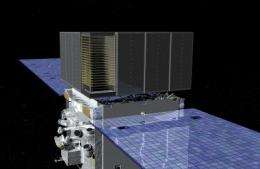
The Large Area Telescope (LAT) on Fermi detects gamma-rays by tracking the electrons positrons they produce after striking layers of tungsten. This ability also makes the LAT an excellent tool for exploring high-energy cosmic rays. Credit: NASA/Goddard Space Flight Center Conceptual Image Lab

(Physorg.com) -- Since its launch last June, NASA's Fermi Gamma-ray Space Telescope has discovered a new class of pulsars, probed gamma-ray bursts and watched flaring jets in galaxies billions of light-years away. Today at the American Physical Society meeting in Denver, Colo., Fermi scientists revealed new details about high-energy particles implicated in a nearby cosmic mystery.

"Fermi's Large Area Telescope is a state-of-the-art gamma-ray detector, but it's also a terrific tool for investigating the high-energy electrons in cosmic rays," said Alexander Moiseev, who presented the findings. Moiseev is an astrophysicist at NASA's Goddard Space Flight Center in Greenbelt, Md.

Cosmic rays are hyperfast electrons, positrons, and atomic nuclei moving at nearly the speed of light. Astronomers believe that the highest-energy cosmic rays arise from exotic places within our galaxy, such as the wreckage of exploded stars.

Fermi's Large Area (LAT) is exquisitely sensitive to electrons and their counterparts, positrons. Looking at the energies of 4.5 million high-energy particles that struck the detector between Aug. 4, 2008, and Jan. 31, 2009, the LAT team found evidence that both supplements and refutes other recent findings.

Compared to the number of cosmic rays at lower energies, more particles striking the LAT had energies greater than 100 billion electron volts (100 GeV) than expected based on previous experiments and traditional models. (Visible light has energies between two and three electron volts.) The observation has implications similar to complementary measurements from a European satellite named PAMELA and from the ground-based High Energy Stereoscopic System (H.E.S.S.), an array of telescopes located in Namibia that sees flashes of light as cosmic rays strike the .

Last fall, a balloon-borne experiment named ATIC captured evidence for a dramatic spike in the number of cosmic rays at energies around 500 GeV. "Fermi would have seen this sharp feature if it was really there, but it didn't." said Luca Latronico, a team member at the National Institute of Nuclear Physics (INFN) in Pisa, Italy. "With the LAT's superior resolution and more than 100 times the number of electrons collected by balloon-borne experiments, we are seeing these cosmic rays with unprecedented accuracy."

Unlike gamma rays, which travel from their sources in straight lines, cosmic rays wend their way around the galaxy. They can ricochet off of galactic gas atoms or become whipped up and redirected by magnetic fields. These events randomize the particle paths and make it difficult to tell where they originated. In fact, determining cosmic-ray sources is one of Fermi's key goals.

What's most exciting about the Fermi, PAMELA, and H.E.S.S. data is that they may imply the presence of a nearby object that's beaming our way. "If these particles were emitted far away, they'd have lost a lot of their energy by the time they reached us," explained Luca Baldini, another Fermi collaborator at INFN.

If a nearby source is sending electrons and positrons toward us, the likely culprit is a pulsar -- the crushed, fast-spinning leftover of an exploded star. A more exotic possibility is on the table, too. The particles could arise from the annihilation of hypothetical particles that make-up so-called dark matter. This mysterious substance neither produces nor impedes light and reveals itself only by its gravitational effects.

"Fermi's next step is to look for changes in the cosmic-ray electron flux in different parts of the sky," Latronico said. "If there is a nearby source, that search will help us unravel where to begin looking for it."

Source: NASA/Goddard Space Flight Center


print this article email this article download pdf blog this article bookmark this article     Stumble it Digg this share on Facebook retweet share on Reddit add to delicious
Rate this story - 4.8 /5 (12 votes)

Rank Filter

Move the slider to adjust rank threshold, so that you can hide some of the comments.


Display comments: newest first

  • yyz - May 04, 2009
    • Rank: 5 / 5 (3)
    A version of this paper can be found here: http://arxiv.org/...25v1.pdf . While these preliminary observations from Fermi look promising for possible detection of DM annihilation, I agree more data is needed to discriminate this probable positron excess as being from nearby pulsars or from DM annihilation. But I do hope the answer may come in as little as a year, fingers crossed. Detection of DM annihilation, especially its mode of decay (and type of DM !), would be a great achievement.
  • omatumr - May 04, 2009
    • Rank: 1 / 5 (2)
    REPULSIVE NEUTRON INTERACTIONS OR ANNIHILATION OF DARK MATTER ??

    The high-energy 'space invaders' observed by the Fermi telescope probably confirm the enormous energy stored in compact stellar objects by repulsive interactions between neutrons [See: "Neutron repulsion confirmed as energy source," Journal of Fusion Energy, Volume 20, Number 4 (December 2001) pp. 197-201; DOI: 10.1023/A:1023485018692; ISSN: 0164-0313 (Print) 1572-9591 (Online) ]

    You can get a link to the article from the publisher, Springer Netherlands, or e-mail me, omatumr@yahoo.com.

    Repulsive interactions between neutrons are evidenced in nuclear rest masses of the 3,000 different types of atoms that comprise the entire visible universe.

    This mechanism seems to have a better observational foundation than the "annihilation of hypothetical particles that make-up so-called dark matter."

    With kind regards,
    Oliver K. Manuel
    http://www.omatumr.com
  • earls - May 04, 2009
    • Rank: 5 / 5 (1)
    "If these particles were emitted far away, they'd have lost a lot of their energy by the time they reached us,"
  • brant - May 04, 2009
    • Rank: 1 / 5 (2)
    They put something in a new class when the instrument they built to detect something their theory predicts, sees the new thing their instrument by some fortuitous circumstance happens to see....
    If they do not see the thing their theory predicts @10-00000000004, then their instrument is not sensitive enough even though thats what the theory predicts.
  • Thecis - May 05, 2009
    • Rank: not rated yet
    why the quote Earls?
  • omatumr - May 22, 2009
    • Rank: 1 / 5 (1)
    They put something in a new class when the instrument they built to detect something their theory predicts, sees the new thing their instrument by some fortuitous circumstance happens to see....

    If they do not see the thing their theory predicts @10-00000000004, then their instrument is not sensitive enough even though thats what the theory predicts.


    You're right, Brant.

    Give us more funds and we'll find whatever you want to see. Oscillating solar neutrinos? Evidence of doubly bad global warming?

    How much is it worth to you? http://www.physor...605.html

    With kind regards,
    Oliver K. Manuel
    http://www.omatumr.com

May 4, 2009 all stories

Comments: 6

4.8 /5 (12 votes)
  • Stumble this up

  • Digg this

  • share this

  • hide
  • Related Stories


  • hide
  • Relevant PhysicsForums posts

  • Sideral question
    created Nov 21, 2009
  • Doppler shifted blackbody spectrum
    created Nov 21, 2009
  • Earth v. Moon
    created Nov 21, 2009
  • help me with coordinates and orbits
    created Nov 21, 2009
  • More from Physics Forums - General Astronomy

Other News

The shore of Deception Island in Antarctica, in 2008

Antarctic ice loss vaster, faster than thought: study

Space & Earth / Earth Sciences

created 1hour ago | popularity 3 / 5 (2) | comments 2

The East Antarctic icesheet, once seen as largely unaffected by global warming, has lost billions of tonnes of ice since 2006 and could boost sea levels in the future, according to a new study.


Astronaut's baby daughter born as he circles Earth (AP)

Astronaut's baby daughter born as he circles Earth

Space & Earth / Space Exploration

created 1hour ago | popularity not rated yet | comments 0

(AP) -- Astronaut Randolph Bresnik jubilantly welcomed his new daughter into the world Sunday as he floated 220 miles above it.


Denmark: 65 world leaders for UN climate summit (AP)

Denmark: 65 world leaders for UN climate summit

Space & Earth / Environment

created 1hour ago | popularity not rated yet | comments 0

(AP) -- Sixty-five world leaders have said they will attend the Copenhagen climate summit in December, and several more have responded positively to invitations, Danish officials said Sunday.


Baby can wait as expectant dad finishes spacewalk (AP)

Baby can wait as expectant dad finishes spacewalk

Space & Earth / Space Exploration

created 22 hours ago | popularity 3 / 5 (2) | comments 0

(AP) -- A spacewalking astronaut put aside the impending birth of his daughter and blazed through his first-ever venture outside the International Space Station on Saturday.


Commuters wait on the platform shrouded by fog in London

Climate change not man-made, say majority of Britons: poll

Space & Earth / Environment

created Nov 15, 2009 | popularity 3.3 / 5 (15) | comments 46

Less than half of Britons believes that human activity is to blame for global warming, according to a poll carried out for The Times newspaper and published on Saturday.