Targeting tumors using tiny gold particles
May 4, 2009 by Anne Trafton Targeting tumors using tiny gold particles

Enlarge

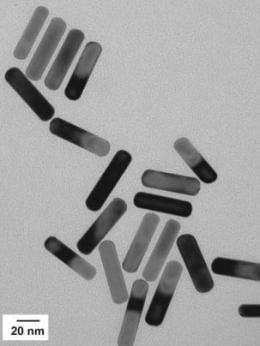
MIT researchers developed these gold nanorods that absorb energy from near-infrared light and emit it as heat, destroying cancer cells. Photo: Sangeeta Bhatia Laboratory; MIT

(PhysOrg.com) -- It has long been known that heat is an effective weapon against tumor cells. However, it's difficult to heat patients' tumors without damaging nearby tissues.

Now, MIT researchers have developed tiny gold particles that can home in on tumors, and then, by absorbing energy from near-infrared light and emitting it as heat, destroy tumors with minimal side effects.

Such particles, known as gold nanorods, could diagnose as well as treat tumors, says MIT graduate student Geoffrey von Maltzahn, who developed the tumor-homing particles with Sangeeta Bhatia, professor in the Harvard-MIT Division of Health Sciences and Technology (HST) and in the Department of Electrical Engineering and Computer Science, a member of the David H. Koch Institute for Integrative at MIT and a Howard Hughes Medical Institute Investigator.

Von Maltzahn and Bhatia describe their gold nanorods in two papers recently published in Cancer Research and . In March, von Maltzahn won the Lemelson-MIT Student Prize, in part for his work with the nanorods.

Cancer affects about seven million people worldwide, and that number is projected to grow to 15 million by 2020. Most of those patients are treated with chemotherapy and/or radiation, which are often effective but can have debilitating side effects because it's difficult to target tumor tissue.

With chemotherapy treatment, 99 percent of drugs administered typically don't reach the tumor, said von Maltzahn. In contrast, the gold nanorods can specifically focus heat on tumors.

"This class of particles provides the most efficient method of specifically depositing energy in tumors," he said.

Wiping out tumors

can absorb different frequencies of light, depending on their shape. Rod-shaped particles, such as those used by von Maltzahn and Bhatia, absorb light at near-infrared frequency; this light heats the rods but passes harmlessly through human tissue.

In a study reported in the team's Cancer Research paper, tumors in mice that received an intravenous injection of nanorods plus near-infrared laser treatment disappeared within 15 days. Those mice survived for three months with no evidence of reoccurrence, until the end of the study, while mice that received no treatment or only the nanorods or laser, did not.

Once the nanorods are injected, they disperse uniformly throughout the bloodstream. Bhatia's team developed a polymer coating for the particles that allows them to survive in the bloodstream longer than any other gold nanoparticles (the half-life is greater than 17 hours).

In designing the particles, the researchers took advantage of the fact that blood vessels located near tumors have tiny pores just large enough for the nanorods to enter. Nanorods accumulate in the tumors, and within three days, the liver and spleen clear any that don't reach the tumor.

During a single exposure to a near-infrared laser, the nanorods heat up to 70 degree Celsius, hot enough to kill tumor cells. Additionally, heating them to a lower temperature weakens tumor cells enough to enhance the effectiveness of existing chemotherapy treatments, raising the possibility of using the nanorods as a supplement to those treatments.

The nanorods could also be used to kill left behind after surgery. The nanorods can be more than 1,000 times more precise than a surgeon's scalpel, says von Maltzahn, so they could potentially remove residual cells the surgeon can't get.

Finding tumors

The nanorods' homing abilities also make them a promising tool for diagnosing tumors. After the particles are injected, they can be imaged using a technique known as Raman scattering. Any tissue that lights up, other than the liver or spleen, could harbor an invasive tumor.

In the Advanced Materials paper, the researchers showed they could enhance the nanorods' imaging abilities by adding molecules that absorb near-infrared light to their surface. Because of this surface-enhanced Raman scattering, very low concentrations of nanorods - to only a few parts per trillion in water [gf1]- can be detected.

Another advantage of the nanorods is that by coating them with different types of light-scattering molecules, they can be designed to simultaneously gather multiple types of information - not only whether there is a tumor, but whether it is at risk of invading other tissues, whether it's a primary or secondary tumor, or where it originated.

Bhatia and von Maltzahn are looking into commercializing the technology. Before the gold nanorods can be used in humans, they must undergo clinical trials and be approved by the FDA, which von Maltzahn says will be a multi-year process.

Other authors of the Advanced Materials paper are Andrea Centrone, postdoctoral associate in chemical engineering; Renuka Ramanathan, undergraduate in biological engineering; Alan Hatton, the Ralph Landau Professor of Chemical Engineering; and Michael Sailor and Ji-Ho Park of the University of California at San Diego.

Park and Sailor are also authors of the Cancer Research paper, along with Amit Agrawal, former postdoctoral associate in HST; and Nanda Kishor Bandaru and Sarit Das of the Indian Institute of Technology Madras.

The research was funded by the National Institutes of Health, the Whitaker Foundation and the National Science Foundation. Nanopartz Inc. supplied gold nanoparticles, gold nanowires and the precursor gold nanorods used in this work.

Provided by Massachusetts Institute of Technology (news : web)


print this article email this article download pdf blog this article bookmark this article     Stumble it Digg this share on Facebook retweet share on Reddit add to delicious
Rate this story - 5 /5 (5 votes)

Rank Filter

Move the slider to adjust rank threshold, so that you can hide some of the comments.


Display comments: newest first

  • Tangent2 - May 04, 2009
    • Rank: not rated yet
    This is not anything new.. researchers have been playing with Gold nanoparticles for the purpose of fighting and killing cancer cells since at least the 90's. The biggest difference is that these researchers used the geometry of their nanoparticle as the functional tumor locator, and the past researchers had grafted a molecule/protein to the nanoparticle which was responsive to the tumor cells and would attach themselves to only the tumor cells directly. After hearing about this kind of ongoing research for over a decade now, the question needs to be asked: When will this be a viable option on the market?? What is taking so long??
  • enantiomer2000 - May 04, 2009
    • Rank: not rated yet
    "What is taking so long??"

    Probably the ridiculously lengthy testing phases that companies must go through. Treatments such as this could very quickly cure save tens of thousands of people from death, but regulatory processes are guaranteed to hold it back.
  • Tangent2 - May 05, 2009
    • Rank: not rated yet
    "Probably the ridiculously lengthy testing phases that companies must go through."

    Perhaps this is true but to this extent? I have trouble beleiving that.. over a decade and still in testing? wow.
  • milz - May 05, 2009
    • Rank: not rated yet
    dang, I dig those gold nanoparticles. So many uses for these tiny bastards.

    Well I guess injecting gold particles into a human body has a lot of constraints and factors that need to be taken care of. Plus, we haven't yet heard of an ACTUAL cancer treatment using Plasmonic Photothermal Therapy (which is what this technique is called) just yet, or have we ?
  • djayspooky - May 08, 2009
    • Rank: not rated yet
    will the heating up of nanorods cause any potential increase or anyother unwanted changes in the total body temprature and/or total body biochemsitry?
    just a question
  • Fazer - May 10, 2009
    • Rank: not rated yet
    I drank a fifth of Goldschlager, then tried to operate on my brain with my infrared TV remote, it didn't seem to work, so maybe my headache wasn't a tumor after all.

    Okay, seriously, I wonder what the dangers of self treatment/experimentation would be? Obviously, destroying the liver and spleen, and perhaps toxicity issues, but if you knew what you were doing and were faced with a malignant tumor, would you take the chance to demonstrate a test case?

May 4, 2009 all stories

Comments: 6

5 /5 (5 votes)
  • Stumble this up

  • Digg this

  • share this

  • hide
  • Related Stories

  • Engineering new uses for gold
    created Aug 22, 2008 | popularity not rated yet | comments 0
  • Nanorods show benefits cancer treatment
    created Mar 14, 2006 | popularity not rated yet | comments 0
  • Gold nanorods shed light on new approach to fighting cancer
    created Oct 16, 2007 | popularity not rated yet | comments 0
  • MIT student develops new innovations to selectively kill cancer cells
    created Mar 03, 2009 | popularity not rated yet | comments 0
  • Golden Nanorods for Medical Applications
    created Sep 08, 2008 | popularity not rated yet | comments 0


  • hide
  • Relevant PhysicsForums posts

Other News

New Digital 'Electronics' Concept May Continue Moore's Law

New Digital 'Electronics' Concept May Continue Moore's Law

Nanotechnology / Nanophysics

created Nov 05, 2009 | popularity 4.6 / 5 (50) | comments 8

(PhysOrg.com) -- Computers of the future could be operating not on electrons, but on tiny waves traveling through an electron "fluid," if a new proposal is successful. The new circuit design, recently introduced ...


Nanoparticles for gene therapy improve

Nanoparticles for gene therapy improve

Nanotechnology / Bio & Medicine

created Nov 06, 2009 | popularity 5 / 5 (4) | comments 3

(PhysOrg.com) -- About five years ago, Professor Janet Sawicki at the Lankenau Institute in Pennsylvania read an article about nanoparticles developed by MIT's Robert Langer for gene therapy, the insertion ...


Breakthrough in industrial-scale nanotube processing

Breakthrough in industrial-scale nanotube processing

Nanotechnology / Nanomaterials

created Nov 02, 2009 | popularity 4.9 / 5 (20) | comments 3

(PhysOrg.com) -- Rice University scientists today unveiled a method for the industrial-scale processing of pure carbon-nanotube fibers that could lead to revolutionary advances in materials science, power ...


Scientists witness nature's complexity unfold in self-assembling quasicrystals

Scientists witness nature's complexity unfold in self-assembling quasicrystals

Nanotechnology / Nanomaterials

created Oct 31, 2009 | popularity 4.9 / 5 (16) | comments 3

(PhysOrg.com) -- Just a few decades ago, scientists believed that all ordered matter consists of self-repeating building blocks -- atoms, ions or molecules. In this view, the ordinary solids of everyday life ...


Nanoparticles may cause DNA damage across a cellular barrier

Nanoparticles may cause DNA damage across a cellular barrier

Nanotechnology / Bio & Medicine

created Nov 05, 2009 | popularity 4.3 / 5 (9) | comments 1

(PhysOrg.com) -- Scientists have shown in the laboratory that metal nanoparticles damaged the DNA in cells on the other side of a cellular barrier. The research, by the University of Bristol, is published ...