Researchers Develop 'Lab on a Tube' Monitoring Device
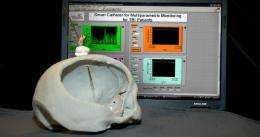
(PhysOrg.com) -- The need for improved monitoring of neurotrauma patients has resulted in the development of a prototype of a novel, multitasking “lab on a tube” at the University of Cincinnati (UC).
UC engineers, working to fill a need expressed by physicians at the Neurotrauma Center at the UC Neuroscience Institute, have developed a preliminary working model of the multimodal tube, or “smart sensor,” which is capable of continuously monitoring multiple physiological parameters in patients. The tube also is capable of draining excess cerebrospinal fluid from the injured brain and could be used to deliver medications to the patient.
Although the monitoring device is not yet ready for testing in humans, UC researchers hailed it as “a groundbreaking start.”
Raj Narayan, MD, chairman and Frank Mayfield professor in the department of neurosurgery and the project’s principal investigator, and Lori Shutter, MD, director of neurocritical dare, expressed the need for a multimodality monitoring device for neurotrauma patients and participated in its design and creation.
The prototype for a smart neuro-catheter was then engineered by Chunyan Li, PhD, a postdoctoral fellow in the UC department of neurosurgery who trained under Chong Ahn, PhD, professor in the department of electrical and computer engineering. Concepts for a “lab on a tube” device with multimodality sensors were developed in the Microsystems and BioMEMS Laboratory headed by Ahn.
“It’s a great story of collaboration and multidisciplinary effort at UC,” Ahn says.
The tube, which is under provisional patent application and which should be ready for testing in an animal model within the next few months, is described in the April issue of Chemical Biology and on the Lab on a Chip Web site xlink.rsc.org/?doi=B900651F .
“Clinical monitoring is poised for exciting advances,” Narayan says. “When we can track what is going on in a patient’s brain tissue, or blood, on a continuous basis, we can treat the patient much more promptly and effectively. We hope to revolutionize the field.”
Traumatic brain injury, the result of a fall or impact, is typically followed by a wave of secondary injury caused by swelling, increased intracranial pressure, reduced blood flow to the brain, lack of oxygen, too much or too little glucose and increased temperature. Because medical science has yet to invent medicines capable of preventing or reducing secondary injury, physicians strive to maximize recovery by maintaining optimal conditions for healing.
The smart sensor could benefit patients through real-time monitoring, as opposed to intermittent monitoring, which is the current standard of care and which reveals undesirable changes after they have occurred. The promise of real-time monitoring from the multimodality tube would enhance care by allowing changes to be identified instantly.
The “lab on a tube” also reduces from two to one the number of holes that must be drilled into the skull for the insertion of sensors. The tube’s diameter also can be expanded or contracted as necessary, thereby improving safety.
“Currently, advanced neuromonitoring requires placement of multiple devices,” Shutter says. “The ability to gather all information from one system has significant potential to increase our ability to manage patients who are critically ill from neurological conditions.”
The spirally rolled device can simultaneously monitor intracranial glucose, oxygen, temperature and pressure, and it can be modified in the future to monitor other parameters as well. It has sensors inside the tube, where they can measure the biochemistry of cerebrospinal fluid, as well as on the outside, where they can measure changes within the brain tissue. The original prototype, 11 centimeters in length and 1.7 millimeters in diameter, is already evolving into an even smaller, more sophisticated tube.
The placement of a single, ultra-thin catheter benefits patients through reduced risk. Li adds that placing a single catheter also would be more economical.
Also contributing to the tube’s development were Pei-Ming Wu and WooSeok Jung of the Microsystems and BioMEMS Laboratory in UC’s department of electrical and computer engineering.
The work was supported by the Integra Lifesciences Foundation, based in Plainsboro, N.J.
The UC Neuroscience Institute, a regional center of excellence, is dedicated to patient care, research, education and the development of new treatments for stroke, brain and spinal tumors, epilepsy, traumatic brain and spinal injury, multiple sclerosis, Alzheimer’s disease, Parkinson’s disease, disorders of the senses (swallowing, voice, hearing, pain, taste and smell) and psychiatric conditions (bipolar disorder, schizophrenia and depression).
Provided by University of Cincinnati (news : web)


