Underwater robot with a sense of touch
May 4, 2009
Underwater robot with a sense of touch

Enlarge

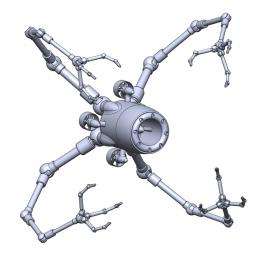
The applications are numerous. Underwater robots with tactile capability can maintain offshore drilling rigs or collect sediment samples. The researchers hope that in future the sensor will be able to distinguish between the current and an obstacle. © DFKI Bremen

(PhysOrg.com) -- Maintenance of offshore drilling rigs or underwater cables, taking samples of sediment - underwater robots perform a variety of deep-sea tasks. Research scientists now aim to equip robots with tactile capability so that they can orientate themselves better under the sea.

The robot dives into the sea, swims to the submerged cable and carries out the necessary repairs, but the person controlling the robot does not have an easy task. It is pitch dark and the robot’s lamp does not help much. What’s more, the current keeps pulling the robot away from where it needs to carry out the work.

In future, the robot could find its own way. A sensor will endow it with a sense of touch and help it to detect its undersea environment autonomously.

“One component in this tactile capability is a strain gauge,” says Marcus Maiwald, project manager at the Fraunhofer Institute for Manufacturing Technology and Applied Materials Research IFAM in Bremen. Together with his Fraunhofer colleagues and staff at the German Research Center for Artificial Intelligence DFKI, Bremen Laboratory, he has developed the model of an underwater robot with a . “If the robot encounters an obstacle, the strain gauge is distorted and the electrical resistance changes. The special feature of our strain gauge is that it is not glued but printed on - which means we can apply the sensor to curved surfaces of the robot.”

The single printed strip is just a few ten micrometers wide, i.e. about half the width of a human hair. As a result, the strain gauges can be applied close to each other and the robot can identify precisely where it is touching an obstacle. The sensor is protected from the salt water by encapsulation.

To produce the strain gauges, the research scientists atomize a solution with nanoparticles to create an aerosol. A software system guides the aerosol stream to the right position. Focusing gas shrouds the beam and ensures that it does not fan out. At the Sensor and Test trade show from May 26 to 28 in Nuremberg, the research scientists are presenting an octopus-shaped underwater which is fitted with a printed sensor.

Provided by Fraunhofer-Gesellschaft (news : web)


Rank 5 /5 (2 votes)
Related Stories
Relevant PhysicsForums posts
  • How to calculate total compressibility in liquid porous solid system
    created2 hours ago
  • Need help reading 3-D
    created22 hours ago
  • A way to send and receive wireless data
    createdFeb 11, 2012
  • Calling function with no input argument
    createdFeb 10, 2012
  • Force free body diagram problem on gym equipment
    createdFeb 10, 2012
  • Empirical data regarding shower heads and water
    createdFeb 10, 2012
  • More from Physics Forums - General Engineering

More news stories

Google might launch Drive for cloud storage soon

(PhysOrg.com) -- Google's next big move, according to the Wall Street Journal, is a cloud storage service called Drive. Hardly first to the plate, Google is simply catching up to introducing its cloud reposi ...

Technology / Internet

created 10 hours ago | popularity 4.8 / 5 (5) | comments 4 | with audio podcast report

Iran blocks email, restricts net access: reports

Iran has further restricted access to the Internet and blocked popular email services for the past few days, in a move a top lawmaker said could "cost the regime dearly," media reports said on Sunday.

Technology / Internet

created 3 hours ago | popularity 5 / 5 (1) | comments 3

Love a click away in Indonesia's Twitter Republic

He was a geeky kid from Yogyakarta, she a glamorous city girl in Jakarta. In a country with one of the world's most vibrant social networking scenes they fell in love on Twitter.

Technology / Internet

created 11 hours ago | popularity 4 / 5 (1) | comments 0

Walney offshore wind farm is world's biggest (for now)

(PhysOrg.com) -- The Walney wind farm on the Irish Sea--characterized by high tides, waves and windy weather--officially opened this week. The farm is treated in the press as a very big deal as the Walney ...

Technology / Energy & Green Tech

created Feb 11, 2012 | popularity 4 / 5 (11) | comments 37 | with audio podcast weblog

Navy to begin tests on electromagnetic railgun prototype launcher

The Office of Naval Research (ONR)'s Electromagnetic (EM) Railgun program will take an important step forward in the coming weeks when the first industry railgun prototype launcher is tested at a facility ...

Technology / Engineering

created Feb 06, 2012 | popularity 4.5 / 5 (17) | comments 94 | with audio podcast


Overeating may double risk of memory loss

New research suggests that consuming between 2,100 and 6,000 calories per day may double the risk of memory loss, or mild cognitive impairment (MCI), among people age 70 and older. The study was released today and will be ...

Scientists discover molecular secrets of 2,000-year-old Chinese herbal remedy

For roughly two thousand years, Chinese herbalists have treated Malaria using a root extract, commonly known as Chang Shan, from a type of hydrangea that grows in Tibet and Nepal. More recent studies suggest that halofuginone, ...

New method to examine batteries -- MRI from the inside

There is an ever-increasing need for advanced batteries for portable electronics, such as phones, cameras, and music players, but also to power electric vehicles and to facilitate the distribution and storage of energy derived ...

Lab study raises questions over nano-particle impact

Tests involving chickens have raised questions about the impact on health from engineered nano-particles, the ultra-fine grains commonly used in drugs and processed foods, scientists said on Sunday.

Injured boomers beware: Know when to see doctor

(AP) -- It happened to nurse Jane Byron years after an in-line skating fall, business owner Haralee Weintraub while doing "men's" push-ups, and avid cyclist Gene Wilberg while lifting a heavy box.

A mitosis mystery solved: How chromosomes align perfectly in a dividing cell

Although the process of mitotic cell division has been studied intensely for more than 50 years, Whitehead Institute researchers have only now solved the mystery of how cells correctly align their chromosomes during symmetric ...