Animals on runways can cause serious problems at small airports
May 4, 2009 Animals on runways can cause serious problems at small airports

Enlarge

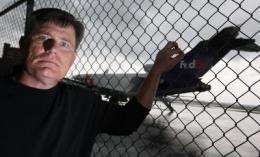
Gene Rhodes, a Purdue professor of forestry and natural resources, found that animals can gain access to runways and infield areas at small airports in Indiana, and likely all over the country, increasing the likelihood of planes striking those animals. Credit: (Purdue Agricultural Communications photo/Tom Campbell)

It's a bird. It's a plane. It's a potentially deadly combination.

A Purdue University study of 10 small Indiana airports found that can gain easy access to runways and infield areas, increasing the likelihood of planes striking those animals.

Animal strikes received national attention in January. Commercial pilot and Purdue alumnus Charles "Sully" Sullenberger was forced to land in the Hudson River after his plane hit a flock of Canada geese.

The study by Gene Rhodes, a professor of forestry and natural resources, documented that animals found ways through damaged fences or unfenced areas onto airport properties. Spotting deer, coyote and other animals in dangerous places was common.

"Just about every pilot we talked to at these airports said that during a landing they've had to pull up to avoid hitting an animal on the runway," Rhodes said. "With the size of planes using these airports, hitting a rabbit could flip a plane."

Rhodes' research was published in the fall issue of the journal Human-Wildlife Conflicts.

While Rhodes' study looked only at Indiana airports, he said there are thousands of airports all over the country that don't have the budgets to adequately fence their properties, endangering countless flights each year.

In the study, only four of the Indiana airports had fences around the entire perimeter, and even those had maintenance problems - such as holes dug under fences, access through culverts and holes in fences - that allowed animals onto the properties.

Despite the desire to keep animals away, Rhodes said airports often are a magnet for wildlife. Airports are required to own property around runways that is often rented to farmers. While that increases airports' meager budgets, those crops can attract animals looking for food.

"What you have planted affects what type of animals will be there," Rhodes said. "Even if you have certain grasses, you have small mammals that eat those, and those attract red-tailed hawks. A red-tailed hawk can bring down a small plane as fast as anything."

Previous studies cited in Rhodes' paper have shown that wildlife strikes cost more than a half a billion dollars each year and have been responsible for more than 350 human deaths in the last century. Travis DeVault, who co-authored the paper as Rhodes' postdoctoral researcher and is now a field station and project leader with the U.S. Department of Agriculture's Wildlife Services, said wildlife strikes have become more common in recent years.

"Many of the most hazardous species are increasing in population size. For example, about two-thirds of the largest bird species have shown population increases during the past 30 years," DeVault said. "Also, air traffic continues to increase. More birds in combination with more flights leads to more bird strikes."

DeVault added that new technology means planes are quieter today, giving birds less time to detect and avoid being struck.

Rhodes' study suggests enclosing 100 percent of perimeters with partially buried fencing, which keeps animals from tunneling underneath. Frequent maintenance also is key because many of the animals observed during the study entered the airports through damaged fences.

"If airports can use this study to show their needs, it can allow them to go after federal grants they need to make improvements," Rhodes said.

Source: Purdue University (news : web)


print this article email this article download pdf blog this article bookmark this article     Stumble it Digg this share on Facebook retweet share on Reddit add to delicious
Rate this story - not rated yet


May 4, 2009 all stories

Comments: 0

not rated yet
  • Stumble this up

  • Digg this

  • share this

  • hide
  • Related Stories

  • Study shows how glaciers affected deer evolution
    created Mar 26, 2009 | popularity not rated yet | comments 0
  • Novel audio telescope heeds call of the wild... birds
    created Nov 09, 2006 | popularity not rated yet | comments 0
  • Airport safety: magnetic fingerprinting in the fog?
    created Jan 24, 2008 | popularity not rated yet | comments 0
  • Study: Airport food improving
    created Nov 21, 2006 | popularity not rated yet | comments 0
  • If it works in London's streets, it can work in our skies
    created Apr 22, 2009 | popularity not rated yet | comments 0


  • hide
  • Relevant PhysicsForums posts

  • Sodium Iodoacetate
    created 10 hours ago
  • Force of Life
    created 20 hours ago
  • Real/Fake Organs
    created Dec 23, 2009
  • Cell turnover rates
    created Dec 23, 2009
  • More from Physics Forums - Biology

Other News

The sun sets behind the Manhattan skyline on December 11 in New York

New Yorkers beware! New cockroach hits the Big Apple

Biology / Evolution

created Dec 24, 2009 | popularity 4.3 / 5 (13) | comments 4

New Yorkers are used to fighting each other for space, but there may be a new contender in town according to a Rockefeller study that appears to have uncovered a new species of cockroach.


Citrus

Citrus surprise: Vitamin C boosts the reprogramming of adult cells into stem cells

Biology / Cell & Microbiology

created Dec 24, 2009 | popularity 4.9 / 5 (22) | comments 2

Famous for its antioxidant properties and role in tissue repair, vitamin C is touted as beneficial for illnesses ranging from the common cold to cancer and perhaps even for slowing the aging process. Now, ...


Ladder-walking locusts show big brains aren't always best

Ladder-walking locusts show big brains aren't always best

Biology / Plants & Animals

created Dec 24, 2009 | popularity 5 / 5 (6) | comments 1

Scientists have shown for the first time that insects, like mammals, use vision rather than touch to find footholds. They made the discovery thanks to high-speed video cameras - technology the BBC uses to ...


duck

Researchers reveal secrets of duck sex: It's all screwed up

Biology / Plants & Animals

created Dec 23, 2009 | popularity 3.7 / 5 (9) | comments 0

Female ducks have evolved an intriguing way to avoid becoming impregnated by undesirable but aggressive males endowed with large corkscrew-shaped penises: vaginas with clockwise spirals that thwart oppositely ...


Scientists show that plants have measure of the shortest day

Biology / Plants & Animals

created Dec 23, 2009 | popularity 5 / 5 (2) | comments 1

(PhysOrg.com) -- It is not only people who feel the effects of short winter days - new research by the University of Edinburgh and the University of Warwick has shed light on how plants calculate their own winter solstice. ...