Research gives clues for self-cleaning materials, water-striding robots
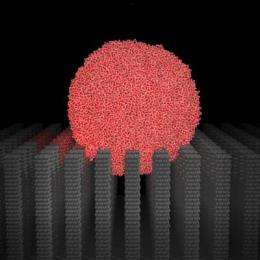
Self-cleaning walls, counter tops, fabrics, even micro-robots that can walk on water -- all those things and more could be closer to reality because of research recently completed by scientists at the University of Nebraska-Lincoln and at Japan's RIKEN institute.
Humans have marveled for millennia at how water beads up and rolls off flowers, caterpillars and some insects, and how insects like water striders are able to walk effortlessly on water. It's a property called super hydrophobia and it's been examined seriously by scientists since at least the 1930s.
"A lot of people study this and engineers especially like the water strider because it can walk on water," said Xiao Cheng Zeng, Ameritas university professor of chemistry at UNL. "Their legs are super hydrophobic and each leg can hold about 15 times their weight. 'Hydrophobic' means water really doesn't like their legs and that's what keeps them on top. A lot of scientists and engineers want to develop surfaces that mimic this from nature."
In a paper to be published in the May 4-8 online edition of the Proceedings of the National Academy of Sciences, Zeng and his Japanese colleagues, Takahiro Koishi of the University of Fukui and RIKEN, Kenji Yasuoka of Keio University, and Shigenori Fujikawa and Toshikazu Ebisuzaki of RIKEN, give engineers and materials scientists important clues in how to develop the long-sought super hydrophobic materials.
In nature, organisms like caterpillars, water striders and the lotus achieve super hydrophobia through a two-level structure -- a hydrophobic waxy surface made super hydrophobic by the addition of microscopic hair-like structures that may be covered by even smaller hairs, greatly increasing the surface area of the organism and making it impossible for water droplets to stick.
Using the superfast supercomputer at RIKEN (the fastest in the world when the research started in 2005), the team designed a computer simulation to perform tens of thousands of experiments that studied how surfaces behaved under many different conditions. Zeng and his colleagues used the RIKEN computer to "rain" virtual water droplets of different sizes and at different speeds on surfaces that had pillars of various heights and widths, and with different amounts of space between the pillars.
They learned there is a critical pillar height, depending on the particular structure of the pillars and their chemical properties, beyond which water droplets cannot penetrate. If the droplet can penetrate the pillar structure and reach the waxy surface, it is in the merely hydrophobic Wenzel state (named for Robert Wenzel, who found the phenomenon in nature in 1936). If it the droplet cannot penetrate the pillars to touch the surface, the structure is in the super hydrophobic Cassie state (named for A.B.D. Cassie, who discovered it in 1942), and the droplet rolls away.
"This kind of simulation -- we call it 'computer-aided surface design' -- can really help engineers in designing a better nanostructured surface," Zeng said. "In the Cassie state, the water droplet stays on top and it can carry dirt away. In the Wenzel state, it's sort of stuck on the surface and lacks self-cleaning functionality. When you build a nanomachine -- a nanorobot -- in the future, you will want to build it so it can self-clean."
Zeng said there were three main advantages to performing the experiments on a computer rather that in a laboratory. First, they were able to conduct thousands more repetitions than would have been possible in a lab. Second, they didn't have to worry about variables such as dirt, temperature and air flow. Third, they could control the size of droplets down to the exact number of molecules, whereas in a laboratory experiment the droplets would unavoidably vary by tens of thousands of molecules.
The idea for the experiment came about in 2005 when Zeng visited RIKEN during his year as a fellow of the John Simon Guggenheim Foundation, which paid for the start-up for the project. Koishi spent the spring of 2005 with Zeng at UNL as they designed the project in detail. Yasuoka and his family spent the 2006-07 academic year in Lincoln during his a one-year sabbatical with Zeng, in part because of this project.
"We wanted to design a grand-challenge project so we could take advantage of the RIKEN super computer," Zeng said. "We thought this was an interesting project and we need a very, very fast computer to deal with it. I also have to acknowledge the Nebraska Research Initiative, the Department of Energy and the National Science Foundation. The NRI is great because it allows me to do highly risky research, to develop this kind of challenging project."
Source: University of Nebraska-Lincoln (news : web)


