Uncovering secrets from beyond the grave
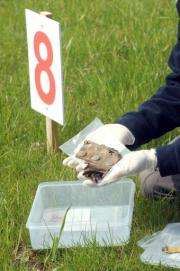
The tools of his trade range from earthmovers and shovels to the finest brushes, surgical tweezers and dentists' mirrors -- and his job is to uncover secrets from beyond the grave.
Trained on the Srebrenica war crimes investigation in Bosnia and probing atrocities in war-torn Iraq, Roland Wessling is one of a dozen forensic anthropologists brought in to excavate a World War I mass grave.
For the next five months the 39-year-old German will be fine-combing a muddy field outside the northern French village of Fromelles to recover and where possible identify the bodies of hundreds of Australian and British soldiers.
Between 250 and 400 soldiers gunned down in a doomed assault on enemy lines on July 19, 1916, are thought to have been buried by German forces in five pits just outside the village of Fromelles.
Once an earthmover has rolled back the top layer of soil Tuesday, Wessling and 10 other excavators take over, working with shovels and hand trowels, right down to surgical tools to expose the bodies without disturbing their rest.
"Our primary concern is to ensure that no damage is done to the bodies," he said. "Once a body is fully surveyed, and documented, the entire body is lifted in its entirety.
"The whole process shows how much respect we have for the dead."
Test digs ordered by the Australian military in 2007 and 2008 revealed human remains in five pits at the site, forming what is perhaps the largest unmarked war grave found since the 1918 Armistice.
Experts already know that the bodies are lying side by side, over two layers, at a depth of around one metre, and they will work in from the edges of the group, with one forensic scientist allocated to each body.
"We expect to find mostly skeletalised remains -- but the first rule of our profession is expect the unexpected," Wessling said.
"This goes back more than 90 years, but there is still a remote possibility of finding skin, or mummified tissue," he said.
Wessling spent years gathering forensic evidence for court cases -- from Bosnia to Iraq, Spain or Cyprus -- or working as a consultant on crime scene investigations in Britain.
In Bosnia, he learned to tell from the cut of the earth whether two burial pits were dug with the same machine -- which constitutes evidence of organised mass murder, and therefore of genocide.
In this case too, contextual information can help solve the puzzle of the servicemen's identities.
"A lot of information comes from the context," he said. "If a button is lying on the sternum of a soldier -- you can say it is associated with him."
But genetic testing, cross referenced with military and family records, is the holy grail that could allow some of the men to be formally identified -- a process expected to take up to five years.
Working under tents in crime-scene conditions, with protective body gear and face masks, the team will take samples from a dozen servicemen's teeth and bones to find out if their DNA is still viable for analysis.
"It will be a proper forensic investigation, with rigorous bar-coding and tracking from the site to the lab," said Peter Jones, genetics consultant for the Commonwealth War Graves Commission which is overseeing the excavation.
There is no way of guessing, however, how well the genetic material have stood the test of time.
"It's likely to be in good condition, since it's an alkaline, clay soil -- but the only real acid test is to take the samples," Jones said.
Adding to the challenge, experts will be comparing samples, not with next of kin but with far more distant relatives -- from great-great-nephews to cousins three times removed.
"If we have a DNA profile that matches, plus other elements like facial features, and documentary evidence, then we can identify a soldier with a high degree of probability," Jones said.
"But it is a giant puzzle -- in fact I don't think anyone has worked on a puzzle on this scale before."
(c) 2009 AFP


