Struggling US newspapers look to e-readers
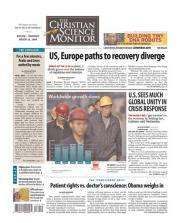
May 5, 2009 by Chris Lefkow The front page of The Christian Science Monitor

Enlarge

The front page of The Christian Science Monitor from March 26. The Christian Science Monitor printed its final edition on March 27, bringing a 100-year run as a daily newspaper to an end but beginning a new era as an online publication.

As US newspapers drown in a sea of red ink, publishers are desperately searching for ways to survive in a digital future.

Some are toying with the idea of charging readers for news on the Web while others are ganging up to extract money from powerful aggregators such as News which link to their articles.

Online advertising is seen as a potential savior in some newsrooms although it currently accounts for less than 15 percent of revenue at most US dailies.

Another proposal gaining currency is selling digital subscriptions through electronic readers similar to Amazon's popular Kindle.

Rupert Murdoch's ., newspaper and magazine publisher Hearst and California-based start-up Plastic Logic are among the companies known to be developing e-readers.

Japanese electronics giant Sony is also reported to be adapting its for daily content and Apple is rumored to be developing a full-color media tablet of its own.

But Amazon may have once again stolen the march on its rivals.

The New York Times reported on Monday that the Seattle, Washington-based online retail giant plans to unveil a large-screen version of its Kindle book reader on Wednesday tailored for displaying newspapers and magazines.

Amazon invited media outlets to a press conference in New York on Wednesday but declined to reveal what it plans to announce at the event.

The Times, however, said Amazon will show off an e-reader that "could present much of the editorial and advertising content of traditional periodicals in generally the same format as they appear in print."

It quoted "people briefed on the plans" as saying that the Times was one of several news organizations "expected to be involved in the introduction of the device."

Amazon's traditional Kindle is designed for electronic books but the new device has a screen roughly the size of a standard sheet of paper and is more geared towards periodicals "and perhaps textbooks," the Times said.

With advertising revenue and circulation declining at US newspapers and magazines, the Times said the device was being seen by struggling US media companies as "a way to get readers to pay for those periodicals."

"Publishers could possibly use these new mobile reading devices to hit the reset button and return in some form to their original business model: selling subscriptions, and supporting their articles with ads," the Times said.

It noted that digital delivery would allow newspaper publishers to save millions on printing and distribution costs.

With so much news already available for free on the Internet, the notion that electronic readers could provide a measure of salvation for the newspaper industry met with some skepticism.

"The idea that a large screen Kindle (or any similar device) could save newspapers is a joke," wrote Silicon Valley technology blog TechCrunch.

"The idea that people are going to run out in droves to get these new giant Kindles just to have the privilege of paying for newspaper content is absurd."

Billionaire investor Warren Buffett did not address the specific subject of e-readers but over the weekend he joined the chorus of those predicting nothing but trouble for the US newspaper industry.

Addressing shareholders in his company Berkshire Hathaway, Buffett said he would not invest in newspapers "at any price" and predicted they could be faced with "unending losses."

Amazon already offers dozens of newspaper subscriptions for its existing Kindle readers but the number of subscribers is believed to be just a tiny fraction of the circulation of the print editions of the newspapers.

The Plastic Logic e-reader, a lightweight device with a touch screen about the size of a pad of letter paper, is going to be used on a test basis by two Detroit newspapers later this year.

(c) 2009 AFP


Rate this story - 4 /5 (1 vote)

Rank Filter

Move the slider to adjust rank threshold, so that you can hide some of the comments.


Display comments: newest first

  • earls - May 05, 2009
    • Rank: not rated yet
    Too little, too late. They should have been thinking about migration years ago.
  • Sirussinder - May 05, 2009
    • Rank: not rated yet
    Now if they could bring the Kindle price down to half of what it is listed for....then maybe it will take off...Right now they want an arm and a leg for it. FORGET IT! its not even color.
  • DoktorSerendipitous - May 06, 2009
    • Rank: not rated yet
    To say that nothing will save the newspaper industry because there is so much news already available for free on the Internet is like saying that there is no future for writing novels because there are already so many novels available. But the existence of previously written novels never stopped new novelists from being successful. However, undoubtedly, there is no future for novelists who write for free.

    The idea of newspaper has always been to provide, foremost, local news, and if any of those newspaper death-wishers want their local news on the Internet, where would they go? Of course, the websites of their local newspapers, where newspapers are faithfully making their contents available free of charge.

    The survival of most newspapers has always depended on their unique local contents--their national and international contents were, with a few exceptions of major city newspapers such as New York Times and Washington Post, always provided by the international press agencies such as Reuters and AP. In fact, nowadays, even the major city newspapers are using content provided by the news agencies rather than by their own reporters to the point that most American newspapers have national and international sections that are virtually identical. Their readers know this, and they are now going to the sources of the news now that it is possible to do so via the Internet.

    But local news is not so easy to obtain, although there are local TV station providing them on fixed time slots. Local TV stations have always competed with their local newspapers, but until the advent of the Internet, newspapers had an advantage in that once the newsprint was in the reader's hand, it was always readily available, whereas TV viewers had to wait for local news to come on at pre-specified times. This is no longer the case, since all local TV stations post their news on the Internet.

    TV stations, in essence, have become more like paperless newspapers also. Thus, in order for newspaper to survive, they must become more of a multimedia provider than just a printed news provider. This was not possible in the days of limited TV channel availability and tight cross-ownership restrictions set by the FCC, but the Internet makes all that mute. Here are some strategic points for newspaper to consider:

    First, the newspapers buying news content from the international press agencies must demand that those agencies stop providing news free of charge on the Internet; after all, why should newspapers pay for the news agencies' reporting, but not the online readers who can access the agencies' website directly? This does not make any business sense.

    Second, all locally generated newspaper content must be fee-based for access, and newspapers must stop providing links to the full articles to news aggregators, such as Google--only the headlines and short trailers should be posted. If Google doesn't like the idea, newspapers should invest in a venture to build a news aggregator website that caters to their interest better than Google.

    Third, establish an industry-wide agency similar to RIAA to enforce the copyright law so that the Internet hobbyists cannot repost news without prior approval from the sources of their reposting. It would also help to ask Congress to pass addenda to the copyright law to tighten reposting requirements and obligations on the Internet on copyrighted news items.

    Fourth, newspapers must recognize that the wasteful practice of printing news on millions of tons of newsprint must come to an end (the same for magazines); thus, the transition to e-readers is inevitable, logical, and environmentally sound.

    Fifth. E-readers should be provided as a part of each annual newspaper subscription. Furthermore, they should have additional functionalities for subscribing to periodicals, as well as reading online e-books (each newspaper can build its own unique library of e-books with reviews, recommendations, and limited-time free offers). The bundling of e-readers with subscription is probably the most difficult part of the survival strategy, as it might not be financially feasible until the cost of each e-reader reaches at $100 or less. It is certain to happen soon, but perhaps not soon enough to save many of the major newspapers that have high level of expense to maintain their operations.

    There are many, many other things that can be done to re-enhance the attractiveness of local newspapers, but in reality, what they must become is not just newspapers to keep up with the latest news but multimedia news sources and the hubs for all sorts of reliable and unique local information that otherwise might be hard to find in any other single website. Local newspaper people know their locality the best, so they need to take full advantage of their knowledge with the help of the Internet.


May 5, 2009 all stories

Comments: 3

4 /5 (1 vote)

  • hide
  • Related Stories

  • Amazon expected to lift wraps on large-screen Kindle
    created May 04, 2009 | popularity not rated yet | comments 0
  • Hearst plans electronic reader for magazines: report
    created Feb 28, 2009 | popularity not rated yet | comments 0
  • Chicago Sun-Times owner files for bankruptcy
    created Mar 31, 2009 | popularity not rated yet | comments 0
  • Google introduces ads to Google News
    created Feb 26, 2009 | popularity not rated yet | comments 0
  • Seattle paper may have digital future
    created Mar 06, 2009 | popularity not rated yet | comments 0


  • hide
  • Relevant PhysicsForums posts

  • how to welding thin SS foil (0.002")?
    created Feb 08, 2010
  • Civil Engineering is hazardous to your career prospects
    created Feb 06, 2010
  • hot water circulator, kitchen faucet, ? mixing
    created Feb 06, 2010
  • Static or dynamic pressures in duct
    created Feb 06, 2010
  • Nuclear Engineering in Australia??
    created Feb 06, 2010
  • Building Gravitational Wave Experiment
    created Feb 05, 2010
  • More from Physics Forums - General Engineering

Other News

The power of 'random'

The power of 'random': 'Seemingly loopy' technique could dramatically improve communications networks

Technology / Computer Sciences

created 16 hours ago | popularity 4.8 / 5 (8) | comments 5 | with audio podcast

A radical new approach to the design of communications networks, called "network coding," promises to make Internet file sharing faster, streaming video more reliable, and cell-phone reception better -- among ...


'Revolutionary' water treatment units on their way to Afghanistan

Technology / Engineering

created 10 hours ago | popularity 4.2 / 5 (5) | comments 4 | with audio podcast

The United States Army has taken delivery of the first two units of a "revolutionary" waste-water treatment system that will clean putrid water within 24 hours and leave no toxic by-products, according to scientists at Sam ...


Imec and Holst Centre achieve breakthrough in battery-less radios

Imec achieves breakthrough in battery-less radios

Technology / Semiconductors

created 11 hours ago | popularity 4.9 / 5 (10) | comments 0 | with audio podcast

At today's International Solid State Circuit Conference, Imec and Holst Centre report a 2.4GHz/915MHz wake-up receiver which consumes only 51µW power. This record low power achievement opens the door to battery-less ...


Android

Google developing a translator for smartphones

Technology / Software

created 17 hours ago | popularity 4.7 / 5 (7) | comments 3 | with audio podcast report

(PhysOrg.com) -- Google is developing a translator for its Android smartphones that aims to almost instantly translate from one spoken language to another during phone calls.


Handling emergencies online

Technology / Internet

created 6 hours ago | popularity not rated yet | comments 0

Online social networking sites could solve many problems plaguing information dissemination and communications when disaster strikes, according to a report from US researchers in a recent issue of the International Journal of ...