Galactic X-ray emissions originate from stars
May 5, 2009 Galactic X-ray emissions originate from stars

Enlarge

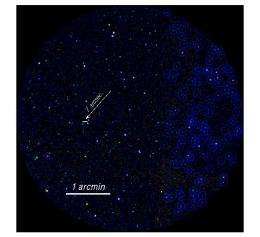
The plane of the Milky Way, recorded with the Chandra satellite in three colours: Photons with energies between 0.5 and 1keV appear red, those between 1 and 3keV green, and those between 3 and 7keV blue. Discrete sources are indicated by circles. Image: Mikhail Revnivtsev

(PhysOrg.com) -- A 25-year old astronomical mystery has been solved: Most of the diffuse X-ray emissions in the Milky Way do not originate from one single source but from so-called white dwarfs and from stars with active outer gas layers. Mikhail Revnivtsev from the Excellence Cluster Universe at the TU Munich and his colleagues at the Max Planck Institute for Astrophysics in Garching, the Space Research Institute in Moscow and the Harvard-Smithsonian Center for Astrophysics in Cambridge have now succeeded in proving this.

It is now 25 years since scientists discovered diffuse X-ray emissions from the vicinity of the plane. Since then, a whole generation of astronomers has been racking its brains as to their origin. Energetic X-ray emissions usually originate from very hot gases in a temperature range between 10 and 100 million degrees Celsius. And this "Galactic Ridge X-ray Emission" (GRXE) is also typical for very hot, optically thin plasma.

A gas with these thermal properties would, however, immediately escape from our galaxy - the Milky Way would continuously lose colossal amounts of energy and finally collapse as the existing energy sources, such as stars and supernovae, would not be sufficient to replenish such a loss. Cosmic particles colliding with the interstellar medium could also be ruled out as an explanation for the GRXE.

It is only recently that observations with the RXTE and Integral satellites have shown that the X-ray emissions of the Milky Way exhibit the same distribution pattern as the stars. Since then, it has been assumed that a large portion of the GRXE originates from individual stars. These findings motivated the international team to carry out more precise measurements with the Chandra X-ray telescope. The test area chosen was a small celestial region near the centre of the Milky Way.

The region chosen, about half as big as a , lent itself to the observations for two reasons: On the one hand because of the high GRXE intensity, which minimized the "interfering radiation" from extra-galactic X-ray sources; and on the other hand because the interstellar matter at this position absorbs only small amounts of radiation so that it was even possible to detect weak discrete sources with Chandra.

Chandra actually managed to identify 473 point sources of X-rays in a sector of the search field covering only 2.6 arcminutes. In a further step, the group used measurements from the Spitzer satellite observatory to prove that the results of the sector observed could be applied to the whole galaxy.

Most of the 473 X-ray sources are probably white dwarfs, which accrete matter from their surroundings, as well as stars with high activity in their outermost gas layer, the corona. White dwarfs are the remnants of extinct, low-mass suns. These cooling dead stars frequently orbit a partner, and in such a binary star system the white dwarf extracts matter from its larger partner until it becomes a Type Ia supernova.

The resolution of the diffuse X-ray emissions in our galaxy into discrete sources has far-reaching consequences for our understanding of a number of astrophysical phenomena. Astronomers can use the GRX emission as a calibration for the spatial distribution of star populations within the Milky Way, for example. The results were also relevant for research into other galaxies: It now seems clear that the diffuse X-ray radiation from these objects originates from and active .
Original work:

More information: Mikhail Revnivtsev, Sergey Sazonov, Eugene Churazov, William Forman, Alexey Vikhlinin and Rashid Sunyaev, Discrete sources as the origin of the Galactic X-ray ridge emission, Nature, Vol. 458, No. 7242, April 30, 2009

Provided by Max-Planck-Institute


print this article email this article download pdf blog this article bookmark this article     Stumble it Digg this share on Facebook retweet share on Reddit add to delicious
Rate this story - 4.9 /5 (7 votes)

Rank Filter

Move the slider to adjust rank threshold, so that you can hide some of the comments.


Display comments: newest first

  • sender - May 06, 2009
    • Rank: not rated yet
    wonder how much x-ray energy is outputted from our local Sol, enough to support the earth and then some i figure, x-ray solar panels?
  • E_L_Earnhardt - May 06, 2009
    • Rank: not rated yet
    "sender" has a point! The COMPLETE solar spectrum could yield about all the energy we need! The x-ray
    portion is just enough to provide a good part of
    our "cancer" needs! It's U.V. plus man-made radiology provides most of the rest!

May 5, 2009 all stories

Comments: 2

4.9 /5 (7 votes)
  • Stumble this up

  • Digg this

  • share this

  • hide
  • Related Stories

  • Resolving a galactic mystery
    created Apr 29, 2009 | popularity not rated yet | comments 0
  • Origin of Galactic X-rays Explained
    created Feb 21, 2006 | popularity not rated yet | comments 0
  • Chandra Lifts the Veil on Milky Way 'Hotspot'
    created Jan 23, 2008 | popularity not rated yet | comments 0
  • Galactic X-ray background source is found
    created Feb 23, 2006 | popularity not rated yet | comments 0
  • Integral sees the Galactic centre playing hide and seek
    created Jan 18, 2007 | popularity not rated yet | comments 0


  • hide
  • Relevant PhysicsForums posts

  • Question about 2-body gravity
    created 22 hours ago
  • life on Mars
    created Nov 24, 2009
  • Semi-major axis from cartesian co-ordinates
    created Nov 23, 2009
  • Primary Mirror grinding
    created Nov 23, 2009
  • More from Physics Forums - General Astronomy

Other News

Mars Reconnaissance Orbite

Mars Reconnaissance Orbite Team Plans Uplink of Protective Files

Space & Earth / Space Exploration

created 7 minutes ago | popularity not rated yet | comments 0

(PhysOrg.com) -- The team operating NASA's Mars Reconnaissance Orbiter plans to uplink protective files to the spacecraft next week as one step toward resuming the orbiter's research and relay activities.


America's increasing food waste is laying waste to the environment

Space & Earth / Environment

created 2 hours ago | popularity not rated yet | comments 0

Food waste contributes to excess consumption of freshwater and fossil fuels which, along with methane and carbon dioxide emissions from decomposing food, impacts global climate change. In a new paper published in the open-access, ...


Shuttle Atlantis leaves space station, headed home (AP)

Shuttle Atlantis leaves space station, headed home

Space & Earth / Space Exploration

created 2 hours ago | popularity not rated yet | comments 0

(AP) -- Atlantis and its seven astronauts have left the International Space Station.


First black holes may have incubated in giant, starlike cocoons, says CU-Boulder study

First black holes may have incubated in giant, starlike cocoons

Space & Earth / Astronomy

created 18 hours ago | popularity 4.4 / 5 (10) | comments 15

(PhysOrg.com) -- The first large black holes in the universe likely formed and grew deep inside gigantic, starlike cocoons that smothered their powerful x-ray radiation and prevented surrounding gases from ...


Cassini Captures Ghostly Dance of Saturn's Northern Lights

Cassini Captures Ghostly Dance of Saturn's Northern Lights (w/ Video)

Space & Earth / Space Exploration

created 15 hours ago | popularity 5 / 5 (7) | comments 1

(PhysOrg.com) -- In the first video showing the auroras above the northern latitudes of Saturn, Cassini has spotted the tallest known "northern lights" in the solar system, flickering in shape and brightness ...