'The world's oldest manufactured beads' are older than previously thought
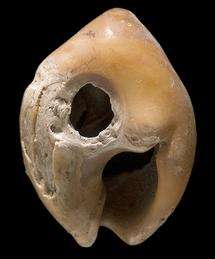
(PhysOrg.com) -- A team of archaeologists has uncovered some of the world’s earliest shell ornaments in a limestone cave in Eastern Morocco. The researchers have found 47 examples of Nassarius marine shells, most of them perforated and including examples covered in red ochre, at the Grotte des Pigeons at Taforalt.
The fingernail-size shells, already known from 82,000-year-old Aterian deposits in the cave, have now been found in even earlier layers. While the team is still awaiting exact dates for these layers, they believe this discovery makes them arguably the earliest shell ornaments in prehistory.
The shells are currently at the centre of a debate concerning the origins of modern behaviour in early humans. Many archaeologists regard the shell bead ornaments as proof that anatomically modern humans had developed a sophisticated symbolic material culture. Up until now, Blombos cave in South Africa has been leading the ‘bead race’ with 41 Nassarius shell beads that can confidently be dated to 72,000 years ago.
Aside from this latest discovery unearthing an even greater number of beads, the research team says the most striking aspect of the Taforalt discoveries is that identical shell types should appear in two such geographically distant regions. As well as Blombos, there are now at least four other Aterian sites in Morocco with Nassarius shell beads. The newest evidence, in a paper by the authors to be published in the next few weeks in the Journal of Quaternary Science Reviews, shows that the Aterian in Morocco dates back to at least 110,000 years ago.
Research team leader, Professor Nick Barton, from the Institute of Archaeology at the University of Oxford, said: ‘These new finds are exciting because they show that bead manufacturing probably arose independently in different cultures and confirms a long suspected pattern that humans with modern symbolic behaviour were present from a very early stage at both ends of the continent, probably as early as 110,000 years ago.’
Also leading the research team Dr Abdeljalil Bouzouggar, from the Institut National des Sciences de l’Archéologie et du Patrimoine in Morocco, said: ‘The archaeological and chronological contexts of the Taforalt discoveries suggest a much longer tradition of bead-making than previously suspected, making them perhaps the earliest such ornaments in the world.’
Archaeologists widely believe that humans in Europe first started fashioning purely symbolic objects about 40,000 years ago, but in Africa this latest evidence shows that humans were engaged in this activity at least 40,000 years before this.
Excavations in April 2009 also continued in the upper levels of Taforalt to investigate a large well-preserved cemetery dating to around 12,500 years ago. The project, co-ordinated by Dr Louise Humphrey, from the Natural History Museum in London, has found adult as well as infant burials at the site. The infant burials throw an interesting light on early burial traditions as many of the infants seem to be buried singly beneath distinctive blue stones with the undersides smeared with red ochre. By contrast, studies by Dr Elaine Turner of the Römisch Germanisches Zentralmuseum, Mainz, show that the adults’ grave pits were generally marked by the horn cores of wild barbary sheep. Taforalt remains the largest necropolis of the Late Stone Age period in North Africa presently under excavation.
Professor Barton said: ‘Taking our new discovery of the shell beads at Taforalt, together with the discoveries of the decorated burials excavated by Dr Louise Humphrey, it shows that the cave must have retained its special interest for different groups of people over many thousands of years. One of its unique attractions and a focal point of interest seems to have been a freshwater spring that rises next to the cave.’
Provided by Oxford University (news : web)


