Storing a Lightning Bolt in Glass for Portable Power
May 5, 2009 Storing a Lightning Bolt in Glass for Portable Power

Enlarge

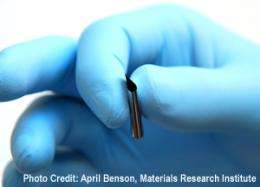
Glass film.

(PhysOrg.com) -- Materials researchers at Penn State University have reported the highest known breakdown strength for a bulk glass ever measured. Breakdown strength, along with dielectric constant, determines how much energy can be stored in an insulating material before it fails and begins to conduct electricity.

A bulk with high breakdown strength and high dielectric constant would make an ideal candidate for the next generation of high energy density storage capacitors to power more efficient electric vehicles, as well as other portable and pulsed power applications.

The highest dielectric breakdown strengths for bulk glasses are typically in the 4-9MV/cm range. The breakdown strength for the tested samples were in the 12MV/cm range, which in conjunction with a relatively high permittivity, resulted in energy densities of 35 J/cm3, as compared to a maximum energy density of 10 J/cm3 for polypropylene, the most common dielectric for pulsed power applications.

“For a bulk glass, this is extraordinary,” says Nick Smith, a Ph.D. candidate in materials science and engineering at Penn State, who is lead author on the report and performed the testing. Smith used samples of 50 micron-thick commercial glass, which he etched for testing with hydrofluoric acid until the samples were only 10-20 microns thick. The resulting glass was so thin it could be flexed like a piece of plastic film, yet so delicate it could easily disintegrate if mishandled. The thinner the glass, the more electric field can be applied before failure.

The etched glass was placed in a polymer fluid for testing and up to 30,000 volts were applied. When the breakdown point was reached, electricity began to flow through the glass suddenly, with a flash and a bang that resembles a lightning bolt conducting through air. The polymer fluid was used to contain the lightning. In each case, failure occurred within 40 to 80 seconds.

The bulk glass tested is an alkali-free barium boroaluminosilicate glass produced in large quantities for flat panel displays and microelectronics packaging. Its high energy storage capability is attributed to the highly polarizable barium atoms, which contribute to the enhanced permittivity, and the alkali-free composition, which inhibits energy loss. Also a factor is the nearly defect-free quality of the glass. The specific process used to manufacture this glass yields a more flaw-free material, especially at the surface, which further enhances resistance to breakdown.

Sheets of 30-micron-thick glass, which are expected to be available commercially in the near future, are likely to have even higher breakdown strength than the etched glass due to an even more uniform flaw-free surface. “This opens a potentially new market for glass,” says Smith. “We are always looking for new functionalities in glass. Ideally, manufacturing will get to a point where they can make any size sheet they need for any size capacitor.”

Contributing author Michael Lanagan points out that engineering challenges remain as they scale up from the small size glass capacitors tested to those ready for commercial production. “We’ll lose some of the energy density as we increase in volume,“ he says, “but we should still end up with some remarkable capacitance.”

A paper reporting their results, titled “Glass as a High Energy Density Dielectric Material,” is currently available online and in the June 2009 edition of Materials Letters. In addition to Smith, the authors are graduate student Badri Rangarajan, engineering science and mechanics, Michael T. Lanagan, associate professor of engineering science and mechanics, and Carlo G. Pantano, distinguished professor of materials science and engineering.

Provided by Pennsylvania State University


print this article email this article download pdf blog this article bookmark this article     Stumble it Digg this share on Facebook retweet share on Reddit add to delicious
Rate this story - 4 /5 (21 votes)

Rank Filter

Move the slider to adjust rank threshold, so that you can hide some of the comments.


Display comments: newest first

  • Alizee - May 05, 2009
    • Rank: 4.4 / 5 (7)
    http://www.youtub...st4VwwEU

    The interior of an 18" square x 1" piece of Plexiglas was charged to about 2.2 million volts (MV) using a 5 million volt particle accelerator. This traps a layer of excess negative charge inside, about half way through the specimen. When discharged, the excess charge escapes with a bright flash and a loud bang. The hot, lightning-like discharges create thousands of microscopic fractures inside the acrylic, resulting in a branching "Captured Lightning" sculpture.

    Read more at:

    http://capturedli...rgs.html
  • TJ_alberta - May 05, 2009
    • Rank: not rated yet
    thanks Alizee. Excellent sites. A whole world of physics in a block of plastic.
  • Bob_Kob - May 05, 2009
    • Rank: not rated yet
    I can imagine, in the future we will all carry around lightning in a crystal for power.
  • KBK - May 06, 2009
    • Rank: not rated yet
    I can imagine, in the future we will all carry around lightning in a crystal for power.


    Just like the Ole Days. Here we go again.....
  • Ruggy - May 07, 2009
    • Rank: not rated yet
    Fantastic discovery!

    I am curious how long these thin sheets of glass will last in an ultracapacitor, given that glass is technically not a solid but a liquid, and as such it can flow very slowly. Of course normally this is so slow that we can disregard it entirely. But could this be a concern down at the micron scale?
  • Alexa - May 07, 2009
    • Rank: 1 / 5 (1)
    this be a concern down at the micron scale?
    Nope, the main trick is, every sheet of light contains tiny invisible surface cracks, which are removed by action of hydrofluoric acid. This makes the sheet of light so bendable, by the way - this is a well known phenomena. But the same effect can be achieved by covering of glass surface by thin layer of varnish.

    Another effect of acid may be in removal of residual traces of alkali metal ions, which are the main source of ion conductivity of glass at elevated temperature. Common sheet of glass contains a more conductive surface layer rich of alkali metal ions from production and the hydrofluoric acid etching removes this surface layer.


    After all, this is why the barium glass was used: barium ions are bivalent and as such they're incorporated into silicate structure more firmly then univalent alkali metal ions - so they cannot move so easily in strong electrostatic field.
  • Slotin - May 07, 2009
    • Rank: 1 / 5 (1)
    Errata: "sheet of light" = sheet of glass, indeed...
  • thubten - Jun 10, 2009
    • Rank: not rated yet
    Who will produce a prototype product first Penn State or EEstor?
  • HeyZeuss - Sep 05, 2009
    • Rank: not rated yet
    33J/cubic cm seems pathetic. thats only 1kw for 15seconds from 1kg....

May 5, 2009 all stories

Comments: 9

4 /5 (21 votes)
  • Stumble this up

  • Digg this

  • share this

  • hide
  • Related Stories

  • Polymer electric storage, flexible and adaptable
    created Aug 20, 2008 | popularity not rated yet | comments 0
  • Unique Material May Allow Capacitors to Store More Energy
    created Jul 20, 2007 | popularity not rated yet | comments 0
  • Switchable mirror glass produced for energy efficient windows
    created Jan 30, 2007 | popularity not rated yet | comments 0
  • High-performance energy storage
    created Jul 03, 2007 | popularity not rated yet | comments 0
  • New nanocomposite processing technique creates more powerful capacitors
    created Apr 26, 2007 | popularity not rated yet | comments 0


  • hide
  • Relevant PhysicsForums posts

  • Ionization vs. photo-generation - what is the difference?
    created 38 minutes ago
  • Ising model
    created 22 hours ago
  • Photon replica
    created Nov 24, 2009
  • Planck's Radiation Law and Stefan's Law
    created Nov 24, 2009
  • More from Physics Forums - Atomic, Solid State, Comp. Physics

Other News

First Neutrino Events Observed at T2K Near Detector

First Neutrino Events Observed at T2K Near Detector

Physics / General Physics

created 22 hours ago | popularity 4.8 / 5 (22) | comments 1

(PhysOrg.com) -- Physicists from the Japanese-led multi-national T2K neutrino collaboration announced today that over the weekend they detected the first events generated by their newly built neutrino beam ...


Researchers develop virtual streams to help restore real ones

Physics / General Physics

created 17 hours ago | popularity not rated yet | comments 0

Researchers at the University of Minnesota have developed a unique new computer model called the Virtual StreamLab, designed to help restore real streams to a healthier state. The Virtual StreamLab, which demonstrates the ...


Scientists react as they stand in front of a screen at CERN

First atoms reported smashed in Large Hadron Collider (Update)

Physics / General Physics

created Nov 23, 2009 | popularity 4.6 / 5 (29) | comments 21

Two circulating beams on Monday produced the first particle collisions in the world's biggest atom smasher, the Large Hadron Collider (LHC), three days after its restart, scientists announced.


Restored machine to explore mysteries of Big Bang (AP)

Restored machine to explore mysteries of Big Bang

Physics / General Physics

created Nov 21, 2009 | popularity 4.6 / 5 (18) | comments 26

(AP) -- Scientists are preparing the world's largest atom smasher to explore the depths of matter after successfully restarting the $10 billion machine following more than a year of repairs.


In the Brain, Seven Is A Magic Number

In the Brain, Seven Is A Magic Number

Physics / General Physics

created Nov 23, 2009 | popularity 4.5 / 5 (31) | comments 8

Having a tough time recalling a phone number someone spoke a few minutes ago or forgetting items from a mental grocery list is not a sign of mental decline; in fact, it's natural.