High-energy Electrons Could Come from Pulsars -- or Dark Matter
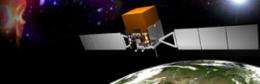
(PhysOrg.com) -- Something in our galactic neighborhood seems to be producing large numbers of high-energy electrons, according to new data gathered by the Fermi Gamma-ray Space Telescope. The electrons could be coming from nearby pulsars—or they could be a longed-for signal of dark matter, the elusive, invisible material thought to make up nearly a quarter of the universe.
FGST's Large Area Telescope, a collaboration between NASA, the U.S. Department of Energy and multiple international partners, has been scanning the skies for gamma rays and particles since its launch last summer. The LAT, which was partially constructed and assembled at SLAC, measured an unexpectedly high number of electrons with energies between 100 billion and one trillion electronvolts. This result is not likely if high-energy particles—also known as cosmic rays—are coming only from distant parts of the galaxy.
"If these particles were emitted far away, they'd have lost a lot of their energy by the time they reached us," said LAT collaborator Luca Baldini of the Istituto Nazionale di Fisica Nucleare in Pisa, Italy.
When combined with other recent results, the LAT finding provides compelling evidence that something close by—probably less than 6,000 light years away—is churning out high-energy particles. The European satellite PAMELA, for example, last fall reported detecting surprisingly large quantities of high-energy positrons, the antimatter counterparts of electrons.
"Between the PAMELA results and our results, it's very hard to construct a conventional galactic cosmic-ray model" explaining this number of high-energy particles, said SLAC Professor Elliott Bloom, who works on the LAT project. "You need relatively local sources of positrons and electrons."
These local sources could be pulsars, rapidly rotating neutron stars that emit intense electromagnetic radiation, positrons and electrons. Or they could be dark matter elementary particles crashing into each other or decaying. Such processes also release high-energy particles, theorists propose.
Physicists infer the existence of dark matter—which doesn't interact with any of the electromagnetic forces, making it invisible to our eyes and our instruments—from its gravitational effects on light and "normal matter" such as stars, planets and interstellar gas. Though studies suggest that dark matter is more than five times as abundant as normal matter, nobody has yet directly measured the strange material or characterized its nature. The LAT team isn't claiming to be the first.
"Occam's Razor says pulsars are the most prosaic, and perhaps most likely, explanation," Bloom said. "But dark matter is also a possibility. This is particle astrophysics at its most exciting, trying to track down what's going on here."
A few other projects have recently mapped the spread of cosmic-ray electron energies in space. One, the ATIC collaboration, reported a very large bump at high energies. The ATIC results are not mirrored by the LAT, which has defined this energy spectrum with much smaller errors.
"This measurement provides the definitive determination of the spectrum of electrons outside of Earth's atmosphere," said SLAC physicist Greg Madejski, another LAT team member. Without such an accurate spectrum, suppositions about pulsars, dark matter or any other source of high-energy particles are on shaky ground.
The LAT measurements, presented May 2 and today at the American Physical Society meeting in Denver, Colorado and published online in the journal Physical Review Letters, are difficult to make. For each electron that hits LAT's detectors, 50 to 100 other charged particles, mainly protons, come through as well.
"It's like finding a needle in a haystack," Baldini said. "It requires a lot of simulations, a lot of cross-checking and a lot of study about how electrons behave in the detector."
The LAT team is currently trying to pin down where exactly the electrons are coming from. They're hoping to correlate any significant departures from the background with positions of known pulsars. And they're extending LAT's reach even further, to electrons with energies of two or three trillion electronvolts, according to collaborator Igor Moskalenko of SLAC.
"What we will see above that level can only come from local sources," he said. "If there are cosmic ray sources nearby, we may be able to find them."
Provided by SLAC National Accelerator Laboratory (news : web)


