Tiny particles make LED light more pleasing
May 5, 2009 By PETER SVENSSON , AP Technology Writer Tiny particles make LED light more pleasing (AP)

Enlarge

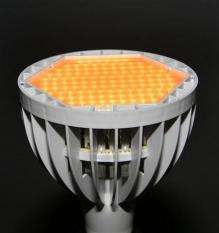
An Array PAR30 LED lamp from Nexxus Lighting is shown at Lightfair International trade show Tuesday, May 5, 2009 in New York. The $100 lamp, which contains 120 light emitting diodes, uses less than 8 watts of energy and produces the equivalent light of a 75 watt incandescent bulb. (AP Photo/Mark Lennihan)

(AP) -- Light-emitting diodes are prime candidates for replacing inefficient incandescent bulbs, but have a few things working against them. They can provide a pleasing warm light or they can be energy-efficient, but they haven't been able to be both at the same time.

On Tuesday, two small companies showed off an LED lamp that's both very power-efficient and produces a light similar to that of a standard tungsten or halogen bulb.

The LEDs in the lamp shine through a thin layer of "," a scattering of particles of very small but precisely controlled size. When light hits them, they emit light of a different color, much like the "phosphor" layer of a fluorescent tube. The magic of quantum dots is that the color they emit can be controlled very accurately by adjusting their size, which means less wasted energy and more pleasing color.

The dots are so small that more than 10,000 of them could be could be lined up over the width of a human hair.

The Quantum Light lamp is made by Nexxus Lighting Inc. of Charlotte, N.C., which demonstrated it at the Light Fair trade show in New York. The lamp will go on sale late this year at an as yet undetermined price. Nexxus already sells a version of it that lacks quantum dots, yielding a bluer, harsher light, for around $100.

The more pleasing light produced by quantum dots could allow LEDs to outshine compact fluorescent bulbs, which are energy-efficient but have taken time to win over consumers, said Bill Blackley, vice president at Nexxus.

"A hundred years, incandescents have been around. That's what people want," Blackley said.

Given the high price of LED lights, the main use for them so far has been in commercial applications, like restaurants and hotels, where the longevity of the lamps makes up for their purchase cost. Nexxus says the lamps last up to 25 times longer than halogen alternatives.

The layer of quantum dots in the lamp are the first commercial product of QD Vision Inc., a Massachusetts Institute of Technology spinoff based in Watertown, Mass. It hopes to spread their use to many other applications, including TV backlights, where they could improve brightness and color saturation.

Quantum dots have shown up in an lighting product before - in strings of colored Christmas lights launched last year by QD Vision competitor Evident Technologies Inc. of Troy, N.Y.

---

On the Net:

http://www.nexxuslighting.com

http://www.qdvision.com

©2009 The Associated Press. All rights reserved. This material may not be published, broadcast, rewritten or redistributed.


print this article email this article download pdf blog this article bookmark this article     Stumble it Digg this share on Facebook retweet share on Reddit add to delicious
Rate this story - 4.9 /5 (11 votes)

Rank Filter

Move the slider to adjust rank threshold, so that you can hide some of the comments.


Display comments: newest first


May 5, 2009 all stories

Comments: 1

4.9 /5 (11 votes)
  • Stumble this up

  • Digg this

  • share this

  • hide
  • Related Stories

  • A Halogen Bulb
    created Sep 26, 2004 | popularity not rated yet | comments 0
  • Powerful Little Light: LED With 1,000 Lumens
    created Mar 15, 2007 | popularity not rated yet | comments 0
  • Quantum dots that produce white light could be the light bulb's successor
    created Oct 20, 2005 | popularity not rated yet | comments 0
  • Researchers set new record for brightness of quantum dots
    created Sep 25, 2007 | popularity not rated yet | comments 0
  • Scientists develop novel multi-color light-emitting diodes
    created May 18, 2005 | popularity not rated yet | comments 0


  • hide
  • Relevant PhysicsForums posts

  • May i know is structure such as bcc, fcc depends on how it process?
    created 5 hours ago
  • Wear patterns
    created Nov 18, 2009
  • What is meant by 'as-cast'?
    created Nov 18, 2009
  • Iron-rich spheres
    created Nov 18, 2009
  • More from Physics Forums - Materials & Chemical Engineering

Other News

Using superconducting probes to get a picture of what it's like inside CNTs

Nanotechnology / Nanophysics

created Nov 20, 2009 | popularity 4.9 / 5 (7) | comments 0

(PhysOrg.com) -- "Carbon nanotubes are exciting for fundamental physics, and for potential technological applications," Nadya Mason tells PhysOrg.com. "However, we are generally limited in the way that we can study them. ...


Nanoparticles used in common household items caused genetic damage in mice

Nanotechnology / Bio & Medicine

created Nov 16, 2009 | popularity 4.7 / 5 (22) | comments 11

Titanium dioxide (TiO2) nanoparticles, found in everything from cosmetics to sunscreen to paint to vitamins, caused systemic genetic damage in mice, according to a comprehensive study conducted by researchers at UCLA's Jonsson ...


Nanotube defects equal better energy and storage systems

Nanotube defects equal better energy and storage systems

Nanotechnology / Nanomaterials

created Nov 19, 2009 | popularity 4.4 / 5 (9) | comments 2

(PhysOrg.com) -- Most people would like to be able to charge their cell phones and other personal electronics quickly and not too often. A recent discovery made by UC San Diego engineers could lead to carbon ...


When It Comes to Drug Delivery, Size Matters

Nanotechnology / Bio & Medicine

created Nov 20, 2009 | popularity 5 / 5 (1) | comments 0

(PhysOrg.com) -- One of the great promises of nanotechnologies lies in its ability to create drug-containing nanoparticles decorated with targeting molecules that recognize and bind to cancer cells, providing drug delivery ...


Scientists synthesize graphene-like material: Polymer with honeycomb structure

Scientists synthesize graphene-like material: Polymer with honeycomb structure

Nanotechnology / Nanomaterials

created Nov 19, 2009 | popularity 4.5 / 5 (6) | comments 1

Two-dimensional carbon layers, so-called graphenes, are regarded as a possible substitute for silicon in the semiconductor industry. The electronic properties of these layers can be varied by "building in" ...