Southern Hemisphere Ants Richer and More Diversified
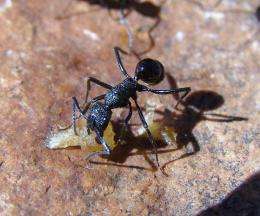
There are fewer species of ants in the northern hemisphere than in the southern hemisphere. This is the conclusion drawn by an international team of scientists that have studied 1,003 local ant assemblages on five different continents. According to the study, ant communities in the northern hemisphere may have suffered more extinctions as a result of the climate changes that occurred between 53 and 54 million years ago.
An international team of more than 26 researchers - including scientists from the Autonomous University of Barcelona (AUB) and the Doñana Biological Station - has studied the global patterns that govern the biological diversity of ant communities. They conclude that latitudinal asymmetry is due to climatic and historical differences between hemispheres, which have led to there being a larger number of species of ants in the southern hemisphere than in the northern hemisphere.
"There is a latitudinal gradient in local ant species richness. However, there is latitudinal asymmetry around the equator and, therefore, sites in the southern hemisphere are more diverse than sites in the northern hemisphere", co-author of the study and a researcher at the Ecology Unit and Centre of Ecological Research and Forestry Applications (CREAF) at the AUB, Xavier Arnan explained to SINC.
The study, which was published recently in Ecology Letters, examines species richness in 1,003 local ant assemblages on five different continents. Researchers attribute the differences between hemispheres to climate-related and historical variables such as regional history, disturbance history and the history of climate change itself.
Results suggest that contemporary climatic conditions explain this difference, along with the Eocene climate changes (between 53 and 54 million years ago). "It appears that a greater change in climate since the Eocene (when temperatures were 10ºC warmer than today) in the northern hemisphere than in the southern hemisphere led to a larger number of extinctions in the north with the subsequent effect on ant species richness on a local scale", Arnan indicated.
Australia has more ants than the entire northern hemisphere
Ant species richness ranges from 0 to 184 different species, variations being caused by temperature and rainfall, the levels of which are higher in the southern hemisphere for one same latitude. Almost half (49%) of the variation in the number of species between the different locations studied is due to climate differences.
In 1845, English naturalist Charles Darwin explained that the greater diversity of life forms in the southern hemisphere was related to a more equable climate, a theory this international study supports.
There is such a large difference between the two hemispheres that Australia alone has greater ant species richness than the entire northern hemisphere. Unlike birds, amphibians or plants, ant species richness is greater in dry habitats, particularly in the warmest regions of the planet. "In warm and dry environments, ants are diverse", the ecologists clarify.
The researchers, from eight different countries, contributed to the study with regional data and their own field work. This information was used to create the Global Ant Community Database, "a database that contains information on the diversity and abundance of ant communities in more than 3,000 sites around the world", Arnan informed SINC Arnan.
This is the second study using this database that has been published and one of the first large-scale studies of local communities, in this case between hemispheres, which jointly considers the impact of both historical and contemporary factors on hemispheric diversity asymmetries," the scientist concludes.
More information: “Climatic drivers of hemispheric asymmetry in global patterns of ant species richness” Ecology Letters 12(4): 324-333 April 2009.
Source: Plataforma SINC (news : web)


