Flow of potassium into cells implicated in schizophrenia
May 6, 2009
Flow of potassium into cells implicated in schizophrenia

Enlarge

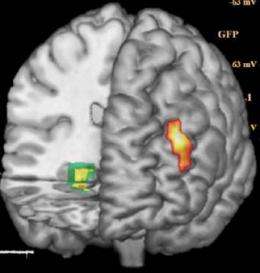
This shows areas in the prefrontal cortex (right) and hippocampus (left) where activity differed in healthy control subjects during thinking tasks, depending on whether they had the risk version of the KCNH2 potassium channel gene. The image is made from functional magnetic resonance imaging data superimposed on 3-D MRI reconstruction of the brain. Credit: NIMH Genes Cognition and Psychosis Program

A study on schizophrenia has implicated machinery that maintains the flow of potassium in cells and revealed a potential molecular target for new treatments. Expression of a previously unknown form of a key such potassium channel was found to be 2.5 fold higher than normal in the brain memory hub of people with the chronic mental illness and linked to a hotspot of genetic variation.

An extensive series of experiments suggest that selectively inhibiting this suspect form could help correct disorganized brain activity in - without risk of cardiac side effects associated with some existing antipsychotic medications. Scientists at the National Institutes of Health and European colleagues report on threads of converging evidence in the May, 2009 issue of the journal Nature Medicine.

"The end game in linking genes with complex disorders like schizophrenia requires that we not only demonstrate statistical association, but also show how a gene version acts biologically to confer risk," explained Daniel Weinberger, M.D., director of National Institute of Mental Health's (NIMH) Genes Cognition and Psychosis Program, who led the research. "We found schizophrenia-like effects in brain circuitry and mental processing in perfectly healthy people who carry the risk-associated version of this potassium channel gene, even though they don't show any psychotic behavior."

Evidence suggests that schizophrenia stems from complex interactions between multiple genes and environmental factors. Several candidate genes have recently been statistically linked to the illness in large genome-wide association studies.

"Our study goes further, spanning discovery of a new gene variant, confirmation of its association with the illness, and multi-level probes into how it works - in human post mortem brain tissue, the living human brain, and neurons," added Weinberger.

By regulating the flow of potassium ions into the cell, control when neurons fire - electrically discharge and release a chemical messenger that signals neighboring neurons in a circuit. This flow is regulated, in part, by activity of the chemical messenger dopamine, the main target of antipsychotic medications used to treat schizophrenia.

One type of potassium channel, called KCNH2, attracted the researchers' interest for its potential role in sustaining the type of neuronal firing that supports the higher mental functions disturbed in schizophrenia. Spurred by hints from postmortem studies of linked to schizophrenia in the genomic neighborhood of KCNH2, the researchers analyzed the gene's association with the illness in 5 independent samples comprising hundreds of families. This pinpointed 4 variations associated with schizophrenia within a small region of the KCNH2 gene.

"Yet this statistical association didn't imply a mechanism," said Weinberger. "It didn't explain how KCNH2 might increase risk for schizophrenia. So we went back to the post-mortem in search of an answer."

It was only then that the researchers discovered a previously unknown version of KCNH2, called Isoform 3.1, that soared to levels 2.5 times higher-than-normal in the hippocampus (memory hub) of people who had schizophrenia - especially those with the risk-associated variations. Isoform 3.1 was also higher-than-normal in healthy individuals who carried the risk-associated variations. This signaled the existence of a risk-associated version of the KCNH2 gene.

Healthy controls carrying the risk gene version also:

  • Performed significantly worse-than-normal on measures of IQ and mental processing speed. Previous studies have linked similar performance with genetic risk for schizophrenia.
  • Inefficiently processed memory in the hippocampus and working memory in the prefrontal cortex, as revealed by functional MRI (magnetic resonance imaging) scans. Although they performed similarly to controls on these tasks, their brains had to work harder to compensate for disordered tuning of circuitry - a phenomenon previously implicated in schizophrenia.
  • Showed significantly decreased volume in the hippocampus - a heritable trait - in anatomical MRI scans.
In addition, Isoform 3.1:
  • Showed levels 1,000 times lower in the heart than the other main form of KCNH2 and does not exist in lower animals, suggesting that it has evolved a unique role in the primate brain. Mutant forms of KCNH2 in the heart can lead to arrhythmias and even sudden death - a rare risk of taking antipsychotic medications, many of which interact with KCNH2. So targeting this brain-specific form potentially opens the way to development of new treatments free of such cardiac side-effects.
  • Dramatically changed activity in rodent brains toward a neuronal firing pattern that may be important for thinking and memory tasks unique to primates.
  • Is expressed much more prior to birth, compared to the other main form of KCNH2, suggesting that it plays a prominent role in the early stages of brain development.
  • Is associated with a hotspot of variation in an area that controls gene expression, hinting that the suspect variations may contribute to schizophrenia risk by over-expressing Isoform 3.1.
Even though it is normally important for our higher order executive functioning, such over expression of Isoform 3.1 in schizophrenia could result in "abnormally increased neuronal excitability, runaway circuit activity and inefficient information processing," suggested Stephen Huffaker, Ph.D., the article's lead author, now a medical student at Harvard. The researchers propose that a treatment designed to inhibit just Isoform 3.1, might spare any heart-related side effects while improving the disorganized neural firing characteristic of the brain in schizophrenia.

More information: A primate-specific, brain isoform of KCNH2 affects cortical physiology, cognition, neuronal repolarization and risk of schizophrenia. Huffaker SJ, Chen J, Nicodemus KK, Sambataro F, Yang F, Mattay V, Lipska BK, Hyde TM, Song J, Rujescu D, Giegling I, Mayilyan K, Proust MJ, Soghoyan A, Caforio G, Callicott JH, Bertolino A, Meyer-Lindenberg A, Chang J, Ji Y, Egan MF, Goldberg TE, Kleinman JE, Lu B, Weinberger DR. Nat Med. 2009 May 3.

Source: NIH/National Institute of Mental Health

Filter


Move the slider to adjust rank threshold, so that you can hide some of the comments.


Display comments: newest first

NonRational
May 06, 2009

Rank: not rated yet
As a sufferer of schizo-affective disorder, this is very exciting news. A potential new target for treatment. I can vouch for the fact that one's memory is poor after developing schizo symptoms. Also they provide a clue as to why I seem to have heart palpitations on an irregular basis.

Thanks to all the researchers. And thanks to science!
Agrippa
May 06, 2009

Rank: 5 / 5 (1)
This could have positive effects on the lack of continuing a medication regimen because of side effects and non-compliance. Knowing what problems can arise from personal family experience, this may be a gift to all concerned.
Rank 5 /5 (8 votes)
Related Stories
Relevant PhysicsForums posts
  • We the immaterial soul
    created8 hours ago
  • Is Everyday Technology Killing Us?
    createdFeb 08, 2012
  • Exercise and weight loss
    createdFeb 08, 2012
  • Why do we have head aches? Our brains can't feel anything.
    createdFeb 07, 2012
  • "The end of diseases" by David Agus, interview from Daily Show with Jon Stewart
    createdFeb 04, 2012
  • Oncolytic adenovirus
    createdFeb 04, 2012
  • More from Physics Forums - Medical Sciences

More news stories

Injured boomers beware: Know when to see doctor

(AP) -- It happened to nurse Jane Byron years after an in-line skating fall, business owner Haralee Weintraub while doing "men's" push-ups, and avid cyclist Gene Wilberg while lifting a heavy box.

Medicine & Health / Health

created 16 minutes ago | popularity not rated yet | comments 0

FDA-approved drug rapidly clears amyloid from the brain, reverses Alzheimer's symptoms in mice

Neuroscientists at Case Western Reserve University School of Medicine have made a dramatic breakthrough in their efforts to find a cure for Alzheimer's disease. The researchers' findings, published in the journal Science, show t ...

Medicine & Health / Neuroscience

created Feb 09, 2012 | popularity 4.9 / 5 (53) | comments 21 | with audio podcast

Green tea found to reduce disability in the elderly

(Medical Xpress) -- A lot of research has been done over the past several years looking into the health benefits of green tea. As a result, scientists have found that regular consumption of the beverage leads ...

Medicine & Health / Health

created Feb 07, 2012 | popularity 4.4 / 5 (14) | comments 11 | with audio podcast report

Teen school drop-outs three times as likely to be on benefits in later life

Teen school drop-outs are almost three times as likely to be on benefits in later life as their peers who complete their schooling, indicates research published online in the Journal of Epidemiology and Community Health.

Medicine & Health / Health

created Feb 06, 2012 | popularity not rated yet | comments 13

To perform with less effort, practice beyond perfection

Whether you are an athlete, a musician or a stroke patient learning to walk again, practice can make perfect, but more practice may make you more efficient, according to a surprising new University of Colorado Boulder study.

Medicine & Health / Neuroscience

created Feb 09, 2012 | popularity 4.4 / 5 (15) | comments 6 | with audio podcast


Google might launch Drive for cloud storage soon

(PhysOrg.com) -- Google's next big move, according to the Wall Street Journal, is a cloud storage service called Drive. Hardly first to the plate, Google is simply catching up to introducing its cloud reposi ...

Latin America mining boom clashes with conservation

Latin America is experiencing a mining boom as prices rise fuelled by a hike in global demand, but the region is also being hit by a wave of violent protests, strikes and rallies by environmentalists.

Love a click away in Indonesia's Twitter Republic

He was a geeky kid from Yogyakarta, she a glamorous city girl in Jakarta. In a country with one of the world's most vibrant social networking scenes they fell in love on Twitter.

Europeans protest controversial Internet pact

Tens of thousands of people marched in protests in more than a dozen European cities Saturday against a controversial anti-online piracy pact that critics say could curtail Internet freedom.

Walney offshore wind farm is world's biggest (for now)

(PhysOrg.com) -- The Walney wind farm on the Irish Sea--characterized by high tides, waves and windy weather--officially opened this week. The farm is treated in the press as a very big deal as the Walney ...

Navy to begin tests on electromagnetic railgun prototype launcher

The Office of Naval Research (ONR)'s Electromagnetic (EM) Railgun program will take an important step forward in the coming weeks when the first industry railgun prototype launcher is tested at a facility ...