Cooperative forces boost collective mobility of cells
May 6, 2009 Cooperative forces boost collective mobility of cells

Enlarge

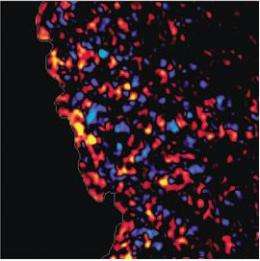
Collective cell mobility is the result of a cooperative process.

An article by Dr. Xavier Trepat, senior researcher of the Cellular and respiratory biomechanics group at the University of Barcelona, Spain, contributes for the first time an experimental answer to the question of how cells move during biological processes as diverse as the development, metastasis, or regeneration of tissues.

The work, entitled “Physical forces during collective cell migration”, has just been published by and addresses the issue of collective mobility of cells, that is to say, how cells are moved within tissues, and what is the prevalent form of movement inside .

"Research into collective cell mobility is very active due to the direct implications it has on fields such as embryologic development, organ regeneration, and cancer. For example, if we could find a way to control cell mobility during metastasis, cancer would be a curable disease in the majority of cases," says Xavier Trepat, who is also researcher in the Department of Physiological Sciences at the University of Barcelona, and in the Networking Biomedical Research Centre for respiratory diseases (CIBER).

Up until now, scientists had proposed various mechanisms to explain collective cell migration. One for example, suggests that the cells move collectively due to the existence of “leader” cells, which stretch out in the rest of the group, like a train pulls carriages behind it. Another hypothesis suggests that each cell moves independently to those around it, like cars on the motorway during a traffic jam, or like soldiers in a military parade. “We have rejected both these possibilities,” says Trepat.

According to his research, collective cell mobility is the result of a cooperative process in which each cell contributes to the movement of the group, stretching to those around it. “It is a mechanism similar to a tug-of-war game, in which two teams pull a rope by its extremes and the team that pulls the hardest wins. During the game, each player generates force and transmits it to the rope, so that the tension in the rope is the sum of the forces generated by each member of the team. Cells do the same. Each cell generates force to stretch to its neighbours in the direction of the movement» explains the researcher.

Source: University of Barcelona (news : web)


print this article email this article download pdf blog this article bookmark this article     Stumble it Digg this share on Facebook retweet share on Reddit add to delicious
Rate this story - 4 /5 (5 votes)


May 6, 2009 all stories

Comments: 0

4 /5 (5 votes)
  • Stumble this up

  • Digg this

  • share this

  • hide
  • Related Stories


  • hide
  • Relevant PhysicsForums posts

  • Noether's Theorem
    created 1hour ago
  • moment of inertia and friction
    created 12 hours ago
  • two-dimensional collision
    created 14 hours ago
  • The acceleration of mass using light
    created 16 hours ago
  • More from Physics Forums - General Physics

Other News

In the Brain, Seven Is A Magic Number

In the Brain, Seven Is A Magic Number

Physics / General Physics

created 20 hours ago | popularity 4.4 / 5 (28) | comments 8

Having a tough time recalling a phone number someone spoke a few minutes ago or forgetting items from a mental grocery list is not a sign of mental decline; in fact, it's natural.


Scientists react as they stand in front of a screen at CERN

First atoms reported smashed in Large Hadron Collider (Update)

Physics / General Physics

created 23 hours ago | popularity 4.7 / 5 (25) | comments 16

Two circulating beams on Monday produced the first particle collisions in the world's biggest atom smasher, the Large Hadron Collider (LHC), three days after its restart, scientists announced.


New tool for helping pediatric heart surgery

Physics / General Physics

created 8 hours ago | popularity not rated yet | comments 0

A team of researchers at the University of California, San Diego and Stanford University has developed a way to simulate blood flow on the computer to optimize surgical designs. It is the basis of a new tool that may help ...


Straightening messy correlations with a quantum comb

Straightening messy correlations with a quantum comb

Physics / Quantum Physics

created 23 hours ago | popularity 4.8 / 5 (8) | comments 0

Quantum computing promises ultra-fast communication, computation and more powerful ways to encrypt sensitive information. But trying to use quantum states as carriers of information is an extremely delicate ...


A mechanical model of vocalization

Physics / General Physics

created 19 hours ago | popularity not rated yet | comments 0

When people speak, sing, or shout, they produce sound by pushing air over their vocal folds -- bits of muscle and tissue that manipulate the air flow and vibrate within it. When someone has polyps or some other problem with ...