Alchemy in Tanzania? Gas Becomes Solid at Surface of Oldoinyo Lengai Volcano
May 6, 2009 Alchemy in Tanzania? Gas Becomes Solid at Surface of Oldoinyo Lengai Volcano

Enlarge

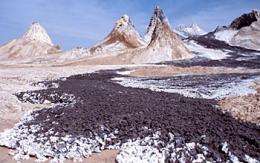
Carbonatite lava that erupted a week before this photo was taken flows from Oldoinyo Lengai volcano. Credit: Tobias Fischer, UNM

(PhysOrg.com) -- Science has unearthed the secret to what might have been alchemy at Oldoinyo Lengai volcano in Tanzania.

There, in the ancient East African Rift at a place known to local Maasai people as the Mountain of God, Oldoinyo Lengai spews forth carbon dioxide-laden lavas called carbonatites. The carbonatites line the volcano's flanks like snowballs.

Oldoinyo Lengai is the only place on Earth where carbonatites currently erupt--and where carbon dioxide from a volcano doesn't vanish into thin air as a gas.


Carbonatite lava at 540 degrees Celsius (1,004 F) erupts from Oldoinyo Lengai volcano in Tanzania. Credit: Tobias Fischer, University of New Mexico

In a paper published this week in the journal Nature, scientists report the results of a study of Oldoinyo Lengai's volcanic gas emissions, sampled by the team during a carbonatite lava eruption.

"We now know the origin of one of the most peculiar magmas on Earth," said William Leeman, program director in the National Science Foundation (NSF)'s Division of Earth Sciences, which funded the research. "These scientists have found that, based on new studies of the chemistry of gas emissions at Oldoinyo Lengai, a very small amount of melting of Earth's mantle, akin to that beneath mid-ocean ridges, can produce carbonatites."

The carbonatites consist of high amounts of carbon dioxide, some 30 percent. Unlike most lavas that are liquid at temperatures above 900 degrees Celsius (1,652 F), carbonatites are much cooler and erupt at only 540 degrees Celsius (1,004 F). However, they're extremely fluid, with a viscosity like that of motor oil.

"We were able to collect pristine samples of the volcanic gases because Oldoinyo Lengai was erupting and under tremendous magma pressure at the time," said Tobias Fischer, a volcanologist at the University of New Mexico and lead author of the paper. "There was minimal air contamination."

"The gases reveal that the carbon dioxide comes directly from the upper mantle, just below the East African Rift," said David Hilton, a geochemist at the Scripps Institution of Oceanography.

"These samples of mantle gases allow us to infer the carbon content of the upper mantle where the carbonatites are produced."

It's about 300 parts per million, a concentration virtually identical to that measured below mid-ocean ridges.
New research study reveals origin of volcano's carbon-based lavas
Enlarge

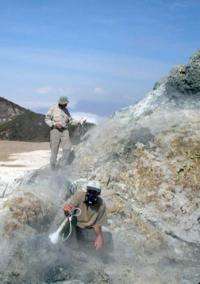
This shows the sampling of volcanic gases in the active crater of Oldoinyo Lengai. Credit: University of New Mexico

The finding is significant, said geochemist Bernard Marty of the CNRS-CRPG (Centre National de la Recherche Scientifique-Centre de Recherches Pe'trographiques et Ge'ochimiques in France), "because it shows that these extremely bizarre lavas and their parent magmas, called nephelinites, were produced by melting of typical upper mantle minerals--which don't have a high carbon dioxide content."

Previous research, mainly based on laboratory experiments, suggested that a higher carbon dioxide content is needed to produce nephelinites and carbonatites.

"Oldoinyo Lengai magmas also contain an unusually high amount of sodium, up to about 35 percent," said Pete Burnard, a geochemist at CNRS-CRPG.

"It's this sodium content that makes the Lengai carbonatites solid rather than gas at the surface. At all other volcanoes on Earth, carbon dioxide 'degasses' into the atmosphere without forming the sodium-rich carbonatite magmas of Oldoinyo Lengai."

Not all Oldoinyo Lengai's carbon dioxide becomes carbonatite, however. Like other volcanoes, Oldoinyo Lengai does emit carbon dioxide into the atmosphere as a gas.

The scientists conclude that the upper mantle below the continents and the oceans is a uniform and well-mixed reservoir in which the compositions and abundances of carbon dioxide and other gases like nitrogen, argon and helium are essentially the same.

Provided by NSF


print this article email this article download pdf blog this article bookmark this article     Stumble it Digg this share on Facebook retweet share on Reddit add to delicious
Rate this story - 4.1 /5 (8 votes)


May 6, 2009 all stories

Comments: 0

4.1 /5 (8 votes)
  • Stumble this up

  • Digg this

  • share this

  • hide
  • Related Stories

  • Lava provides window on early Earth
    created Nov 02, 2007 | popularity not rated yet | comments 0
  • Why is the Earth's mantle conductive?
    created Dec 04, 2008 | popularity not rated yet | comments 0
  • Measurements link magma melting rate to tectonic plate subduction rate
    created Nov 08, 2007 | popularity not rated yet | comments 0
  • Study Reconciles Long-Standing Contradiction of Deep-Earth Dynamics
    created Aug 25, 2005 | popularity not rated yet | comments 0
  • Diamonds show how Earth is recycled
    created Jul 30, 2008 | popularity not rated yet | comments 0


  • hide
  • Relevant PhysicsForums posts

  • The IPCC and the term "most"
    created Nov 23, 2009
  • Is global warming a fact?
    created Nov 23, 2009
  • Random variability of wind patterns
    created Nov 23, 2009
  • Record precipitation in the UK
    created Nov 22, 2009
  • How to move cloud from one time to another..
    created Nov 22, 2009
  • Which countries around the world cause the most destruction to the rain forest
    created Nov 21, 2009
  • More from Physics Forums - Earth

Other News

Cassini Captures Ghostly Dance of Saturn's Northern Lights

Cassini Captures Ghostly Dance of Saturn's Northern Lights (w/ Video)

Space & Earth / Space Exploration

created 6 hours ago | popularity 5 / 5 (3) | comments 0

(PhysOrg.com) -- In the first video showing the auroras above the northern latitudes of Saturn, Cassini has spotted the tallest known "northern lights" in the solar system, flickering in shape and brightness ...


First black holes may have incubated in giant, starlike cocoons, says CU-Boulder study

First black holes may have incubated in giant, starlike cocoons

Space & Earth / Astronomy

created 9 hours ago | popularity 4.7 / 5 (9) | comments 7

(PhysOrg.com) -- The first large black holes in the universe likely formed and grew deep inside gigantic, starlike cocoons that smothered their powerful x-ray radiation and prevented surrounding gases from ...


ET: Check your voicemail

ET: Check your voicemail

Space & Earth / Space Exploration

created 6 hours ago | popularity 3.4 / 5 (5) | comments 4

(PhysOrg.com) -- Alien beings on faraway planets may not have noticed, but it’s been 35 years since human beings made the first deliberate effort to send them a message.


The drying shores of the Dead Sea

Dead Sea needs world help to stay alive

Space & Earth / Environment

created 8 hours ago | popularity 3.7 / 5 (3) | comments 0

The Dead Sea may soon shrink to a lifeless pond as Middle East political strife blocks vital measures needed to halt the decay of the world's lowest and saltiest body of water, experts say.


From Greenhouse to Icehouse

From Greenhouse to Icehouse

Space & Earth / Earth Sciences

created 15 hours ago | popularity 4.8 / 5 (8) | comments 7

A new study that reconstructed ocean temperatures from millions of years ago could provide new insight into how the Earth responds to climate change.