Mechanical stress leads to self-sensing in solid polymers (w/Video)
May 6, 2009
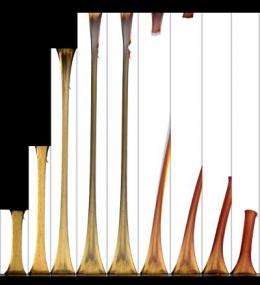
This shows progressive images of a mechanophore linked elastomer during tensile loading. After the polymer reaches a critical strain, a force-induced red color results from selective covalent bond cleavage in the mechanophore just prior to failure. Credit: Beckman Institute ITG, Darren Stevenson and Alex Jerez
Parachute cords, climbing ropes, and smart coatings for bridges that change color when overstressed are several possible uses for force-sensitive polymers being developed by researchers at the University of Illinois.
The polymers contain mechanically active molecules called mechanophores. When pushed or pulled with a certain force, specific chemical reactions are triggered in the mechanophores.
"This offers a new way to build function directly into synthetic materials," said Nancy Sottos, a Willett Professor of materials science and engineering at the U. of I. "And it opens the door to creating mechanophores that can perform different responsive functions, including self-sensing and self-reinforcing, when stressed."
This video is not supported by your browser at this time.
This video shows the force-induced color change in a mechanophore cross-linked polymer bead under compressive loading (left) and corresponding force-displacment curve (right). Credit: Jinglei Yang, Beckman Institute
In previous work, Sottos and collaborators showed they could use mechanical force to induce a reaction in mechanophore-linked polymers that were in solution. Now, as reported in the May 7 issue of the journal Nature, the researchers show they can perform a similar feat in a solid polymer.Mechanically induced chemical activation (also known as mechanochemical transduction) enables an extraordinary range of physiological processes, including the senses of touch, hearing and balance, as well as growth and remodeling of tissue and bone.
Analogous to the responsive behavior of biological systems, the channeling of mechanical energy to selectively trigger a reaction that alters or enhances a material's properties is being harnessed by the U. of I. researchers.
In critical material systems, such as polymers used in aircraft components,
self-sensing and self-reinforcing capabilities could be used to report damage and warn of potential component failure, slow the spread of damage to extend a material's lifetime, or even repair damage in early stages to avoid catastrophic failure.
"By coupling mechanical energy directly to structural response, the desired functionality could be precisely linked to the triggering stimulus," said Sottos, who also is affiliated with the university's Beckman Institute.
In their work, the researchers used molecules called spiropyrans, a promising class of molecular probes that serve as color-generating mechanophores, capable of vivid color changes when they undergo mechanochemical change. Normally colorless, the spiropyran used in the experiments turns red or purple when exposed to certain levels of mechanical stress.
"Mechanical stress induces a ring-opening reaction of the spiropyran that changes the color of the material," said Douglas Davis, a graduate research assistant and the paper's lead author. "The reaction is reversible, so we can repeat the opening and closing of the mechanophore."
"Spiropyrans can serve as molecular probes to aid in understanding the effects of stress and accumulated damage in polymeric materials, thereby providing an opportunity for assessment, modification and improvement prior to failure," Davis said.
To demonstrate the mechanochemical response, the researchers prepared two different mechanophore-linked polymers and subjected them to different levels of mechanical stress.
In one polymer, an elastomer, the material was stretched until it broke in two. A vivid color change in the polymer occurred just before it snapped.
The second polymer was formed into rigid beads several hundred microns in diameter. When the beads were squeezed, they changed from colorless to purple.
The color change that took place within both polymers could serve as a good indicator of how much stress a mechanical part or structural component made of the material had undergone.
"We've moved very seamlessly from chemistry to materials, and from materials we are now moving into engineering applications," Sottos said. "With a deeper understanding of mechanophore design rules and efficient chemical response pathways, we envision new classes of dynamically responsive polymers that locally remodel, reorganize or even regenerate via mechanical regulation."
Source: University of Illinois at Urbana-Champaign (news : web)
-
Mechanics meets chemistry in new way to manipulate matter
Mar 21, 2007 |
not rated yet |
0
-
New recipe for self-healing plastic includes dash of food additive
Oct 15, 2008 |
not rated yet |
0
-
New polymer has applications for dentistry, electronics, automobiles
Jun 10, 2005 |
not rated yet |
0
-
Tough tubes -- Carbon nanotubes endure heavy wear and tear
Jul 02, 2007 |
not rated yet |
0
-
Clicking synthetic and biological molecules together
Feb 19, 2008 |
not rated yet |
0
-
Engineers build first sub-10-nm carbon nanotube transistor
Feb 01, 2012 |
4.9 / 5 (33) |
30
-
Something old, something new: Evolution and the structural divergence of duplicate genes
Jan 31, 2012 |
4.6 / 5 (7) |
1
-
The hidden nanoworld of ice crystals: Revealing the dynamic behavior of quasi-liquid layers
Jan 30, 2012 |
5 / 5 (4) |
1
-
Stock market network reveals investor clustering
Jan 27, 2012 |
3.9 / 5 (23) |
8
-
Of microchemistry and molecules: Electronic microfluidic device synthesizes biocompatible probes
Jan 26, 2012 |
5 / 5 (2) |
0
-
Flipping a coin
3 hours ago
-
coil force to the plunger
5 hours ago
-
Can better sensors extract unlimited info from old lens?
9 hours ago
-
rate of effusion dependance on pressure
9 hours ago
-
Weightlessness in a common swing
10 hours ago
-
How would I calculate the centripetal acceleration of a car on an elliptical path?
18 hours ago
- More from Physics Forums - Classical Physics
More news stories
Scientists discover molecular secrets of 2,000-year-old Chinese herbal remedy
For roughly two thousand years, Chinese herbalists have treated Malaria using a root extract, commonly known as Chang Shan, from a type of hydrangea that grows in Tibet and Nepal. More recent studies suggest that halofuginone, ...
7 hours ago |
4.5 / 5 (17) |
10
|
New method to examine batteries -- MRI from the inside
There is an ever-increasing need for advanced batteries for portable electronics, such as phones, cameras, and music players, but also to power electric vehicles and to facilitate the distribution and storage of energy derived ...
Chemistry / Analytical Chemistry
7 hours ago |
5 / 5 (6) |
0
|
Hydrogen from acidic water: Researchers develop potential low cost alternative to platinum for splitting water
A technique for creating a new molecule that structurally and chemically replicates the active part of the widely used industrial catalyst molybdenite has been developed by researchers with the Lawrence Berkeley ...
Feb 09, 2012 |
4.8 / 5 (16) |
21
|
Fool's gold may prove an unlikely alternative to overexploited catalytic materials
Catalytic materials, which lower the energy barriers for chemical reactions, are used in everything from the commercial production of chemicals to catalytic converters in car engines. However, with current catalytic materials ...
Feb 10, 2012 |
4.4 / 5 (8) |
8
|
Research provides octagonal window of opportunity for carbon capture
(PhysOrg.com) -- Filtering carbon dioxide, a greenhouse gas, from factory smokestacks is a necessary, but expensive part of many manufacturing processes. However, a collaborative research team from the National ...
Feb 08, 2012 |
5 / 5 (2) |
5
|
A mitosis mystery solved: How chromosomes align perfectly in a dividing cell
Although the process of mitotic cell division has been studied intensely for more than 50 years, Whitehead Institute researchers have only now solved the mystery of how cells correctly align their chromosomes during symmetric ...
Google might launch Drive for cloud storage soon
(PhysOrg.com) -- Google's next big move, according to the Wall Street Journal, is a cloud storage service called Drive. Hardly first to the plate, Google is simply catching up to introducing its cloud reposi ...
Lab study raises questions over nano-particle impact
Tests involving chickens have raised questions about the impact on health from engineered nano-particles, the ultra-fine grains commonly used in drugs and processed foods, scientists said on Sunday.
Overeating may double risk of memory loss
New research suggests that consuming between 2,100 and 6,000 calories per day may double the risk of memory loss, or mild cognitive impairment (MCI), among people age 70 and older. The study was released today and will be ...
Starve a virus, feed a cure? Findings show how some cells protect themselves against HIV
A protein that protects some of our immune cells from the most common and virulent form of HIV works by starving the virus of the molecular building blocks that it needs to replicate, according to research published online ...
Researchers find extensive RNA editing in human transcriptome
In a new study published online in Nature Biotechnology, researchers from BGI, the world's largest genomics organization, reported the evidence of extensive RNA editing in a human cell line by analysis of RNA-seq data, demons ...