New Study: Home Energy Savings Are Made in the Shade
May 6, 2009 New Study: Home Energy Savings Are Made in the Shade

Enlarge

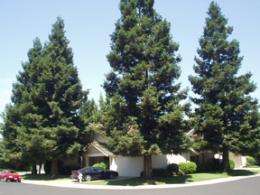
Shade trees positioned near houses in Sacramento, Calif., such as those in this photo, can significantly affect electricity use. Tree cover on the west and south sides of Sacramento homes reduced average summertime electricity demand by more than 5 percent, according to a study by NIST and the USDA. Credit: NIST

(PhysOrg.com) -- Trees positioned to shade the west and south sides of a house may decrease summertime electric bills by 5 percent on average, according to a recent study of California homes by researchers from the National Institute of Standards and Technology and the U.S. Department of Agriculture.

The first large-scale study of its kind, the research paper considers the effects of shade on 460 single-family homes in Sacramento during the summer of 2007 and provides hard statistics showing how well-placed shade can reduce and atmospheric carbon, as well.

“People have known for a long time that trees have multiple benefits for people, but we’ve quantified one of them for the first time using actual billing data and put a dollar value on it,” said NIST’s David Butry, who authored the paper with Geoffrey Donovan of the USDA Forest Service’s Pacific Northwest Research Station.

The study’s findings included:

• Planting trees on the west and south sides of a house decreased summertime electricity use, but planting them on the north actually increased it. Those on the east had no effect.

• Fast-growing trees provide better help than do smaller ones, and placement of the trees, particularly the distance from the house, is a significant factor.

• A London plane tree, planted on the west side of a house, can reduce carbon emissions from summertime electricity use by an average of 31 percent over 100 years.

This last finding was particularly significant to Butry, who said that trees not only reduce the carbon produced by the local gas or coal-fired power generator, but also remove carbon dioxide—a greenhouse gas—from the atmosphere.

“Trees sequester carbon in addition to providing shade,” Butry said. “We measured how much these reduced the carbon created by burning fuels to produce the electricity, and found that the trees also sequestered an equivalent amount of carbon on top of that. So there’s a double benefit.”

Utility companies from as far away as South Korea and South Africa have contacted the team about expanding the study, which was limited to a single season in a single city.

“It would be really interesting to look at how the effect varies across regions of the U.S. and of the world, and to see what happens in wintertime,” Butry said. “Sacramento Municipal Utility was very helpful in providing us with the data we needed. But future studies will depend on who has data and shares it with us.”

More information: G.H. Donovan and D.T. Butry. The value of : Estimating the effect of urban trees on summertime electricity use. Energy and Buildings June, 2009, 662-668. doi: 10.1016/j.enbuild.2009.01.002.

Provided by National Institute of Standards and Technology (news : web)


print this article email this article download pdf blog this article bookmark this article     Stumble it Digg this share on Facebook retweet share on Reddit add to delicious
Rate this story - 5 /5 (1 vote)


May 6, 2009 all stories

Comments: 0

5 /5 (1 vote)
  • Stumble this up

  • Digg this

  • share this

  • hide
  • Related Stories

  • California study shows shade trees reduce summertime electricity use
    created Jan 05, 2009 | popularity not rated yet | comments 0
  • Shade trees fight global warming in Calif.
    created Sep 04, 2006 | popularity not rated yet | comments 0
  • Shade Tree Coverage Reduces Power Costs
    created Nov 15, 2008 | popularity not rated yet | comments 0
  • Study: Amazon trees older than believed
    created Dec 13, 2005 | popularity not rated yet | comments 0
  • Ancient oak trees help reduce global warming
    created Jun 27, 2008 | popularity not rated yet | comments 0


  • hide
  • Relevant PhysicsForums posts

  • Trying to adapt a fuel gage circuit
    created 4 hours ago
  • Pushing the piston.
    created 9 hours ago
  • Do Camcorders/ Video camera have Sensors in them?
    created 14 hours ago
  • Aspiring Engineering major looking for general answers
    created Nov 19, 2009
  • More from Physics Forums - General Engineering

Other News

Newspaper circulation may be worse than it looks (AP)

Newspaper circulation may be worse than it looks

Technology / Internet

created 10 hours ago | popularity not rated yet | comments 0

(AP) -- While U.S. newspapers are losing subscribers at a staggering rate, a few dailies stand out because their circulation is rising. But they aren't necessarily selling more copies.


Canadian woman loses benefits over Facebook photo

Technology / Internet

created 10 hours ago | popularity 5 / 5 (1) | comments 0

(AP) -- A Canadian woman on long-term sick leave for depression says she lost her benefits because her insurance agent found photos of her on Facebook in which she appeared to be having fun.


China is the world's largest emitter of the greenhouse gases blamed for global warming

China harnesses mountain wind power

Technology / Energy

created 20 hours ago | popularity 4.1 / 5 (7) | comments 1

In the mountains above the southwestern Chinese town of Dali, dozens of new wind turbines dot the landscape -- a symbol of the country's sky-high ambitions for clean, green energy.


Analysts say AmEx is most interested in the so-called peer-to-peer services of Revolution

American Express takes aim at PayPal with Revolution

Technology / Internet

created 17 hours ago | popularity 4.5 / 5 (2) | comments 1

With its deal to buy Revolution Money, American Express is taking aim at the growing market for online and alternative payments, in a challenge to recognized leader PayPal, analysts say.


Hackers leak e-mails, stoke climate debate

Technology / Internet

created Nov 21, 2009 | popularity 4.3 / 5 (34) | comments 27

(AP) -- Computer hackers have broken into a server at a well-respected climate change research center in Britain and posted hundreds of private e-mails and documents online - stoking debate over whether some scientists have ...