Feds: Mountain-dwelling pika may need protection
May 6, 2009 By MIKE STARK , Associated Press Writer Feds: Mountain-dwelling pika may need protection (AP)

Enlarge

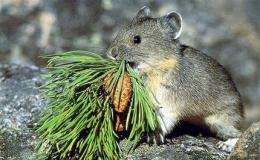
FILE - This undated photo released by the U.S. Geological Survey, shows a mountain-dwelling American pika. The American pika, a short-legged, softball-sized fur ball that often huddles in high mountain slopes, isn't built for long-distance travel. So as the West's climate warms, the tiny pika has little choice but to scurry a little farther up slope to beat the heat. (AP Photo/US Geological Survey, File)

(AP) -- A tiny mammal that can't handle warm weather could become the first animal in the lower 48 states to get Endangered Species Act protection primarily because of climate change.

The U.S. Fish and Wildlife Service, responding to a petition from environmentalists, said Wednesday that it will launch an in-depth review of the American pika and submit findings by Feb. 1, 2010.

The agency acknowledged that there's "substantial information" indicating that climate change may threaten the pikas' habitat and range.

"The service knows that climate change is real. It is the biggest conservation challenge of our time," said Diane Katzenberger, a Fish and Wildlife spokeswoman in Denver.

The pika - a furry, big-eared relative of the rabbit - dwells mostly in high, rocky mountain slopes in 10 Western states.

It is well-suited for alpine conditions, with dense fur, slow reproductivity and a thermal regulation system that doesn't do well in the heat. Even brief exposure to temperatures of 78 degrees or warmer can cause death.

As the West warms, scientists say some pikas have tried to move upslope to find cooler refuges but have run out of room.

Any steps taken to protect the pika could also help other species affected by climate change, said Greg Loarie, an attorney with Oakland, Calif.-based Earthjustice who has worked on pika lawsuits pressing for protections.

"The pika is the fire alarm and this is our opportunity to come to grips with and prevent an extinction crisis," Loarie said.

Extending federal protections to the pika primarily because of climate change would likely lead to larger policy discussions about how best to mitigate those effects. Environmentalists say the pika listing should be part of a sweeping movement to curb emissions that most climate scientists say is contributing to global warming.

Katzenberger said Fish and Wildlife is in the midst of developing a five-year plan on how it will deal with .

The Bush administration listed the polar bear as a threatened species in 2008, the first to be protected because of the threats of global warming. Officials quickly completed regulations, though, to ensure the listing couldn't be used to block projects that contribute to global warming. That decision is now being challenged in court.

The pika lives in parts of California, Colorado, Idaho, Montana, Nevada, New Mexico, Oregon, Utah, Washington and Wyoming.

A study in 2003 found six of 25 previously known pika populations in the Great Basin had disappeared, primarily because of the effects of warming temperatures.

Shaye Wolf, a biologist with the Center for Biological Diversity, the environmental group that petitioned to have the pika protected, said subsequent studies indicate other populations in the Great Basin have disappeared. Formal results of those follow-up studies have not been published.

---

On the Net:

http://www.fws.gov/

©2009 The Associated Press. All rights reserved. This material may not be published, broadcast, rewritten or redistributed.


print this article email this article download pdf blog this article bookmark this article     Stumble it Digg this share on Facebook retweet share on Reddit add to delicious
Rate this story - 3 /5 (2 votes)

Rank Filter

Move the slider to adjust rank threshold, so that you can hide some of the comments.


Display comments: newest first

  • Mercury_01 - May 06, 2009
    • Rank: not rated yet
    We need to assemble a team of midget sheep shearers to shave every pika. Or perhaps we could feed them all dioxins so that their hair falls off. Hey, sometimes you just gotta take action.

May 6, 2009 all stories

Comments: 1

3 /5 (2 votes)
  • Stumble this up

  • Digg this

  • share this

  • hide
  • Related Stories

  • As West warms, some fear for tiny mountain dweller
    created Apr 04, 2009 | popularity not rated yet | comments 0
  • Pikas in peril in the Rockies
    created Jan 15, 2008 | popularity not rated yet | comments 0
  • Climate change driving pika to extinction
    created Dec 29, 2005 | popularity not rated yet | comments 0
  • White House considers listing polar bears
    created Feb 04, 2008 | popularity not rated yet | comments 0
  • Adaptive functional evolution of leptin in cold-adaptive pika family
    created Jan 23, 2008 | popularity not rated yet | comments 0


  • hide
  • Relevant PhysicsForums posts

Other News

Invading camels to be shot in Australian town (AP)

Invading camels to be shot in Australian town

Biology / Ecology

created 1hour ago | popularity not rated yet | comments 0

(AP) -- Australian authorities plan to corral about 6,000 wild camels with helicopters and gun them down after they overran a small Outback town in search of water, trampling fences, smashing tanks and contaminating ...


Variable Temperatures Leave Insects wtih a Frosty Reception

Biology / Plants & Animals

created 15 hours ago | popularity not rated yet | comments 0

(PhysOrg.com) -- For the first time, scientists at The University of Western Ontario have shown that insects exposed to repeated periods of cold will trade reproduction for immediate survival.


When camouflage is a plant's best protection

Rare woodland plant uses 'cryptic coloration' to hide from predators

Biology / Plants & Animals

created 17 hours ago | popularity 4.3 / 5 (3) | comments 0

It is well known that some animal species use camouflage to hide from predators. Individuals that are able to blend in to their surroundings and avoid being eaten are able to survive longer, reproduce, and ...


Cells defend themselves from viruses, bacteria with armor of protein errors

Biology / Cell & Microbiology

created 19 hours ago | popularity 5 / 5 (7) | comments 0

When cells are confronted with an invading virus or bacteria or exposed to an irritating chemical, they protect themselves by going off their DNA recipe and inserting the wrong amino acid into new proteins to defend them ...


Researchers discover biological basis of 'bacterial immune system'

Biology / Cell & Microbiology

created 19 hours ago | popularity 4.7 / 5 (3) | comments 0

Bacteria don't have easy lives. In addition to mammalian immune systems that besiege the bugs, they have natural enemies called bacteriophages, viruses that kill half the bacteria on Earth every two days.