Entomologists name 'diving beetle' for Comedy Central's Stephen Colbert
May 6, 2009
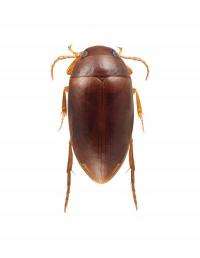
Agaporomorphus colberti, a diving beetle from Venezuela, was named by entomologists Quentin Wheeler of Arizona State University and Kelly Miller of the University of New Mexico to honor Stephen Colbert, the satirical host and executive producer of Comedy Central's "The Colbert Report." Credit: Kelly Miller and Quentin Wheeler
"What has six legs and is way cooler than a spider?" asks a riddle on the cover of a birthday card sent to Stephen Colbert by entomologists Quentin Wheeler at Arizona State University and Kelly Miller at the University of New Mexico.
The answer - Agaporomorphus colberti - is a diving beetle from Venezuela named by Wheeler and Miller to honor Colbert, the satirical host and executive producer of Comedy Central's "The Colbert Report."
Knowing Colbert's fondness for recognition (there's his popular segment on the show: "Who's Not Honoring Me Now") and for presents, the scientists sent the political satirist a framed print of the beetle as a birthday gift to mark his 45th birthday on May 13.
"Last year, Stephen shamelessly asked the science community to name something cooler than a spider to honor him. His top choices were a giant ant or a laser lion. While those would be cool species to discover, our research involves beetles, and they are 'way cooler' than a spider any day," Wheeler says.
Wheeler and Miller are no strangers to shameless promotion, especially when it comes to shining attention on biodiversity and the field of taxonomy. The pair have named beetles to honor the late rock 'n' roll legend Roy Orbison and his widow Barbara (Orectochilus orbisonorum); for fictional "Star Wars" character Darth Vader (Agathidium vaderi); and for former President George W. Bush, former Vice President Dick Cheney, and former Secretary of Defense Donald Rumsfeld (Agathidium bushi, A. cheneyi and A. rumsfeldi).
Wheeler is director of the International Institute for Species Exploration at Arizona State University, in addition to being a university vice president, dean of ASU's College of Liberal Arts and Sciences, and a professor in the School of Life Sciences.
Miller, a former student of Wheeler, is an assistant professor of biology at the University of New Mexico and curator of arthropods at UNM's Museum of Southwestern Biology.
What makes beetles cooler than spiders? Their strength in numbers - they dominate other groups of species. Taxonomists believe there are roughly 500,000 named species in the scientific order Coleoptera (beetles) and probably three times that many waiting to be discovered - an amount that far exceeds the number of species in any other group of plant or animal.
The beetle named for Colbert - Agaporomorphus colberti - belongs to a species group (A. knischi Zimmerman) based on the common presence of a pair of rows of fine setae on the dorsal surface of the male's reproductive organs.
There are about 1.8 million species that have been described since Carolus Linnaeus initiated the modern systems for naming plants and animals in the 18th century. Scientists estimate there are between 2 million and 100 million species on Earth, though most put that number closer to 10 million. Even with some 20,000 new species discovered each year, there are many that will go out of existence before being studied.
"Charting the species of the world and their unique attributes are essential parts of understanding the history of life," Wheeler says. "It is our own self-interest as we face the challenges of living on a rapidly changing planet."
That urgency is shared by Miller and others, including Harvard biologist and conservationist E.O. Wilson, in their quest to draw attention to biodiversity.
"In a time when new planets are being found around other stars and people are wondering whether life exists elsewhere in the universe, many people aren't aware of how much is not known about life on our own planet," says Miller. "Opportunities like this help boost awareness of the vast diversity that remains undiscovered on Earth, and of taxonomy, the science that seeks to discover it."
Wheeler adds: "Naming a beetle for Stephen Colbert is in sync with the institute's goal to popularize science."
As another part of its public awareness campaign, the International Institute for Species Exploration at Arizona State University annually unveils the top 10 new species described in the previous year. The list of top 10 new species from 2008 will be announced May 23, a date that coincides with the birth of Linnaeus.
The top 10 new species are selected by an international committee of taxonomists - scientists responsible for species exploration and classification. Last year's list is at: http://species.asu.edu.
More information: More information about Agaporomorphus colberti is at: http://www.mapress … 859p068f.pdf .
-
Whirligig beetle gets rock 'n' roll legendary name
Jan 28, 2008 |
not rated yet |
0
-
Scientists announce top 10 new species, issue SOS
May 23, 2008 |
not rated yet |
0
-
Life's 6-legged survivors -- evolutionary study shows beetles are in it for the long run
Dec 20, 2007 |
not rated yet |
0
-
New catfish species named for museum mail supervisor
Jun 09, 2008 |
not rated yet |
0
-
Rove beetles act as warning signs for clear-cutting consequences
Jun 12, 2007 |
not rated yet |
0
-
Engineers build first sub-10-nm carbon nanotube transistor
Feb 01, 2012 |
4.9 / 5 (33) |
30
-
Something old, something new: Evolution and the structural divergence of duplicate genes
Jan 31, 2012 |
4.6 / 5 (7) |
1
-
The hidden nanoworld of ice crystals: Revealing the dynamic behavior of quasi-liquid layers
Jan 30, 2012 |
5 / 5 (4) |
1
-
Stock market network reveals investor clustering
Jan 27, 2012 |
3.9 / 5 (23) |
8
-
Of microchemistry and molecules: Electronic microfluidic device synthesizes biocompatible probes
Jan 26, 2012 |
5 / 5 (2) |
0
-
Factors affecting beet root cell membrane
17 hours ago
-
Stem cell question.
Feb 10, 2012
-
Protease cleavage
Feb 10, 2012
-
Pertubance in a model
Feb 10, 2012
-
Cancer drugs and Alzheimer's, Oh my!
Feb 09, 2012
-
Squishing cells
Feb 09, 2012
- More from Physics Forums - Biology
More news stories
A mitosis mystery solved: How chromosomes align perfectly in a dividing cell
Although the process of mitotic cell division has been studied intensely for more than 50 years, Whitehead Institute researchers have only now solved the mystery of how cells correctly align their chromosomes during symmetric ...
13 hours ago |
4.4 / 5 (20) |
0
|
Researchers find extensive RNA editing in human transcriptome
In a new study published online in Nature Biotechnology, researchers from BGI, the world's largest genomics organization, reported the evidence of extensive RNA editing in a human cell line by analysis of RNA-seq data, demons ...
13 hours ago |
5 / 5 (4) |
0
|
The proteins ensuring genome protection
Researchers from the University of Geneva (UNIGE), Switzerland, have discovered the crucial role of two proteins in developing a cell 'anti-enzyme shield'. This protection system, which operates at the level of molecular ...
13 hours ago |
5 / 5 (3) |
0
|
Entire genome of extinct human decoded from fossil
(PhysOrg.com) -- In 2010, Svante Pääbo and his colleagues presented a draft version of the genome from a small fragment of a human finger bone discovered in Denisova Cave in southern Siberia. The ...
Feb 07, 2012 |
4.7 / 5 (60) |
51
|
Why are there so few fish in the Earth's oceans?
(PhysOrg.com) -- A Stony Brook University researcher has found that, contrary to popular belief, there are not plenty of fish in the sea.
Feb 08, 2012 |
4.3 / 5 (19) |
27
|
Scientists discover molecular secrets of 2,000-year-old Chinese herbal remedy
For roughly two thousand years, Chinese herbalists have treated Malaria using a root extract, commonly known as Chang Shan, from a type of hydrangea that grows in Tibet and Nepal. More recent studies suggest that halofuginone, ...
New method to examine batteries -- MRI from the inside
There is an ever-increasing need for advanced batteries for portable electronics, such as phones, cameras, and music players, but also to power electric vehicles and to facilitate the distribution and storage of energy derived ...
Google might launch Drive for cloud storage soon
(PhysOrg.com) -- Google's next big move, according to the Wall Street Journal, is a cloud storage service called Drive. Hardly first to the plate, Google is simply catching up to introducing its cloud reposi ...
Lab study raises questions over nano-particle impact
Tests involving chickens have raised questions about the impact on health from engineered nano-particles, the ultra-fine grains commonly used in drugs and processed foods, scientists said on Sunday.
Starve a virus, feed a cure? Findings show how some cells protect themselves against HIV
A protein that protects some of our immune cells from the most common and virulent form of HIV works by starving the virus of the molecular building blocks that it needs to replicate, according to research published online ...
Iran blocks email, restricts net access: reports
Iran has further restricted access to the Internet and blocked popular email services for the past few days, in a move a top lawmaker said could "cost the regime dearly," media reports said on Sunday.
May 06, 2009
Rank: 2.1 / 5 (11)
May 06, 2009
Rank: not rated yet
May 06, 2009
Rank: 5 / 5 (2)
May 06, 2009
Rank: 5 / 5 (2)
They should indeed name a cockroach after you.
May 07, 2009
Rank: 5 / 5 (2)
I bet if you made it solar powered, you'd be famous in no time!
May 07, 2009
Rank: not rated yet