Xerox looks to make color printing more affordable
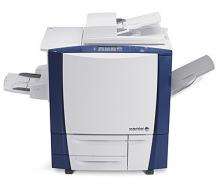
May 7, 2009 By ANDREW VANACORE , AP Business Writer Xerox ColorQube 9201

Enlarge

Xerox ColorQube 9201

(AP) -- The economics of color printing in big offices are simple: A page of black and white costs about 2 cents per page, while color runs about 8 cents.

That's one reason why only 15 percent of the 2.25 trillion pages printed worldwide each year are in color.

Xerox Corp. is hoping to upend that math - and its competition in the printing business - partly with the help of new technology.

The company is unveiling a printer Thursday - the ColorQube - that uses a waxy substance resembling a huge crayon instead of ink or toner cartridges. The technology previously had been used in smaller Xerox printers. And Xerox said that instead of the common setup of charging corporate customers 2 cents for black and white pages or 8 cents for color, the company will charge based on how much color a given printing job requires.

That will mean a 62 percent drop in the price of color printing, according to Xerox.

"There is a fundamental barrier that we were trying to break," says Ursula Burns, the company's president. "The world is in color, that's what our customers want."

Green is one color in particular Xerox is pushing with the new machine. The company says it produces less waste and less power than average .

Coming out with such a printer carries risks for the Norwalk, Conn.-based company. After all, many of the color machines Xerox is looking to render obsolete are Xerox machines.

"The trick is to make sure that it doesn't just displace the laser jets," said Angele Boyd, an analyst with the research firm IDC. Xerox will have to try to appeal to a wider market and steal share from competitors, perhaps by touting its green credentials.

Hewlett-Packard Co., one of Xerox's main rivals, is skeptical. Tom Codd, an HP vice president, said the solid ink printers already on the market have produced images of lesser quality than standard laser printers; colors fade and leave a waxy residue on the page that's hard to write over. And because solid ink machines have to keep the ink heated, they have tended to use more power.

Xerox concedes that quality and power use have been problems in the past. But the company says it has smoothed out the kinks.

The ColorQube does indeed have to keep its ink heated, said Jim Rise, Xerox vice president in charge of solid ink. Some is kept in a "molten" state, which means using more power than a laser machine when it's idle.

But Rice says the more than makes up the difference by using less power while it's running.

©2009 The Associated Press. All rights reserved. This material may not be published, broadcast, rewritten or redistributed.


print this article email this article download pdf blog this article bookmark this article     Stumble it Digg this share on Facebook retweet share on Reddit add to delicious
Rate this story - 5 /5 (1 vote)

Rank Filter

Move the slider to adjust rank threshold, so that you can hide some of the comments.


Display comments: newest first

  • MatthiasF - May 07, 2009
    • Rank: not rated yet
    I've worked with three different models of solid ink printers in the past and all were very unreliable when it comes to color accuracy. Colors would not only come out looking noticeably different than intended (Pantone) or on screen, but colors would shift between copies of the same print.

    I can understand there could be cost savings by using a higher density ink material, but why can't toner based applications be economized with smart printing technologies?

    Most prints are placed on paper using a grid of pixels/points, much like monitors, but you don't necessarily need to print every pixel. You can trick the eye using contrasts and such, so why not have an on-board processor in the printer run filters on images to print only what data a human eye will notice.

    For business graphics which this solid ink system seems to be targeting, most users would probably not even care if only 30-40% of the pixels/points were actually laid on the paper if there's no noticeable difference. And since it would use significantly less toner, color prints would become cheaper.

    I'm not talking about an economy mode like they have now where it lays less toner over the entire page. I'm talking about a smart economy mode that evaluates the amount of toner in areas based off content.

May 7, 2009 all stories

Comments: 1

5 /5 (1 vote)
  • Stumble this up

  • Digg this

  • share this

  • hide
  • Related Stories

  • HP Pushes Ink Jet Printing to 70 Pages per Minute
    created Apr 12, 2007 | popularity not rated yet | comments 0
  • Xerox Buys Global Imaging Systems
    created Apr 03, 2007 | popularity not rated yet | comments 0
  • HP Claims Breakthrough in Ink-Based Printing Technology
    created Jul 11, 2005 | popularity not rated yet | comments 0
  • Oki Slashes Large-Format Color Printing Costs
    created May 08, 2007 | popularity not rated yet | comments 0
  • Xerox Releases Latest Enterprise Printer
    created Apr 04, 2007 | popularity not rated yet | comments 0


  • hide
  • Relevant PhysicsForums posts

Other News

Posters promote Apple iPhones at a store in Beijing

iPhone disappoints in China launch: analysts

Electronics / Consumer & Gadgets

created 23 hours ago | popularity not rated yet | comments 0

The official launch of Apple's iPhone in China has been disappointing at best for mobile operator China Unicom, with the grey market still booming and competitors offering worthy alternatives, experts say.


Samsung launches a new vacuuming robot

Samsung launches a new vacuuming robot

Electronics / Consumer & Gadgets

created Nov 06, 2009 | popularity 4.4 / 5 (7) | comments 8

(PhysOrg.com) -- Samsung Electronics has launched its latest autonomous robot vacuum cleaner, the Tango, which is capable of vacuuming hardwood floors, carpets, and even beds without human assistance.


new iphone

Touchscreen smartphones being snatched up in US

Electronics / Consumer & Gadgets

created Nov 03, 2009 | popularity 2.7 / 5 (3) | comments 3

US smartphone buyers can't wait to get their hands on touchscreen devices, according to figures released Tuesday by industry tracker comScore.


Robot fish could monitor water quality

Robot fish could monitor water quality

Electronics / Robotics

created Nov 02, 2009 | popularity not rated yet | comments 2

Nature inspires technology for an engineer and an ecologist teamed up at Michigan State University. They're developing robots that use advanced materials to swim like fish to probe underwater environments.


Review: Motorola's Droid is a serious smart phone (AP)

Review: Motorola's Droid is a serious smart phone

Electronics / Consumer & Gadgets

created Nov 04, 2009 | popularity 4.6 / 5 (5) | comments 0

(AP) -- Since its debut in 2007, millions of people have gravitated toward Apple's iPhone, wooed by its sleek hardware, simple user interface and abundance of applications.