Sniffing Out the Physical Condition of Conspecifics
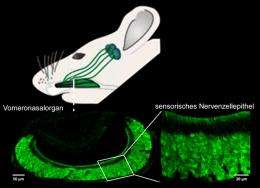
To date, it has been unknown exactly how mammals are capable of sniffing out whether a conspecific is ill. The biologists Prof. Marc Spehr and Daniela Flügge are following a good lead. They have discovered that a messenger substance of the immune system that attracts defence cells to the affected site in bacterial infections also responds to receptors in the vomeronasal organ (VMO, Jacobson's organ). This organ, which has hardly been studied to date, reacts to pheromones and is also held responsible for spontaneous aversion or attraction when selecting a partner. The results of this study on the newly detected receptor family FPR (formyl peptide receptor) within the olfactory system have been published in the current Internet edition of Nature.
Detecting and evaluating the quality of foodstuffs, remote perception of possible hazards, the recognition of territorial boundaries or subconscious activation of memories considered forgotten - the sense of smell (olfactory mechanism) supplies an abundance of important information. The scent signals between conspecifics are of particular significance for their social and sexual communication. The majority of mammals perceive such chemosensors, often referred to as pheromones, via a specific sensory organ, the vomeronasal organ (VNO).
The VNO, located at the base of the nasal septum, is a small tubular sensory organ lined with many thousands of neurons. The neurons in the VNO “perceive” pheromones with the aid of specific proteins, so-called vomeronasal receptors. Mice are known to have about 300 different types of these receptors, which can roughly be divided into two protein families - so-called V1R and V2R receptors.
One of the many capabilities of the olfactory sense of many mammals is that it enables them to draw conclusions on the physical condition of conspecifics based on their specific odour. Prof. Spehr stated that just how the olfactory sense achieves this task, and which processes are active in the individual neurons during the course thereof, is one the most challenging and interesting aspects of modern neurobiology and sensory biology. He, in close collaboration with the neurogenetic research group under the auspices of Prof. Ivan Rodriguez at the University in Geneva, and his colleague Daniela Flügge have now managed to identify a new family of VNO receptor proteins and to investigate their function.
To date, the proteins designated as formyl peptide receptors (FPR) were considered special proteins of the immune system. They are the receptors that initiate targeted movement (chemotaxis) of specific immune cells (granulocytes) to the site of infection during inflammatory reactions after bacterial infections. In the process thereof, the receptors are activated by bacterial degradation products, including the so-called formyl peptides.
FPRs, just like the vomeronasal V1R and V2R proteins, are members of the group of so-called G protein-linked receptors. With the aid of activity measurements using a fluorescent microscope, the German-Swiss research group was now able to demonstrate not only the existence of five such receptors in the olfactory organ of mammals, but also to elucidate significant aspects of their function at this site. Flügge and Spehr were able to show that, amongst other things, the same bacterial substances that trigger an immune reaction can also activate vomeronasal neurons.
The bonding of the bacterial peptides onto FPRs leads to a short-term increase in the potassium concentration in the neurons. This signal subsequently leads to electrical discharge of the cells. The bacterial degradation products that develop during the inflammatory reaction are also excreted in diverse bodily secretions, thus the scientists are of the opinion that they have found an important pathway that enables an individual to assess the physical condition of its vis-à-vis based on the latter’s body odour.
More information: Formyl receptors-like are a novel family of vomeronasal chemosensors. In: NATURE, online am 22.4.2009, DOI: 10.1038/nature08029
Source: Ruhr-Universitaet-Bochum (news : web)


