The rise of oxygen caused Earth's earliest ice age
May 7, 2009 The rise of oxygen caused Earth's earliest ice age

Enlarge

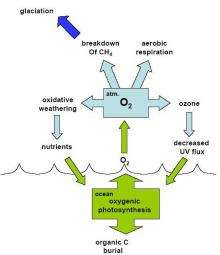
The evolution of organic photosynthesis ca.2.5 billion years ago would have had a profound effect on Earth's surface environments, and potentially on aerobic respiration by eukaryotes.

(PhysOrg.com) -- Geologists may have uncovered the answer to an age-old question - an ice-age-old question, that is. It appears that Earth's earliest ice ages may have been due to the rise of oxygen in Earth's atmosphere, which consumed atmospheric greenhouse gases and chilled the earth.

Alan J. Kaufman, professor of geology at the University of Maryland, Maryland geology colleague James Farquhar, and a team of scientists from Germany, South Africa, Canada, and the U.S.A., uncovered evidence that the oxygenation of Earth's - generally known as the Great Oxygenation Event - coincided with the first widespread ice age on the planet.

"We can now put our hands on the rock library that preserves evidence of irreversible atmospheric change," said Kaufman. "This singular event had a profound effect on the climate, and also on life."

Using sulfur isotopes to determine the content of ~2.3 billion year-old rocks in the Transvaal Supergroup in South Africa, they found evidence of a sudden increase in atmospheric oxygen that broadly coincided with physical evidence of glacial debris, and geochemical evidence of a new world-order for the .

"The sulfur isotope change we recorded coincided with the first known anomaly in the carbon cycle. This may have resulted from the diversification of photosynthetic life that produced the oxygen that changed the atmosphere," Kaufman said.

Two and a half billion years ago, before the Earth's atmosphere contained appreciable oxygen, photosynthetic bacteria gave off oxygen that first likely oxygenated the surface of the ocean, and only later the atmosphere. The first formed oxygen reacted with iron in the oceans, creating iron oxides that settled to the ocean floor in sediments called banded iron-formations - layered deposits of red-brown rock that accumulated in ocean basins worldwide. Later, once the iron was used up, oxygen escaped from the oceans and started filling up the atmosphere.

Once oxygen made it into the atmosphere, Kaufman's team suggests that it reacted with methane, a powerful greenhouse gas, to form carbon dioxide, which is 62 times less effective at warming the surface of the planet. "With less warming potential, surface temperatures may have plummeted, resulting in globe-encompassing glaciers and sea ice" said Kaufman.

In addition to its affect on climate, the rise in oxygen stimulated the rise in stratospheric ozone, our global sunscreen. This gas layer, which lies between 12 and 30 miles above the surface, decreased the amount of damaging ultraviolet sunrays reaching the oceans, allowing photosynthetic organisms that previously lived deeper down, to move up to the surface, and hence increase their output of oxygen, further building up stratospheric ozone.

"New oxygen in the atmosphere would also have stimulated weathering processes, delivering more nutrients to the seas, and may have also pushed biological evolution towards eukaryotes, which require free oxygen for important biosynthetic pathways," said Kaufman.

The result of the Great Oxidation Event, according to Kaufman and his colleagues, was a complete transformation of Earth's atmosphere, of its climate, and of the life that populated its surface. The study is published in the May issue of Geology.

Source: University of Maryland (news : web)


print this article email this article download pdf blog this article bookmark this article     Stumble it Digg this share on Facebook retweet share on Reddit add to delicious
Rate this story - 4.6 /5 (20 votes)

Rank Filter

Move the slider to adjust rank threshold, so that you can hide some of the comments.


Display comments: newest first

  • tkjtkj - May 07, 2009
    • Rank: 5 / 5 (5)
    I strongly object to PhysOrg's habit of entitling articles incorrectly! This article says ".. MAY " . Your title, however, makes a statement that indicates
    'certainty'! A certainty that does not exist.

    Please wake up, and decide whether to deal with 'science' or to deal with 'misleading headline publishing'... Fox News does enough of that for any planet!

  • CSharpner - May 07, 2009
    • Rank: 2.8 / 5 (4)
    I agree with tkjtkj, except Fox News is one of the few that are closer to the truth, while MSNBC, CNN, and the like spew only one side, constantly.
  • dbren - May 07, 2009
    • Rank: 3 / 5 (4)
    It's funnier if you call it "Faux News". Get it? FAUX News! Ha! Ha! Ha!

    Of course, the gag only works if you don't know how to pronounce "faux".
  • brant - May 07, 2009
    • Rank: 1 / 5 (2)
    Guessing again????
  • mikiwud - May 08, 2009
    • Rank: 2.3 / 5 (3)
    Guessing again????

    This is good and understandable reasoning. More chance of being correct than the AGW con.
  • El_Nose - May 08, 2009
    • Rank: 1 / 5 (1)
    -- Fox news - shows both sides of issues -- not only president bush's side -- but vice president cheney --- But seriously CNN is against whoever is in power, used to think they were a democratic new station to oppose FOX but its just not true -- they just spin against whatever the ruling majority is but we all know more than a few of the anchors seem to be Democrats they still give very stark and critical analysis of their actions

May 7, 2009 all stories

Comments: 6

4.6 /5 (20 votes)
  • Stumble this up

  • Digg this

  • share this

  • hide
  • Related Stories


  • hide
  • Relevant PhysicsForums posts

  • The IPCC and the term "most"
    created Nov 23, 2009
  • Is global warming a fact?
    created Nov 23, 2009
  • Random variability of wind patterns
    created Nov 23, 2009
  • Record precipitation in the UK
    created Nov 22, 2009
  • More from Physics Forums - Earth

Other News

Cosmic 'dig' reveals vestiges of the Milky Way's building blocks

Cosmic 'Dig' Reveals Vestiges of the Milky Way's Building Blocks

Space & Earth / Astronomy

created 9 hours ago | popularity 4.9 / 5 (12) | comments 1

(PhysOrg.com) -- Peering through the thick dust clouds of our galaxy's "bulge" (the myriads of stars surrounding its center), a team of astronomers has unveiled an unusual mix of stars in the stellar grouping ...


No Wheel Stall in Diagnostic Drive

Spirit Mars Rover: No Wheel Stall in Diagnostic Drive

Space & Earth / Space Exploration

created 5 hours ago | popularity 5 / 5 (1) | comments 0

(PhysOrg.com) -- On Sol 2095 (Tuesday, Nov. 24), Spirit performed a set of diagnostic actions related to a stall of the right-rear wheel on the previous drive, three days earlier.


Monster Waves on the Sun are Real

Monster Waves on the Sun are Real (w/ Video)

Space & Earth / Astronomy

created 4 hours ago | popularity 5 / 5 (8) | comments 0

Sometimes you really can believe your eyes. That's what NASA's STEREO (Solar Terrestrial Relations Observatory) spacecraft are telling researchers about a controversial phenomenon on the sun known as the "solar ...


Oceanic crust formation is dynamic after all

Oceanic crust formation is dynamic after all

Space & Earth / Earth Sciences

created 8 hours ago | popularity 4.3 / 5 (3) | comments 0

Imagine the Earth's crust as the planet's skin: Some areas are old and wrinkled while others have a fresher, more youthful sheen, as if they had been regularly lathered with lotion.


Climate experts debate strategies for reducing atmospheric carbon and future warming

Climate experts debate strategies for reducing atmospheric carbon and future warming

Space & Earth / Environment

created 5 hours ago | popularity 3 / 5 (4) | comments 4

(PhysOrg.com) -- Reducing carbon dioxide to safe levels may require extracting carbon from the air, says Cornell climate researcher.