Honeybees are on the rise but demand grows faster
May 7, 2009 Honeybee

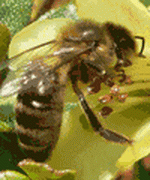
The notion that a decline in pollinators may threaten the human food supply - producing a situation that has been referred to as a "pollination crisis" - can be considered a myth, at least where honey bees are concerned, say researchers reporting online on May 7th in Current Biology, a Cell Press publication. First of all, most agricultural crop production does not depend on pollinators. On top of that, while honey bees may be dwindling in some parts of the world, the number of domesticated bees world-wide is actually on the rise, their new report shows.

"The decline observed in the USA and in other European countries including Great Britain, which has been attributed in part to parasitic mites and more recently to colony collapse disorder, could be misguiding us to think that this is a global phenomenon," said Marcelo Aizen of Universidad Nacional del Comahue in Argentina. "We found here that is not the case."

By analyzing data from the Food and Agriculture Organization of the United Nations for temporal trends in the number of commercial bee hives, they found that the global stock of domesticated honey bees has increased by about 45 percent over the last five decades. That increase has primarily been driven by an increased demand for honey from a growing human population, rather than an increased need for , he added.

But the news isn't all good: The data also show that the demand for crops that rely on insects for pollination has more than tripled over the last half century, suggesting that the global capacity for pollination may still be under considerable stress. These crops include "luxury" agriculture items, now common in any supermarket, like plums, raspberries, and cherries, as well as mangos, guavas, Brazil nuts, and cashew nuts.

"We were particularly astonished when we found that the fraction of agricultural production that depends on pollinators, which includes all of these luxury agriculture items, started growing at a faster pace since the fall of communism in the former USSR and Eastern Europe, and at a much higher rate than the larger fraction of agricultural production that does not depend on pollinators, including wheat and rice, which just follow human population growth," Aizen said. "Although the primary cause of the accelerating increase of pollinator-dependent crops seems to be economic and political - not biological - their rapid expansion has the potential to trigger future pollination problems for both these crops and native species in neighboring areas."

The associated increase in demand for agricultural land could also hasten the destruction of habitat that now supports hundreds or thousands of species of wild pollinators, which would in turn cause a drop in crop yield, he said.

"Most importantly, decreasing yield by these pollinator-dependent crops surely would imply rising market prices, which undoubtedly would constitute a further incentive for their cultivation," Aizen said. "This situation would create a positive feedback circuit that could promote more habitat destruction and further deterioration of pollination services. The good news is that less-intensively managed agro-ecosystems that preserve patches of natural and semi-natural habitats and uncultivated field edges can sustain abundant and diverse communities of wild pollinators."

Source: Cell Press (news : web)


print this article email this article download pdf blog this article bookmark this article     Stumble it Digg this share on Facebook retweet share on Reddit add to delicious
Rate this story - 4 /5 (2 votes)

Rank Filter

Move the slider to adjust rank threshold, so that you can hide some of the comments.


Display comments: newest first

  • Caliban - May 07, 2009
    • Rank: not rated yet
    This report is quite a bit wide of the mark, at best. Wonder how long before the contrary is again expressed.

May 7, 2009 all stories

Comments: 1

4 /5 (2 votes)
  • Stumble this up

  • Digg this

  • share this

  • hide
  • Related Stories

  • Pollinator decline not reducing crop yields just yet
    created Nov 10, 2008 | popularity not rated yet | comments 0
  • Pollinators help one-third of world's crop production, says new study
    created Oct 25, 2006 | popularity not rated yet | comments 0
  • Wild bees make honey bees better pollinators
    created Aug 29, 2006 | popularity not rated yet | comments 0
  • Bee species outnumber mammals and birds combined
    created Jun 11, 2008 | popularity not rated yet | comments 0
  • Saving our bees: Ecologists assess the impact of people on pollinators
    created Aug 04, 2008 | popularity not rated yet | comments 0


  • hide
  • Relevant PhysicsForums posts

  • What is transpulmonary pressure?
    created Nov 24, 2009
  • Is there a gay gene?
    created Nov 23, 2009
  • Super quick question about Starling forces?
    created Nov 22, 2009
  • Questions about diffusion
    created Nov 22, 2009
  • More from Physics Forums - Biology

Other News

Variable Temperatures Leave Insects wtih a Frosty Reception

Biology / Plants & Animals

created 9 hours ago | popularity not rated yet | comments 0

(PhysOrg.com) -- For the first time, scientists at The University of Western Ontario have shown that insects exposed to repeated periods of cold will trade reproduction for immediate survival.


When camouflage is a plant's best protection

Rare woodland plant uses 'cryptic coloration' to hide from predators

Biology / Plants & Animals

created 12 hours ago | popularity 4.3 / 5 (3) | comments 0

It is well known that some animal species use camouflage to hide from predators. Individuals that are able to blend in to their surroundings and avoid being eaten are able to survive longer, reproduce, and ...


Cells defend themselves from viruses, bacteria with armor of protein errors

Biology / Cell & Microbiology

created 13 hours ago | popularity 5 / 5 (7) | comments 0

When cells are confronted with an invading virus or bacteria or exposed to an irritating chemical, they protect themselves by going off their DNA recipe and inserting the wrong amino acid into new proteins to defend them ...


'Safety valve' protects photosynthesis from too much light

Biology / Cell & Microbiology

created 13 hours ago | popularity 4.7 / 5 (3) | comments 0

Photosynthetic organisms need to cope with a wide range of light intensities, which can change over timescales of seconds to minutes. Too much light can damage the photosynthetic machinery and cause cell death. Scientists ...


Researchers discover biological basis of 'bacterial immune system'

Biology / Cell & Microbiology

created 14 hours ago | popularity 4.7 / 5 (3) | comments 0

Bacteria don't have easy lives. In addition to mammalian immune systems that besiege the bugs, they have natural enemies called bacteriophages, viruses that kill half the bacteria on Earth every two days.